return to home page Computational Chemistry Comparison and Benchmark DataBase Release 22 (May 2022) Standard Reference Database 101 National Institute of Standards and Technology
You are here: Calculated > Energy > Optimized > Energy

All results from a given calculation for C4H8 (cyclobutane)

using model chemistry: QCISD/6-31G*

19 10 17 12 22

States and conformations

State Conformation minimum conformation conformer description state description
1 1 yes D2D 1A1
Energy calculated at QCISD/6-31G*
 hartrees
Energy at 0K-156.665988
Energy at 298.15K-156.675208
HF Energy-156.096213
Nuclear repulsion energy126.959780
The energy at 298.15K was derived from the energy at 0K and an integrated heat capacity that used the calculated vibrational frequencies.
Vibrational Frequencies calculated at QCISD/6-31G*
Mode Number Symmetry Frequency
(cm-1)
Scaled Frequency
(cm-1)
IR Intensities
(km mol-1)
Raman Act
(Å4/u)
Dep P Dep U
1 A1 3124 2975 0.00      
2 A1 3089 2942 0.00      
3 A1 1577 1502 0.00      
4 A1 1217 1159 0.00      
5 A1 1052 1002 0.00      
6 A1 232 221 0.00      
7 A2 1285 1224 0.00      
8 A2 983 936 0.00      
9 B1 1298 1236 0.00      
10 B1 1198 1141 0.00      
11 B1 975 928 0.00      
12 B2 3151 3000 96.75      
13 B2 3081 2934 11.92      
14 B2 1542 1469 4.23      
15 B2 928 884 0.05      
16 B2 648 617 2.19      
17 E 3135 2986 22.03      
18 E 3082 2935 66.73      
19 E 1538 1464 0.31      
19 E 1538 1464 0.31      
20 E 1333 1270 1.07      
20 E 1333 1270 1.07      
21 E 1279 1218 0.20      
21 E 1279 1218 0.20      
22 E 946 900 2.83      
22 E 946 900 2.83      
23 E 780 742 0.49      
23 E 780 742 0.49      

Unscaled Zero Point Vibrational Energy (zpe) 24781.2 cm-1
Scaled (by 0.9523) Zero Point Vibrational Energy (zpe) 23599.2 cm-1
See section III.C.1 List or set vibrational scaling factors to change the scale factors used here.
See section III.C.2 Calculate a vibrational scaling factor for a given set of molecules to determine the least squares best scaling factor.
Rotational Constants (cm-1) from geometry optimized at QCISD/6-31G*
ABC
0.35666 0.35666 0.21253

See section I.F.4 to change rotational constant units
Geometric Data calculated at QCISD/6-31G*

Point Group is D2d

Cartesians (Å)
Atom x (Å) y (Å) z (Å)
C1 0.000 1.078 0.138
C2 0.000 -1.078 0.138
C3 -1.078 0.000 -0.138
C4 1.078 0.000 -0.138
H5 0.000 1.380 1.194
H6 0.000 1.982 -0.483
H7 0.000 -1.380 1.194
H8 0.000 -1.982 -0.483
H9 -1.380 0.000 -1.194
H10 -1.982 0.000 0.483
H11 1.380 0.000 -1.194
H12 1.982 0.000 0.483

Atom - Atom Distances (Å)
  C1 C2 C3 C4 H5 H6 H7 H8 H9 H10 H11 H12
C12.15671.54991.54991.09751.09652.67493.12242.20022.28222.20022.2822
C22.15671.54991.54992.67493.12241.09751.09652.20022.28222.20022.2822
C31.54991.54992.15672.20022.28222.20022.28221.09751.09652.67493.1224
C41.54991.54992.15672.20022.28222.20022.28222.67493.12241.09751.0965
H51.09752.67492.20022.20021.78182.75923.75633.08342.51693.08342.5169
H61.09653.12242.28222.28221.78183.75633.96322.51692.96432.51692.9643
H72.67491.09752.20022.20022.75923.75631.78183.08342.51693.08342.5169
H83.12241.09652.28222.28223.75633.96321.78182.51692.96432.51692.9643
H92.20022.20021.09752.67493.08342.51693.08342.51691.78182.75923.7563
H102.28222.28221.09653.12242.51692.96432.51692.96431.78183.75633.9632
H112.20022.20022.67491.09753.08342.51693.08342.51692.75923.75631.7818
H122.28222.28223.12241.09652.51692.96432.51692.96433.75633.96321.7818

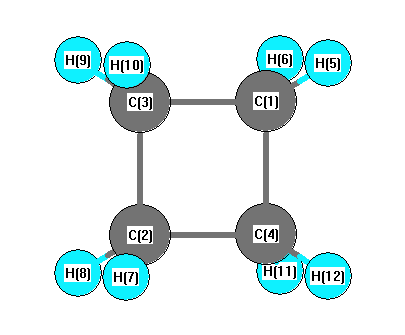
picture of cyclobutane state 1 conformation 1
More geometry information
Calculated Bond Angles
atom1 atom2 atom3 angle atom1 atom2 atom3 angle
C1 C3 C2 88.170 C1 C3 H9 111.272
C1 C3 H10 118.152 C1 C4 C2 88.170
C1 C4 H11 111.272 C1 C4 H12 118.152
C2 C3 H9 111.272 C2 C3 H10 118.152
C2 C4 H11 111.272 C2 C4 H12 118.152
C3 C1 C4 88.170 C3 C1 H5 111.272
C3 C1 H6 118.152 C3 C2 C4 88.170
C3 C2 H7 111.272 C3 C2 H8 118.152
C4 C1 H5 111.272 C4 C1 H6 118.152
C4 C2 H7 111.272 C4 C2 H8 118.152
H5 C1 H6 108.605 H7 C2 H8 108.605
H9 C3 H10 108.605 H11 C4 H12 108.605
Electronic energy levels

Electronic state

Charges, Dipole, Quadrupole and Polarizability