return to home page Computational Chemistry Comparison and Benchmark DataBase Release 22 (May 2022) Standard Reference Database 101 National Institute of Standards and Technology
You are here: Calculated > Energy > Optimized > Energy

All results from a given calculation for C2H4O3 (trioxolane124)

using model chemistry: QCISD/6-31G*

19 10 17 12 22

States and conformations

State Conformation minimum conformation conformer description state description
1 1 yes C2 1A
Energy calculated at QCISD/6-31G*
 hartrees
Energy at 0K-303.342160
Energy at 298.15K-303.348929
HF Energy-302.517881
Nuclear repulsion energy195.704839
The energy at 298.15K was derived from the energy at 0K and an integrated heat capacity that used the calculated vibrational frequencies.
Vibrational Frequencies calculated at QCISD/6-31G*
Mode Number Symmetry Frequency
(cm-1)
Scaled Frequency
(cm-1)
IR Intensities
(km mol-1)
Raman Act
(Å4/u)
Dep P Dep U
1 A 3161 3010 1.23      
2 A 3081 2934 0.47      
3 A 1586 1510 0.00      
4 A 1458 1389 16.46      
5 A 1253 1193 3.23      
6 A 1180 1123 0.04      
7 A 1087 1035 37.66      
8 A 1003 955 54.83      
9 A 868 826 13.49      
10 A 764 728 0.62      
11 A 391 373 6.54      
12 B 3162 3011 53.89      
13 B 3078 2931 117.65      
14 B 1573 1498 7.49      
15 B 1394 1327 3.45      
16 B 1243 1184 5.93      
17 B 1172 1116 13.64      
18 B 1143 1088 190.65      
19 B 990 943 2.83      
20 B 722 688 3.02      
21 B 169 161 19.37      

Unscaled Zero Point Vibrational Energy (zpe) 15238.4 cm-1
Scaled (by 0.9523) Zero Point Vibrational Energy (zpe) 14511.5 cm-1
See section III.C.1 List or set vibrational scaling factors to change the scale factors used here.
See section III.C.2 Calculate a vibrational scaling factor for a given set of molecules to determine the least squares best scaling factor.
Rotational Constants (cm-1) from geometry optimized at QCISD/6-31G*
ABC
0.27351 0.26974 0.15265

See section I.F.4 to change rotational constant units
Geometric Data calculated at QCISD/6-31G*

Point Group is C2

Cartesians (Å)
Atom x (Å) y (Å) z (Å)
O1 0.000 0.000 1.190
C2 0.000 1.123 0.321
C3 0.000 -1.123 0.321
O4 -0.387 -0.622 -0.948
O5 0.387 0.622 -0.948
H6 -1.003 1.567 0.279
H7 1.003 -1.567 0.279
H8 0.761 1.850 0.622
H9 -0.761 -1.850 0.622

Atom - Atom Distances (Å)
  O1 C2 C3 O4 O5 H6 H7 H8 H9
O11.42001.42002.26032.26032.07192.07192.07942.0794
C21.42002.24632.19251.41861.09792.87181.09443.0838
C31.42002.24631.41862.19252.87181.09793.08381.0944
O42.26032.19251.41861.46542.58452.08153.14582.0284
O52.26031.41862.19251.46542.08152.58452.02843.1458
H62.07191.09792.87182.58452.08153.72181.81893.4434
H72.07192.87181.09792.08152.58453.72183.44341.8189
H82.07941.09443.08383.14582.02841.81893.44344.0009
H92.07943.08381.09442.02843.14583.44341.81894.0009

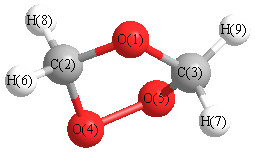
picture of trioxolane124 state 1 conformation 1
More geometry information
Calculated Bond Angles
atom1 atom2 atom3 angle atom1 atom2 atom3 angle
O1 C2 O4 74.017 O1 C2 H6 110.092
O1 C2 H8 110.925 O1 C3 O5 74.017
O1 C3 H7 110.092 O1 C3 H9 110.925
C2 O1 C3 104.553 C2 O4 O5 39.726
C3 O5 O4 39.726 O4 C2 H6 97.963
O4 C2 H8 144.175 O5 C3 H7 97.963
O5 C3 H9 144.175 H6 C2 H8 112.129
H7 C3 H9 112.129
Electronic energy levels
Charges, Dipole, Quadrupole and Polarizability