Jump to
S1C2
Energy calculated at MP3/6-31G*
| | hartrees |
|---|
| Energy at 0K | -957.754644 |
| Energy at 298.15K | |
| HF Energy | -957.356457 |
| Nuclear repulsion energy | 125.656519 |
The energy at 298.15K was derived from the energy at 0K
and an integrated heat capacity that used the calculated vibrational frequencies.
Vibrational Frequencies calculated at MP3/6-31G*
| Mode Number |
Symmetry |
Frequency
(cm-1) |
Scaled Frequency
(cm-1) |
IR Intensities
(km mol-1) |
Raman Act
(Å4/u) |
Dep P |
Dep U |
|---|
| 1 |
A1 |
3353 |
3148 |
0.11 |
|
|
|
| 2 |
A1 |
784 |
736 |
11.34 |
|
|
|
| 3 |
A1 |
323 |
303 |
0.60 |
|
|
|
| 4 |
B1 |
420i |
394i |
55.63 |
|
|
|
| 5 |
B2 |
1316 |
1235 |
60.05 |
|
|
|
| 6 |
B2 |
976 |
916 |
128.38 |
|
|
|
Unscaled Zero Point Vibrational Energy (zpe) 3166.0 cm
-1
Scaled (by 0.9386) Zero Point Vibrational Energy (zpe) 2971.6 cm
-1
See section
III.C.1 List or set vibrational scaling factors
to change the scale factors used here.
See section
III.C.2
Calculate a vibrational scaling factor for a given set of molecules
to determine the least squares best scaling factor.
Geometric Data calculated at MP3/6-31G*
Point Group is C2v
Cartesians (Å)
| Atom |
x (Å) |
y (Å) |
z (Å) |
|---|
| C1 |
0.000 |
0.000 |
0.671 |
| H2 |
0.000 |
0.000 |
1.748 |
| Cl3 |
0.000 |
1.477 |
-0.170 |
| Cl4 |
0.000 |
-1.477 |
-0.170 |
Atom - Atom Distances (Å)
| |
C1 |
H2 |
Cl3 |
Cl4 |
| C1 | | 1.0776 | 1.6997 | 1.6997 |
H2 | 1.0776 | | 2.4211 | 2.4211 | Cl3 | 1.6997 | 2.4211 | | 2.9544 | Cl4 | 1.6997 | 2.4211 | 2.9544 | |
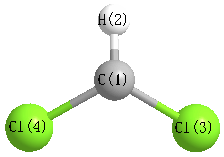 More geometry information
Calculated Bond Angles
| atom1 |
atom2 |
atom3 |
angle |
|
atom1 |
atom2 |
atom3 |
angle |
| Cl3 |
C1 |
H2 |
119.646 |
|
Cl3 |
C1 |
Cl4 |
120.707 |
| Cl4 |
C1 |
H2 |
119.646 |
|
Electronic energy levels
Charges, Dipole, Quadrupole and Polarizability
Jump to
S1C1
Energy calculated at MP3/6-31G*
| | hartrees |
|---|
| Energy at 0K | -957.755670 |
| Energy at 298.15K | -957.756536 |
| HF Energy | -957.357928 |
| Nuclear repulsion energy | 125.517768 |
The energy at 298.15K was derived from the energy at 0K
and an integrated heat capacity that used the calculated vibrational frequencies.
Vibrational Frequencies calculated at MP3/6-31G*
| Mode Number |
Symmetry |
Frequency
(cm-1) |
Scaled Frequency
(cm-1) |
IR Intensities
(km mol-1) |
Raman Act
(Å4/u) |
Dep P |
Dep U |
|---|
| 1 |
A' |
3311 |
3108 |
1.93 |
|
|
|
| 2 |
A' |
791 |
743 |
17.55 |
|
|
|
| 3 |
A' |
539 |
506 |
24.30 |
|
|
|
| 4 |
A' |
317 |
297 |
0.65 |
|
|
|
| 5 |
A" |
1321 |
1240 |
51.08 |
|
|
|
| 6 |
A" |
946 |
888 |
150.94 |
|
|
|
Unscaled Zero Point Vibrational Energy (zpe) 3612.4 cm
-1
Scaled (by 0.9386) Zero Point Vibrational Energy (zpe) 3390.6 cm
-1
See section
III.C.1 List or set vibrational scaling factors
to change the scale factors used here.
See section
III.C.2
Calculate a vibrational scaling factor for a given set of molecules
to determine the least squares best scaling factor.
Geometric Data calculated at MP3/6-31G*
Point Group is Cs
Cartesians (Å)
| Atom |
x (Å) |
y (Å) |
z (Å) |
|---|
| C1 |
0.012 |
0.695 |
0.000 |
| H2 |
-0.483 |
1.656 |
0.000 |
| Cl3 |
0.012 |
-0.171 |
1.473 |
| Cl4 |
0.012 |
-0.171 |
-1.473 |
Atom - Atom Distances (Å)
| |
C1 |
H2 |
Cl3 |
Cl4 |
| C1 | | 1.0809 | 1.7089 | 1.7089 |
H2 | 1.0809 | | 2.3987 | 2.3987 | Cl3 | 1.7089 | 2.3987 | | 2.9461 | Cl4 | 1.7089 | 2.3987 | 2.9461 | |
More geometry information
Calculated Bond Angles
| atom1 |
atom2 |
atom3 |
angle |
|
atom1 |
atom2 |
atom3 |
angle |
| Cl3 |
C1 |
H2 |
116.790 |
|
Cl3 |
C1 |
Cl4 |
119.083 |
| Cl4 |
C1 |
H2 |
116.790 |
|
Electronic energy levels
Charges, Dipole, Quadrupole and Polarizability
