Jump to
S1C2
Energy calculated at CCSD/6-31G*
| | hartrees |
|---|
| Energy at 0K | -168.111295 |
| Energy at 298.15K | |
| HF Energy | -167.626507 |
| Nuclear repulsion energy | 59.904676 |
The energy at 298.15K was derived from the energy at 0K
and an integrated heat capacity that used the calculated vibrational frequencies.
Vibrational Frequencies calculated at CCSD/6-31G*
| Mode Number |
Symmetry |
Frequency
(cm-1) |
Scaled Frequency
(cm-1) |
IR Intensities
(km mol-1) |
Raman Act
(Å4/u) |
Dep P |
Dep U |
|---|
| 1 |
Σ |
3544 |
3347 |
233.01 |
|
|
|
| 2 |
Σ |
2348 |
2217 |
292.94 |
|
|
|
| 3 |
Σ |
1274 |
1203 |
132.24 |
|
|
|
| 4 |
Xpi |
560 |
529 |
0.56 |
|
|
|
| 4 |
Xpi |
560 |
529 |
0.56 |
|
|
|
| 5 |
Xpi |
153 |
145 |
83.33 |
|
|
|
| 5 |
Xpi |
153 |
145 |
83.33 |
|
|
|
Unscaled Zero Point Vibrational Energy (zpe) 4295.9 cm
-1
Scaled (by 0.9443) Zero Point Vibrational Energy (zpe) 4056.6 cm
-1
See section
III.C.1 List or set vibrational scaling factors
to change the scale factors used here.
See section
III.C.2
Calculate a vibrational scaling factor for a given set of molecules
to determine the least squares best scaling factor.
Geometric Data calculated at CCSD/6-31G*
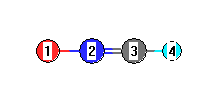
Point Group is C∞v
Cartesians (Å)
| Atom |
x (Å) |
y (Å) |
z (Å) |
|---|
| O1 |
0.000 |
0.000 |
1.195 |
| N2 |
0.000 |
0.000 |
-0.024 |
| C3 |
0.000 |
0.000 |
-1.189 |
| H4 |
0.000 |
0.000 |
-2.255 |
Atom - Atom Distances (Å)
| |
O1 |
N2 |
C3 |
H4 |
| O1 | | 1.2194 | 2.3841 | 3.4501 |
N2 | 1.2194 | | 1.1647 | 2.2307 | C3 | 2.3841 | 1.1647 | | 1.0659 | H4 | 3.4501 | 2.2307 | 1.0659 | |
 More geometry information
Calculated Bond Angles
| atom1 |
atom2 |
atom3 |
angle |
|
atom1 |
atom2 |
atom3 |
angle |
| O1 |
N2 |
C3 |
180.000 |
|
N2 |
C3 |
H4 |
180.000 |
Electronic energy levels
Charges, Dipole, Quadrupole and Polarizability
Jump to
S1C1
Energy calculated at CCSD/6-31G*
| | hartrees |
|---|
| Energy at 0K | -168.111295 |
| Energy at 298.15K | -168.111704 |
| HF Energy | -167.626492 |
| Nuclear repulsion energy | 59.898788 |
The energy at 298.15K was derived from the energy at 0K
and an integrated heat capacity that used the calculated vibrational frequencies.
Vibrational Frequencies calculated at CCSD/6-31G*
| Mode Number |
Symmetry |
Frequency
(cm-1) |
Scaled Frequency
(cm-1) |
IR Intensities
(km mol-1) |
Raman Act
(Å4/u) |
Dep P |
Dep U |
|---|
| 1 |
A' |
3544 |
3346 |
233.01 |
|
|
|
| 2 |
A' |
2347 |
2216 |
292.39 |
|
|
|
| 3 |
A' |
1273 |
1202 |
132.32 |
|
|
|
| 4 |
A' |
560 |
529 |
0.56 |
|
|
|
| 5 |
A' |
155 |
147 |
83.30 |
|
|
|
| 6 |
A" |
554 |
523 |
0.51 |
|
|
|
Unscaled Zero Point Vibrational Energy (zpe) 4216.3 cm
-1
Scaled (by 0.9443) Zero Point Vibrational Energy (zpe) 3981.5 cm
-1
See section
III.C.1 List or set vibrational scaling factors
to change the scale factors used here.
See section
III.C.2
Calculate a vibrational scaling factor for a given set of molecules
to determine the least squares best scaling factor.
Geometric Data calculated at CCSD/6-31G*
Point Group is Cs
Cartesians (Å)
| Atom |
x (Å) |
y (Å) |
z (Å) |
|---|
| O1 |
-0.000 |
-1.195 |
0.000 |
| N2 |
0.000 |
0.024 |
0.000 |
| C3 |
0.000 |
1.189 |
0.000 |
| H4 |
0.000 |
2.255 |
0.000 |
Atom - Atom Distances (Å)
| |
O1 |
N2 |
C3 |
H4 |
| O1 | | 1.2196 | 2.3843 | 3.4503 |
N2 | 1.2196 | | 1.1647 | 2.2307 | C3 | 2.3843 | 1.1647 | | 1.0660 | H4 | 3.4503 | 2.2307 | 1.0660 | |
More geometry information
Calculated Bond Angles
| atom1 |
atom2 |
atom3 |
angle |
|
atom1 |
atom2 |
atom3 |
angle |
| O1 |
N2 |
C3 |
179.998 |
|
N2 |
C3 |
H4 |
179.988 |
Electronic energy levels
Charges, Dipole, Quadrupole and Polarizability
