Jump to
S1C2
Energy calculated at CCSD(T)/6-31G*
| | hartrees |
|---|
| Energy at 0K | -151.510347 |
| Energy at 298.15K | |
| HF Energy | -151.079553 |
| Nuclear repulsion energy | 51.949879 |
The energy at 298.15K was derived from the energy at 0K
and an integrated heat capacity that used the calculated vibrational frequencies.
Vibrational Frequencies calculated at CCSD(T)/6-31G*
| Mode Number |
Symmetry |
Frequency
(cm-1) |
Scaled Frequency
(cm-1) |
IR Intensities
(km mol-1) |
Raman Act
(Å4/u) |
Dep P |
Dep U |
|---|
| 1 |
Σ |
3479 |
3347 |
|
|
|
|
| 2 |
Σ |
2099 |
2019 |
|
|
|
|
| 3 |
Σ |
1297 |
1248 |
|
|
|
|
| 4 |
Π |
536 |
516 |
|
|
|
|
| 4 |
Π |
495 |
476 |
|
|
|
|
| 5 |
Π |
289 |
278 |
|
|
|
|
| 5 |
Π |
493i |
474i |
|
|
|
|
Unscaled Zero Point Vibrational Energy (zpe) 3850.4 cm
-1
Scaled (by 0.9621) Zero Point Vibrational Energy (zpe) 3704.5 cm
-1
See section
III.C.1 List or set vibrational scaling factors
to change the scale factors used here.
See section
III.C.2
Calculate a vibrational scaling factor for a given set of molecules
to determine the least squares best scaling factor.
Geometric Data calculated at CCSD(T)/6-31G*
Point Group is C∞v
Cartesians (Å)
| Atom |
x (Å) |
y (Å) |
z (Å) |
|---|
| C1 |
0.000 |
0.000 |
0.016 |
| C2 |
0.000 |
0.000 |
-1.253 |
| O3 |
0.000 |
0.000 |
1.218 |
| H4 |
0.000 |
0.000 |
-2.322 |
Atom - Atom Distances (Å)
| |
C1 |
C2 |
O3 |
H4 |
| C1 | | 1.2688 | 1.2021 | 2.3374 |
C2 | 1.2688 | | 2.4709 | 1.0686 | O3 | 1.2021 | 2.4709 | | 3.5395 | H4 | 2.3374 | 1.0686 | 3.5395 | |
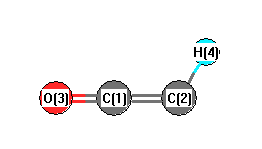 More geometry information
Calculated Bond Angles
| atom1 |
atom2 |
atom3 |
angle |
|
atom1 |
atom2 |
atom3 |
angle |
| C1 |
C2 |
H4 |
180.000 |
|
C2 |
C1 |
O3 |
180.000 |
Electronic energy levels
Charges, Dipole, Quadrupole and Polarizability
Jump to
S1C1
Energy calculated at CCSD(T)/6-31G*
| | hartrees |
|---|
| Energy at 0K | -151.514125 |
| Energy at 298.15K | |
| HF Energy | -151.077891 |
| Nuclear repulsion energy | 51.789434 |
The energy at 298.15K was derived from the energy at 0K
and an integrated heat capacity that used the calculated vibrational frequencies.
Vibrational Frequencies calculated at CCSD(T)/6-31G*
| Mode Number |
Symmetry |
Frequency
(cm-1) |
Scaled Frequency
(cm-1) |
IR Intensities
(km mol-1) |
Raman Act
(Å4/u) |
Dep P |
Dep U |
|---|
| 1 |
A' |
3355 |
3228 |
|
|
|
|
| 2 |
A' |
2083 |
2004 |
|
|
|
|
| 3 |
A' |
1255 |
1207 |
|
|
|
|
| 4 |
A' |
551 |
531 |
|
|
|
|
| 5 |
A' |
531 |
511 |
|
|
|
|
| 6 |
A" |
488 |
470 |
|
|
|
|
Unscaled Zero Point Vibrational Energy (zpe) 4131.3 cm
-1
Scaled (by 0.9621) Zero Point Vibrational Energy (zpe) 3974.7 cm
-1
See section
III.C.1 List or set vibrational scaling factors
to change the scale factors used here.
See section
III.C.2
Calculate a vibrational scaling factor for a given set of molecules
to determine the least squares best scaling factor.
Geometric Data calculated at CCSD(T)/6-31G*
Point Group is Cs
Cartesians (Å)
| Atom |
x (Å) |
y (Å) |
z (Å) |
|---|
| C1 |
0.000 |
0.065 |
0.000 |
| C2 |
1.171 |
-0.519 |
0.000 |
| O3 |
-1.152 |
0.360 |
0.000 |
| H4 |
2.186 |
-0.155 |
0.000 |
Atom - Atom Distances (Å)
| |
C1 |
C2 |
O3 |
H4 |
| C1 | | 1.3087 | 1.1890 | 2.1973 |
C2 | 1.3087 | | 2.4838 | 1.0785 | O3 | 1.1890 | 2.4838 | | 3.3774 | H4 | 2.1973 | 1.0785 | 3.3774 | |
More geometry information
Calculated Bond Angles
| atom1 |
atom2 |
atom3 |
angle |
|
atom1 |
atom2 |
atom3 |
angle |
| C1 |
C2 |
H4 |
133.750 |
|
C2 |
C1 |
O3 |
167.888 |
Electronic energy levels
Charges, Dipole, Quadrupole and Polarizability
