Jump to
S1C2
Energy calculated at CID/6-31G*
| | hartrees |
|---|
| Energy at 0K | -151.447755 |
| Energy at 298.15K | |
| HF Energy | -151.081772 |
| Nuclear repulsion energy | 52.685510 |
The energy at 298.15K was derived from the energy at 0K
and an integrated heat capacity that used the calculated vibrational frequencies.
Vibrational Frequencies calculated at CID/6-31G*
| Mode Number |
Symmetry |
Frequency
(cm-1) |
Scaled Frequency
(cm-1) |
IR Intensities
(km mol-1) |
Raman Act
(Å4/u) |
Dep P |
Dep U |
|---|
| 1 |
Σ |
3580 |
3306 |
145.68 |
|
|
|
| 2 |
Σ |
2297 |
2122 |
565.98 |
|
|
|
| 3 |
Σ |
1420 |
1312 |
37.26 |
|
|
|
| 4 |
Π |
602 |
556 |
1.34 |
|
|
|
| 4 |
Π |
562 |
519 |
12.85 |
|
|
|
| 5 |
Π |
378 |
349 |
35.90 |
|
|
|
| 5 |
Π |
395i |
364i |
166.11 |
|
|
|
Unscaled Zero Point Vibrational Energy (zpe) 4222.1 cm
-1
Scaled (by 0.9237) Zero Point Vibrational Energy (zpe) 3900.0 cm
-1
See section
III.C.1 List or set vibrational scaling factors
to change the scale factors used here.
See section
III.C.2
Calculate a vibrational scaling factor for a given set of molecules
to determine the least squares best scaling factor.
Geometric Data calculated at CID/6-31G*
Point Group is C∞v
Cartesians (Å)
| Atom |
x (Å) |
y (Å) |
z (Å) |
|---|
| C1 |
0.000 |
0.000 |
0.022 |
| C2 |
0.000 |
0.000 |
-1.238 |
| O3 |
0.000 |
0.000 |
1.199 |
| H4 |
0.000 |
0.000 |
-2.299 |
Atom - Atom Distances (Å)
| |
C1 |
C2 |
O3 |
H4 |
| C1 | | 1.2598 | 1.1775 | 2.3211 |
C2 | 1.2598 | | 2.4373 | 1.0613 | O3 | 1.1775 | 2.4373 | | 3.4985 | H4 | 2.3211 | 1.0613 | 3.4985 | |
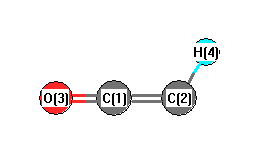 More geometry information
Calculated Bond Angles
| atom1 |
atom2 |
atom3 |
angle |
|
atom1 |
atom2 |
atom3 |
angle |
| C1 |
C2 |
H4 |
180.000 |
|
C2 |
C1 |
O3 |
180.000 |
Electronic energy levels
Charges, Dipole, Quadrupole and Polarizability
Jump to
S1C1
Energy calculated at CID/6-31G*
| | hartrees |
|---|
| Energy at 0K | -151.449817 |
| Energy at 298.15K | |
| HF Energy | -151.080985 |
| Nuclear repulsion energy | 52.544576 |
The energy at 298.15K was derived from the energy at 0K
and an integrated heat capacity that used the calculated vibrational frequencies.
Vibrational Frequencies calculated at CID/6-31G*
| Mode Number |
Symmetry |
Frequency
(cm-1) |
Scaled Frequency
(cm-1) |
IR Intensities
(km mol-1) |
Raman Act
(Å4/u) |
Dep P |
Dep U |
|---|
| 1 |
A' |
3471 |
3206 |
57.97 |
|
|
|
| 2 |
A' |
2301 |
2125 |
697.49 |
|
|
|
| 3 |
A' |
1365 |
1261 |
5.18 |
|
|
|
| 4 |
A' |
608 |
561 |
18.04 |
|
|
|
| 5 |
A' |
457 |
422 |
318.26 |
|
|
|
| 6 |
A" |
534 |
493 |
9.48 |
|
|
|
Unscaled Zero Point Vibrational Energy (zpe) 4367.5 cm
-1
Scaled (by 0.9237) Zero Point Vibrational Energy (zpe) 4034.2 cm
-1
See section
III.C.1 List or set vibrational scaling factors
to change the scale factors used here.
See section
III.C.2
Calculate a vibrational scaling factor for a given set of molecules
to determine the least squares best scaling factor.
Geometric Data calculated at CID/6-31G*
Point Group is Cs
Cartesians (Å)
| Atom |
x (Å) |
y (Å) |
z (Å) |
|---|
| C1 |
0.000 |
0.047 |
0.000 |
| C2 |
1.012 |
-0.757 |
0.000 |
| O3 |
-1.019 |
0.615 |
0.000 |
| H4 |
2.078 |
-0.664 |
0.000 |
Atom - Atom Distances (Å)
| |
C1 |
C2 |
O3 |
H4 |
| C1 | | 1.2930 | 1.1666 | 2.1960 |
C2 | 1.2930 | | 2.4515 | 1.0695 | O3 | 1.1666 | 2.4515 | | 3.3505 | H4 | 2.1960 | 1.0695 | 3.3505 | |
More geometry information
Calculated Bond Angles
| atom1 |
atom2 |
atom3 |
angle |
|
atom1 |
atom2 |
atom3 |
angle |
| C1 |
C2 |
H4 |
136.514 |
|
C2 |
C1 |
O3 |
170.670 |
Electronic energy levels
Charges, Dipole, Quadrupole and Polarizability
