Jump to
S1C2
Energy calculated at QCISD/6-31G*
| | hartrees |
|---|
| Energy at 0K | -151.496748 |
| Energy at 298.15K | |
| HF Energy | -151.080064 |
| Nuclear repulsion energy | 52.063929 |
The energy at 298.15K was derived from the energy at 0K
and an integrated heat capacity that used the calculated vibrational frequencies.
Vibrational Frequencies calculated at QCISD/6-31G*
| Mode Number |
Symmetry |
Frequency
(cm-1) |
Scaled Frequency
(cm-1) |
IR Intensities
(km mol-1) |
Raman Act
(Å4/u) |
Dep P |
Dep U |
|---|
| 1 |
Σ |
3500 |
3333 |
102.98 |
|
|
|
| 2 |
Σ |
2114 |
2013 |
130.71 |
|
|
|
| 3 |
Σ |
1306 |
1244 |
20.77 |
|
|
|
| 4 |
Π |
548 |
522 |
0.00 |
|
|
|
| 4 |
Π |
504 |
480 |
5.04 |
|
|
|
| 5 |
Π |
307 |
292 |
36.02 |
|
|
|
| 5 |
Π |
409i |
390i |
125.48 |
|
|
|
Unscaled Zero Point Vibrational Energy (zpe) 3934.7 cm
-1
Scaled (by 0.9523) Zero Point Vibrational Energy (zpe) 3747.0 cm
-1
See section
III.C.1 List or set vibrational scaling factors
to change the scale factors used here.
See section
III.C.2
Calculate a vibrational scaling factor for a given set of molecules
to determine the least squares best scaling factor.
Geometric Data calculated at QCISD/6-31G*
Point Group is C∞v
Cartesians (Å)
| Atom |
x (Å) |
y (Å) |
z (Å) |
|---|
| C1 |
0.000 |
0.000 |
0.015 |
| C2 |
0.000 |
0.000 |
-1.250 |
| O3 |
0.000 |
0.000 |
1.215 |
| H4 |
0.000 |
0.000 |
-2.317 |
Atom - Atom Distances (Å)
| |
C1 |
C2 |
O3 |
H4 |
| C1 | | 1.2654 | 1.1999 | 2.3323 |
C2 | 1.2654 | | 2.4652 | 1.0669 | O3 | 1.1999 | 2.4652 | | 3.5322 | H4 | 2.3323 | 1.0669 | 3.5322 | |
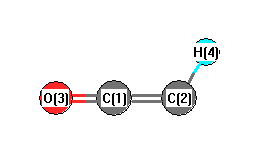 More geometry information
Calculated Bond Angles
| atom1 |
atom2 |
atom3 |
angle |
|
atom1 |
atom2 |
atom3 |
angle |
| C1 |
C2 |
H4 |
180.000 |
|
C2 |
C1 |
O3 |
180.000 |
Electronic energy levels
Charges, Dipole, Quadrupole and Polarizability
Jump to
S1C1
Energy calculated at QCISD/6-31G*
| | hartrees |
|---|
| Energy at 0K | -151.499488 |
| Energy at 298.15K | |
| HF Energy | -151.078781 |
| Nuclear repulsion energy | 51.921472 |
The energy at 298.15K was derived from the energy at 0K
and an integrated heat capacity that used the calculated vibrational frequencies.
Vibrational Frequencies calculated at QCISD/6-31G*
| Mode Number |
Symmetry |
Frequency
(cm-1) |
Scaled Frequency
(cm-1) |
IR Intensities
(km mol-1) |
Raman Act
(Å4/u) |
Dep P |
Dep U |
|---|
| 1 |
A' |
3392 |
3230 |
32.58 |
|
|
|
| 2 |
A' |
2084 |
1984 |
231.97 |
|
|
|
| 3 |
A' |
1260 |
1200 |
7.71 |
|
|
|
| 4 |
A' |
534 |
508 |
43.90 |
|
|
|
| 5 |
A' |
512 |
488 |
199.99 |
|
|
|
| 6 |
A" |
478 |
455 |
5.19 |
|
|
|
Unscaled Zero Point Vibrational Energy (zpe) 4129.9 cm
-1
Scaled (by 0.9523) Zero Point Vibrational Energy (zpe) 3932.9 cm
-1
See section
III.C.1 List or set vibrational scaling factors
to change the scale factors used here.
See section
III.C.2
Calculate a vibrational scaling factor for a given set of molecules
to determine the least squares best scaling factor.
Geometric Data calculated at QCISD/6-31G*
Point Group is Cs
Cartesians (Å)
| Atom |
x (Å) |
y (Å) |
z (Å) |
|---|
| C1 |
0.000 |
0.060 |
0.000 |
| C2 |
1.160 |
-0.529 |
0.000 |
| O3 |
-1.144 |
0.380 |
0.000 |
| H4 |
2.192 |
-0.226 |
0.000 |
Atom - Atom Distances (Å)
| |
C1 |
C2 |
O3 |
H4 |
| C1 | | 1.3006 | 1.1880 | 2.2105 |
C2 | 1.3006 | | 2.4766 | 1.0755 | O3 | 1.1880 | 2.4766 | | 3.3906 | H4 | 2.2105 | 1.0755 | 3.3906 | |
More geometry information
Calculated Bond Angles
| atom1 |
atom2 |
atom3 |
angle |
|
atom1 |
atom2 |
atom3 |
angle |
| C1 |
C2 |
H4 |
136.762 |
|
C2 |
C1 |
O3 |
168.756 |
Electronic energy levels
Charges, Dipole, Quadrupole and Polarizability
