Jump to
S1C2
Energy calculated at QCISD/6-31G*
| | hartrees |
|---|
| Energy at 0K | -189.254693 |
| Energy at 298.15K | -189.257421 |
| HF Energy | -188.759050 |
| Nuclear repulsion energy | 69.813036 |
The energy at 298.15K was derived from the energy at 0K
and an integrated heat capacity that used the calculated vibrational frequencies.
Vibrational Frequencies calculated at QCISD/6-31G*
| Mode Number |
Symmetry |
Frequency
(cm-1) |
Scaled Frequency
(cm-1) |
IR Intensities
(km mol-1) |
Raman Act
(Å4/u) |
Dep P |
Dep U |
|---|
| 1 |
A' |
3694 |
3518 |
53.27 |
|
|
|
| 2 |
A' |
3136 |
2987 |
45.71 |
|
|
|
| 3 |
A' |
1860 |
1772 |
300.93 |
|
|
|
| 4 |
A' |
1441 |
1372 |
4.79 |
|
|
|
| 5 |
A' |
1353 |
1288 |
8.75 |
|
|
|
| 6 |
A' |
1165 |
1109 |
253.62 |
|
|
|
| 7 |
A' |
632 |
602 |
52.97 |
|
|
|
| 8 |
A" |
1066 |
1015 |
0.65 |
|
|
|
| 9 |
A" |
700 |
666 |
170.42 |
|
|
|
Unscaled Zero Point Vibrational Energy (zpe) 7523.0 cm
-1
Scaled (by 0.9523) Zero Point Vibrational Energy (zpe) 7164.2 cm
-1
See section
III.C.1 List or set vibrational scaling factors
to change the scale factors used here.
See section
III.C.2
Calculate a vibrational scaling factor for a given set of molecules
to determine the least squares best scaling factor.
Geometric Data calculated at QCISD/6-31G*
Point Group is Cs
Cartesians (Å)
| Atom |
x (Å) |
y (Å) |
z (Å) |
|---|
| C1 |
0.000 |
0.418 |
0.000 |
| O2 |
-1.038 |
-0.440 |
0.000 |
| O3 |
1.169 |
0.113 |
0.000 |
| H4 |
-0.380 |
1.451 |
0.000 |
| H5 |
-0.667 |
-1.343 |
0.000 |
Atom - Atom Distances (Å)
| |
C1 |
O2 |
O3 |
H4 |
H5 |
| C1 | | 1.3468 | 1.2081 | 1.1005 | 1.8835 |
O2 | 1.3468 | | 2.2747 | 2.0022 | 0.9760 | O3 | 1.2081 | 2.2747 | | 2.0472 | 2.3430 | H4 | 1.1005 | 2.0022 | 2.0472 | | 2.8088 | H5 | 1.8835 | 0.9760 | 2.3430 | 2.8088 | |
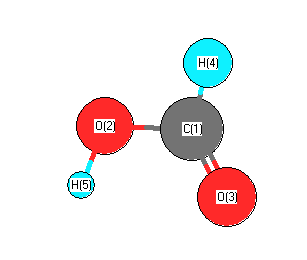 More geometry information
Calculated Bond Angles
| atom1 |
atom2 |
atom3 |
angle |
|
atom1 |
atom2 |
atom3 |
angle |
| C1 |
O2 |
H5 |
107.287 |
|
O2 |
C1 |
O3 |
125.741 |
| O2 |
C1 |
H4 |
109.383 |
|
O3 |
C1 |
H4 |
124.876 |
Electronic energy levels
Electronic state
Charges, Dipole, Quadrupole and Polarizability
Jump to
S1C1
Energy calculated at QCISD/6-31G*
| | hartrees |
|---|
| Energy at 0K | -189.245536 |
| Energy at 298.15K | |
| HF Energy | -188.749277 |
| Nuclear repulsion energy | 69.573140 |
The energy at 298.15K was derived from the energy at 0K
and an integrated heat capacity that used the calculated vibrational frequencies.
Vibrational Frequencies calculated at QCISD/6-31G*
| Mode Number |
Symmetry |
Frequency
(cm-1) |
Scaled Frequency
(cm-1) |
IR Intensities
(km mol-1) |
Raman Act
(Å4/u) |
Dep P |
Dep U |
|---|
| 1 |
A' |
3750 |
3571 |
49.93 |
|
|
|
| 2 |
A' |
3034 |
2890 |
83.61 |
|
|
|
| 3 |
A' |
1904 |
1813 |
236.45 |
|
|
|
| 4 |
A' |
1468 |
1398 |
1.37 |
|
|
|
| 5 |
A' |
1326 |
1263 |
328.79 |
|
|
|
| 6 |
A' |
1148 |
1093 |
43.39 |
|
|
|
| 7 |
A' |
660 |
629 |
10.41 |
|
|
|
| 8 |
A" |
1051 |
1001 |
1.39 |
|
|
|
| 9 |
A" |
514 |
490 |
105.18 |
|
|
|
Unscaled Zero Point Vibrational Energy (zpe) 7427.5 cm
-1
Scaled (by 0.9523) Zero Point Vibrational Energy (zpe) 7073.2 cm
-1
See section
III.C.1 List or set vibrational scaling factors
to change the scale factors used here.
See section
III.C.2
Calculate a vibrational scaling factor for a given set of molecules
to determine the least squares best scaling factor.
Geometric Data calculated at QCISD/6-31G*
Point Group is Cs
Cartesians (Å)
| Atom |
x (Å) |
y (Å) |
z (Å) |
|---|
| C1 |
0.000 |
0.387 |
0.000 |
| O2 |
-0.905 |
-0.624 |
0.000 |
| O3 |
1.187 |
0.191 |
0.000 |
| H4 |
-0.455 |
1.395 |
0.000 |
| H5 |
-1.804 |
-0.251 |
0.000 |
Atom - Atom Distances (Å)
| |
C1 |
O2 |
O3 |
H4 |
H5 |
| C1 | | 1.3569 | 1.2031 | 1.1059 | 1.9135 |
O2 | 1.3569 | | 2.2448 | 2.0687 | 0.9736 | O3 | 1.2031 | 2.2448 | | 2.0361 | 3.0234 | H4 | 1.1059 | 2.0687 | 2.0361 | | 2.1283 | H5 | 1.9135 | 0.9736 | 3.0234 | 2.1283 | |
More geometry information
Calculated Bond Angles
| atom1 |
atom2 |
atom3 |
angle |
|
atom1 |
atom2 |
atom3 |
angle |
| C1 |
O2 |
H5 |
109.281 |
|
O2 |
C1 |
O3 |
122.430 |
| O2 |
C1 |
H4 |
113.894 |
|
O3 |
C1 |
H4 |
123.676 |
Electronic energy levels
Charges, Dipole, Quadrupole and Polarizability
