return to home page Computational Chemistry Comparison and Benchmark DataBase Release 22 (May 2022) Standard Reference Database 101 National Institute of Standards and Technology
You are here: Calculated > Energy > Optimized > Energy

All results from a given calculation for C2H4O3 (1,2,3-trioxolane)

using model chemistry: QCISD/6-31G*

19 10 17 12 22

States and conformations

State Conformation minimum conformation conformer description state description
1 1 yes CS 1A'
Energy calculated at QCISD/6-31G*
 hartrees
Energy at 0K-303.263987
Energy at 298.15K-303.270547
HF Energy-302.423062
Nuclear repulsion energy192.364827
The energy at 298.15K was derived from the energy at 0K and an integrated heat capacity that used the calculated vibrational frequencies.
Vibrational Frequencies calculated at QCISD/6-31G*
Mode Number Symmetry Frequency
(cm-1)
Scaled Frequency
(cm-1)
IR Intensities
(km mol-1)
Raman Act
(Å4/u)
Dep P Dep U
1 A' 3172 3021 32.16      
2 A' 3098 2951 38.26      
3 A' 1567 1493 0.20      
4 A' 1381 1315 0.57      
5 A' 1266 1206 0.90      
6 A' 1042 993 30.97      
7 A' 971 924 13.00      
8 A' 906 863 2.87      
9 A' 884 842 0.76      
10 A' 711 677 1.35      
11 A' 416 397 4.47      
12 A" 3155 3005 0.28      
13 A" 3088 2941 25.12      
14 A" 1550 1476 0.02      
15 A" 1376 1311 3.94      
16 A" 1254 1194 0.06      
17 A" 1180 1124 0.00      
18 A" 1052 1002 3.04      
19 A" 769 733 37.51      
20 A" 730 695 0.01      
21 A" 117 111 3.68      

Unscaled Zero Point Vibrational Energy (zpe) 14842.1 cm-1
Scaled (by 0.9523) Zero Point Vibrational Energy (zpe) 14134.2 cm-1
See section III.C.1 List or set vibrational scaling factors to change the scale factors used here.
See section III.C.2 Calculate a vibrational scaling factor for a given set of molecules to determine the least squares best scaling factor.
Rotational Constants (cm-1) from geometry optimized at QCISD/6-31G*
ABC
0.27182 0.25084 0.14682

See section I.F.4 to change rotational constant units
Geometric Data calculated at QCISD/6-31G*

Point Group is Cs

Cartesians (Å)
Atom x (Å) y (Å) z (Å)
O1 -0.566 -1.050 0.000
O2 0.140 -0.491 1.106
O3 0.140 -0.491 -1.106
C4 0.140 0.899 0.778
C5 0.140 0.899 -0.778
H6 1.047 1.325 1.218
H7 1.047 1.325 -1.218
H8 -0.748 1.405 1.179
H9 -0.748 1.405 -1.179

Atom - Atom Distances (Å)
  O1 O2 O3 C4 C5 H6 H7 H8 H9
O11.42641.42642.21432.21433.11853.11852.72882.7288
O21.42642.21211.42872.34162.03333.08552.09493.0991
O31.42642.21212.34161.42873.08552.03333.09912.0949
C42.21431.42872.34161.55591.09392.23281.09772.2075
C52.21432.34161.42871.55592.23281.09392.20751.0977
H63.11852.03333.08551.09392.23282.43511.79692.9950
H73.11853.08552.03332.23281.09392.43512.99501.7969
H82.72882.09493.09911.09772.20751.79692.99502.3577
H92.72883.09912.09492.20751.09772.99501.79692.3577

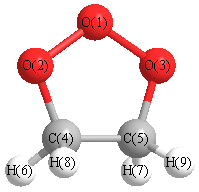
picture of 1,2,3-trioxolane state 1 conformation 1
More geometry information
Calculated Bond Angles
atom1 atom2 atom3 angle atom1 atom2 atom3 angle
O1 O2 C4 101.710 O1 O3 C5 101.710
O2 O1 O3 101.686 O2 C4 C5 103.275
O2 C4 H6 106.662 O2 C4 H8 111.363
O3 C5 C4 103.275 O3 C5 H7 106.662
O3 C5 H9 111.363 C4 C5 H7 113.694
C4 C5 H9 111.421 C5 C4 H6 113.694
C5 C4 H8 111.421 H6 C4 H8 110.150
H7 C5 H9 110.150
Electronic energy levels
Charges, Dipole, Quadrupole and Polarizability