Jump to
S1C2
Energy calculated at CCSD(T)/6-31G*
| | hartrees |
|---|
| Energy at 0K | -134.726460 |
| Energy at 298.15K | -134.734696 |
| HF Energy | -134.246081 |
| Nuclear repulsion energy | 82.448309 |
The energy at 298.15K was derived from the energy at 0K
and an integrated heat capacity that used the calculated vibrational frequencies.
Vibrational Frequencies calculated at CCSD(T)/6-31G*
| Mode Number |
Symmetry |
Frequency
(cm-1) |
Scaled Frequency
(cm-1) |
IR Intensities
(km mol-1) |
Raman Act
(Å4/u) |
Dep P |
Dep U |
|---|
| 1 |
A' |
3434 |
3304 |
|
|
|
|
| 2 |
A' |
3118 |
2999 |
|
|
|
|
| 3 |
A' |
3054 |
2938 |
|
|
|
|
| 4 |
A' |
3038 |
2923 |
|
|
|
|
| 5 |
A' |
1719 |
1654 |
|
|
|
|
| 6 |
A' |
1549 |
1491 |
|
|
|
|
| 7 |
A' |
1532 |
1474 |
|
|
|
|
| 8 |
A' |
1453 |
1398 |
|
|
|
|
| 9 |
A' |
1409 |
1356 |
|
|
|
|
| 10 |
A' |
1190 |
1145 |
|
|
|
|
| 11 |
A' |
1097 |
1056 |
|
|
|
|
| 12 |
A' |
951 |
915 |
|
|
|
|
| 13 |
A' |
896 |
862 |
|
|
|
|
| 14 |
A' |
408 |
392 |
|
|
|
|
| 15 |
A" |
3524 |
3390 |
|
|
|
|
| 16 |
A" |
3119 |
3001 |
|
|
|
|
| 17 |
A" |
3091 |
2973 |
|
|
|
|
| 18 |
A" |
1539 |
1481 |
|
|
|
|
| 19 |
A" |
1417 |
1363 |
|
|
|
|
| 20 |
A" |
1304 |
1255 |
|
|
|
|
| 21 |
A" |
1027 |
988 |
|
|
|
|
| 22 |
A" |
790 |
760 |
|
|
|
|
| 23 |
A" |
319 |
307 |
|
|
|
|
| 24 |
A" |
269 |
259 |
|
|
|
|
Unscaled Zero Point Vibrational Energy (zpe) 20622.8 cm
-1
Scaled (by 0.9621) Zero Point Vibrational Energy (zpe) 19841.2 cm
-1
See section
III.C.1 List or set vibrational scaling factors
to change the scale factors used here.
See section
III.C.2
Calculate a vibrational scaling factor for a given set of molecules
to determine the least squares best scaling factor.
Geometric Data calculated at CCSD(T)/6-31G*
Point Group is Cs
Cartesians (Å)
| Atom |
x (Å) |
y (Å) |
z (Å) |
|---|
| N1 |
-1.313 |
-0.087 |
0.000 |
| C2 |
0.000 |
0.579 |
0.000 |
| C3 |
1.214 |
-0.356 |
0.000 |
| H4 |
2.157 |
0.209 |
0.000 |
| H5 |
1.206 |
-1.003 |
0.889 |
| H6 |
1.206 |
-1.003 |
-0.889 |
| H7 |
0.035 |
1.237 |
-0.881 |
| H8 |
0.035 |
1.237 |
0.881 |
| H9 |
-1.368 |
-0.705 |
0.814 |
| H10 |
-1.368 |
-0.705 |
-0.814 |
Atom - Atom Distances (Å)
| |
N1 |
C2 |
C3 |
H4 |
H5 |
H6 |
H7 |
H8 |
H9 |
H10 |
| N1 | | 1.4721 | 2.5411 | 3.4826 | 2.8239 | 2.8239 | 2.0845 | 2.0845 | 1.0238 | 1.0238 |
C2 | 1.4721 | | 1.5326 | 2.1888 | 2.1792 | 2.1792 | 1.0996 | 1.0996 | 2.0456 | 2.0456 | C3 | 2.5411 | 1.5326 | | 1.0994 | 1.0997 | 1.0997 | 2.1684 | 2.1684 | 2.7300 | 2.7300 | H4 | 3.4826 | 2.1888 | 1.0994 | | 1.7788 | 1.7788 | 2.5168 | 2.5168 | 3.7318 | 3.7318 | H5 | 2.8239 | 2.1792 | 1.0997 | 1.7788 | | 1.7783 | 3.0854 | 2.5274 | 2.5925 | 3.1010 | H6 | 2.8239 | 2.1792 | 1.0997 | 1.7788 | 1.7783 | | 2.5274 | 3.0854 | 3.1010 | 2.5925 | H7 | 2.0845 | 1.0996 | 2.1684 | 2.5168 | 3.0854 | 2.5274 | | 1.7611 | 2.9348 | 2.3970 | H8 | 2.0845 | 1.0996 | 2.1684 | 2.5168 | 2.5274 | 3.0854 | 1.7611 | | 2.3970 | 2.9348 | H9 | 1.0238 | 2.0456 | 2.7300 | 3.7318 | 2.5925 | 3.1010 | 2.9348 | 2.3970 | | 1.6283 | H10 | 1.0238 | 2.0456 | 2.7300 | 3.7318 | 3.1010 | 2.5925 | 2.3970 | 2.9348 | 1.6283 | |
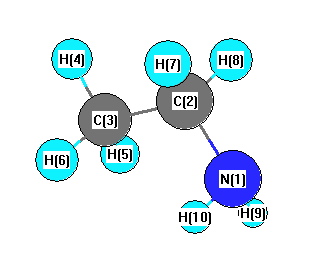 More geometry information
Calculated Bond Angles
| atom1 |
atom2 |
atom3 |
angle |
|
atom1 |
atom2 |
atom3 |
angle |
| N1 |
C2 |
C3 |
115.484 |
|
N1 |
C2 |
H7 |
107.417 |
| N1 |
C2 |
H8 |
107.417 |
|
C2 |
N1 |
H9 |
108.755 |
| C2 |
N1 |
H10 |
108.755 |
|
C2 |
C3 |
H4 |
111.470 |
| C2 |
C3 |
H5 |
110.687 |
|
C2 |
C3 |
H6 |
110.687 |
| C3 |
C2 |
H7 |
109.844 |
|
C3 |
C2 |
H8 |
109.844 |
| H4 |
C3 |
H5 |
107.974 |
|
H4 |
C3 |
H6 |
107.974 |
| H5 |
C3 |
H6 |
107.914 |
|
H7 |
C2 |
H8 |
106.420 |
| H9 |
N1 |
H10 |
105.356 |
|
Electronic energy levels
Charges, Dipole, Quadrupole and Polarizability
Jump to
S1C1
Energy calculated at CCSD(T)/6-31G*
| | hartrees |
|---|
| Energy at 0K | -134.726025 |
| Energy at 298.15K | |
| Nuclear repulsion energy | |
The energy at 298.15K was derived from the energy at 0K
and an integrated heat capacity that used the calculated vibrational frequencies.
Vibrational Frequencies calculated at CCSD(T)/6-31G*
Geometric Data calculated at CCSD(T)/6-31G*
Point Group is Cs
Electronic energy levels
Charges, Dipole, Quadrupole and Polarizability
