return to home page Computational Chemistry Comparison and Benchmark DataBase Release 22 (May 2022) Standard Reference Database 101 National Institute of Standards and Technology
You are here: Calculated > Energy > Optimized > Energy

All results from a given calculation for CF3CH2Cl (2,2,2-Trifluoroethyl chloride)

using model chemistry: CID/6-31G*

19 10 17 12 22

States and conformations

State Conformation minimum conformation conformer description state description
1 1 yes CS 1A'
Energy calculated at CID/6-31G*
 hartrees
Energy at 0K-835.477742
Energy at 298.15K-835.481791
HF Energy-834.710336
Nuclear repulsion energy324.752245
The energy at 298.15K was derived from the energy at 0K and an integrated heat capacity that used the calculated vibrational frequencies.
Vibrational Frequencies calculated at CID/6-31G*
Mode Number Symmetry Frequency
(cm-1)
Scaled Frequency
(cm-1)
IR Intensities
(km mol-1)
Raman Act
(Å4/u)
Dep P Dep U
1 A' 3256 3008 7.91      
2 A' 1575 1455 27.55      
3 A' 1486 1373 70.62      
4 A' 1398 1291 149.53      
5 A' 1292 1193 257.23      
6 A' 925 854 27.33      
7 A' 861 795 22.80      
8 A' 674 622 30.95      
9 A' 561 518 7.97      
10 A' 378 349 0.56      
11 A' 197 182 1.82      
12 A" 3325 3072 0.19      
13 A" 1431 1322 184.77      
14 A" 1227 1133 89.01      
15 A" 989 913 8.47      
16 A" 556 514 2.79      
17 A" 369 341 1.29      
18 A" 111 102 3.56      

Unscaled Zero Point Vibrational Energy (zpe) 10304.7 cm-1
Scaled (by 0.9237) Zero Point Vibrational Energy (zpe) 9518.4 cm-1
See section III.C.1 List or set vibrational scaling factors to change the scale factors used here.
See section III.C.2 Calculate a vibrational scaling factor for a given set of molecules to determine the least squares best scaling factor.
Rotational Constants (cm-1) from geometry optimized at CID/6-31G*
ABC
0.17930 0.06043 0.05982

See section I.F.4 to change rotational constant units
Geometric Data calculated at CID/6-31G*

Point Group is Cs

Cartesians (Å)
Atom x (Å) y (Å) z (Å)
C1 -0.855 0.485 0.000
C2 0.650 0.424 0.000
Cl3 -1.579 -1.122 0.000
H4 -1.176 1.019 0.886
H5 -1.176 1.019 -0.886
F6 1.127 1.673 0.000
F7 1.127 -0.193 1.076
F8 1.127 -0.193 -1.076

Atom - Atom Distances (Å)
  C1 C2 Cl3 H4 H5 F6 F7 F8
C11.50641.76331.08281.08282.31072.35522.3552
C21.50642.71352.11502.11501.33691.32921.3292
Cl31.76332.71352.35182.35183.89103.05703.0570
H41.08282.11502.35181.77222.55292.60943.2593
H51.08282.11502.35181.77222.55293.25932.6094
F62.31071.33693.89102.55292.55292.15472.1547
F72.35521.32923.05702.60943.25932.15472.1520
F82.35521.32923.05703.25932.60942.15472.1520

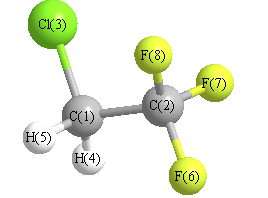
picture of 2,2,2-Trifluoroethyl chloride state 1 conformation 1
More geometry information
Calculated Bond Angles
atom1 atom2 atom3 angle atom1 atom2 atom3 angle
C1 C2 F6 108.569 C1 C2 F7 112.164
C1 C2 F8 112.164 C2 C1 Cl3 111.935
C2 C1 H4 108.430 C2 C1 H5 108.430
Cl3 C1 H4 109.096 Cl3 C1 H5 109.096
H4 C1 H5 109.835 F6 C2 F7 107.837
F6 C2 F8 107.837 F7 C2 F8 108.095
Electronic energy levels
Charges, Dipole, Quadrupole and Polarizability