return to home page Computational Chemistry Comparison and Benchmark DataBase Release 22 (May 2022) Standard Reference Database 101 National Institute of Standards and Technology
You are here: Calculated > Energy > Optimized > Energy

All results from a given calculation for C3H4O2 (Methyl glyoxal)

using model chemistry: CID/6-31G*

19 10 17 12 22

States and conformations

State Conformation minimum conformation conformer description state description
1 1 yes CS 1A'
Energy calculated at CID/6-31G*
 hartrees
Energy at 0K-266.272272
Energy at 298.15K-266.276520
HF Energy-265.640391
Nuclear repulsion energy160.680741
The energy at 298.15K was derived from the energy at 0K and an integrated heat capacity that used the calculated vibrational frequencies.
Vibrational Frequencies calculated at CID/6-31G*
Mode Number Symmetry Frequency
(cm-1)
Scaled Frequency
(cm-1)
IR Intensities
(km mol-1)
Raman Act
(Å4/u)
Dep P Dep U
1 A' 3296 3045 4.21      
2 A' 3180 2937 0.24      
3 A' 3142 2903 60.28      
4 A' 1951 1802 6.90      
5 A' 1928 1781 202.44      
6 A' 1557 1438 14.30      
7 A' 1501 1387 32.75      
8 A' 1438 1329 4.96      
9 A' 1348 1245 21.96      
10 A' 1080 997 5.03      
11 A' 840 776 10.43      
12 A' 609 563 12.74      
13 A' 509 470 32.28      
14 A' 263 243 18.91      
15 A" 3253 3005 2.94      
16 A" 1559 1440 10.53      
17 A" 1141 1054 3.15      
18 A" 970 896 0.32      
19 A" 494 456 1.14      
20 A" 141 130 17.28      
21 A" 109 101 9.19      

Unscaled Zero Point Vibrational Energy (zpe) 15153.8 cm-1
Scaled (by 0.9237) Zero Point Vibrational Energy (zpe) 13997.6 cm-1
See section III.C.1 List or set vibrational scaling factors to change the scale factors used here.
See section III.C.2 Calculate a vibrational scaling factor for a given set of molecules to determine the least squares best scaling factor.
Rotational Constants (cm-1) from geometry optimized at CID/6-31G*
ABC
0.30577 0.14995 0.10250

See section I.F.4 to change rotational constant units
Geometric Data calculated at CID/6-31G*

Point Group is Cs

Cartesians (Å)
Atom x (Å) y (Å) z (Å)
C1 -0.843 -0.720 0.000
C2 0.000 0.548 0.000
C3 1.489 0.384 0.000
O4 -0.359 -1.819 0.000
O5 -0.581 1.604 0.000
H6 -1.926 -0.541 0.000
H7 1.962 1.360 0.000
H8 1.800 -0.185 0.875
H9 1.800 -0.185 -0.875

Atom - Atom Distances (Å)
  C1 C2 C3 O4 O5 H6 H7 H8 H9
C11.52292.58041.20072.33941.09803.49222.83532.8353
C21.52291.49842.39381.20552.21272.12332.13162.1316
C32.58041.49842.87492.40323.53851.08481.08861.0886
O41.20072.39382.87493.43042.02273.93572.84522.8452
O52.33941.20552.40323.43042.53222.55433.10433.1043
H61.09802.21273.53852.02272.53224.32793.84443.8444
H73.49222.12331.08483.93572.55434.32791.78281.7828
H82.83532.13161.08862.84523.10433.84441.78281.7493
H92.83532.13161.08862.84523.10433.84441.78281.7493

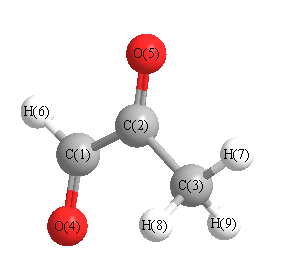
picture of Methyl glyoxal state 1 conformation 1
More geometry information
Calculated Bond Angles
atom1 atom2 atom3 angle atom1 atom2 atom3 angle
C1 C2 C3 117.318 C1 C2 O5 117.588
C2 C1 O4 122.586 C2 C1 H6 114.206
C2 C3 H7 109.528 C2 C3 H8 109.954
C2 C3 H9 109.954 C3 C2 O5 125.094
O4 C1 H6 123.208 H7 C3 H8 110.228
H7 C3 H9 110.228 H8 C3 H9 106.918
Electronic energy levels
Charges, Dipole, Quadrupole and Polarizability