Jump to
S1C2
Energy calculated at CCSD(T)/6-31G*
| | hartrees |
|---|
| Energy at 0K | -1071.453395 |
| Energy at 298.15K | -1071.455900 |
| HF Energy | -1070.698409 |
| Nuclear repulsion energy | 262.504866 |
The energy at 298.15K was derived from the energy at 0K
and an integrated heat capacity that used the calculated vibrational frequencies.
Vibrational Frequencies calculated at CCSD(T)/6-31G*
| Mode Number |
Symmetry |
Frequency
(cm-1) |
Scaled Frequency
(cm-1) |
IR Intensities
(km mol-1) |
Raman Act
(Å4/u) |
Dep P |
Dep U |
|---|
| 1 |
A' |
3179 |
3059 |
|
|
|
|
| 2 |
A' |
3011 |
2897 |
|
|
|
|
| 3 |
A' |
1805 |
1737 |
|
|
|
|
| 4 |
A' |
1425 |
1371 |
|
|
|
|
| 5 |
A' |
1252 |
1204 |
|
|
|
|
| 6 |
A' |
1096 |
1054 |
|
|
|
|
| 7 |
A' |
807 |
776 |
|
|
|
|
| 8 |
A' |
443 |
426 |
|
|
|
|
| 9 |
A' |
331 |
319 |
|
|
|
|
| 10 |
A' |
262 |
252 |
|
|
|
|
| 11 |
A" |
1297 |
1248 |
|
|
|
|
| 12 |
A" |
1015 |
976 |
|
|
|
|
| 13 |
A" |
769 |
740 |
|
|
|
|
| 14 |
A" |
284 |
273 |
|
|
|
|
| 15 |
A" |
72 |
69 |
|
|
|
|
Unscaled Zero Point Vibrational Energy (zpe) 8523.8 cm
-1
Scaled (by 0.9621) Zero Point Vibrational Energy (zpe) 8200.7 cm
-1
See section
III.C.1 List or set vibrational scaling factors
to change the scale factors used here.
See section
III.C.2
Calculate a vibrational scaling factor for a given set of molecules
to determine the least squares best scaling factor.
Geometric Data calculated at CCSD(T)/6-31G*
Point Group is Cs
Cartesians (Å)
| Atom |
x (Å) |
y (Å) |
z (Å) |
|---|
| C1 |
0.383 |
-0.020 |
0.000 |
| C2 |
-0.173 |
1.401 |
0.000 |
| H3 |
1.474 |
0.007 |
0.000 |
| Cl4 |
-0.173 |
-0.846 |
1.477 |
| Cl5 |
-0.173 |
-0.846 |
-1.477 |
| O6 |
0.555 |
2.374 |
0.000 |
| H7 |
-1.279 |
1.467 |
0.000 |
Atom - Atom Distances (Å)
| |
C1 |
C2 |
H3 |
Cl4 |
Cl5 |
O6 |
H7 |
| C1 | | 1.5261 | 1.0917 | 1.7811 | 1.7811 | 2.4012 | 2.2305 |
C2 | 1.5261 | | 2.1577 | 2.6887 | 2.6887 | 1.2159 | 1.1082 | H3 | 1.0917 | 2.1577 | | 2.3712 | 2.3712 | 2.5396 | 3.1165 | Cl4 | 1.7811 | 2.6887 | 2.3712 | | 2.9547 | 3.6169 | 2.9589 | Cl5 | 1.7811 | 2.6887 | 2.3712 | 2.9547 | | 3.6169 | 2.9589 | O6 | 2.4012 | 1.2159 | 2.5396 | 3.6169 | 3.6169 | | 2.0466 | H7 | 2.2305 | 1.1082 | 3.1165 | 2.9589 | 2.9589 | 2.0466 | |
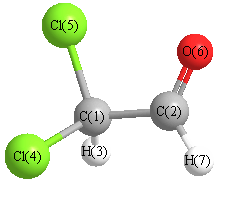 More geometry information
Calculated Bond Angles
| atom1 |
atom2 |
atom3 |
angle |
|
atom1 |
atom2 |
atom3 |
angle |
| C1 |
C2 |
O6 |
121.846 |
|
C1 |
C2 |
H7 |
114.792 |
| C2 |
C1 |
H3 |
109.917 |
|
C2 |
C1 |
Cl4 |
108.530 |
| C2 |
C1 |
Cl5 |
108.530 |
|
H3 |
C1 |
Cl4 |
108.883 |
| H3 |
C1 |
Cl5 |
108.883 |
|
Cl4 |
C1 |
Cl5 |
112.083 |
| O6 |
C2 |
H7 |
123.362 |
|
Electronic energy levels
Charges, Dipole, Quadrupole and Polarizability
Jump to
S1C1
Energy calculated at CCSD(T)/6-31G*
| | hartrees |
|---|
| Energy at 0K | -1071.453395 |
| Energy at 298.15K | |
| HF Energy | -1070.698407 |
| Nuclear repulsion energy | 262.481912 |
The energy at 298.15K was derived from the energy at 0K
and an integrated heat capacity that used the calculated vibrational frequencies.
Vibrational Frequencies calculated at CCSD(T)/6-31G*
| Mode Number |
Symmetry |
Frequency
(cm-1) |
Scaled Frequency
(cm-1) |
IR Intensities
(km mol-1) |
Raman Act
(Å4/u) |
Dep P |
Dep U |
|---|
| 1 |
A |
3183 |
3063 |
|
|
|
|
| 2 |
A |
3014 |
2900 |
|
|
|
|
| 3 |
A |
1805 |
1737 |
|
|
|
|
| 4 |
A |
1424 |
1370 |
|
|
|
|
| 5 |
A |
1296 |
1247 |
|
|
|
|
| 6 |
A |
1250 |
1203 |
|
|
|
|
| 7 |
A |
1096 |
1055 |
|
|
|
|
| 8 |
A |
1014 |
976 |
|
|
|
|
| 9 |
A |
807 |
777 |
|
|
|
|
| 10 |
A |
768 |
738 |
|
|
|
|
| 11 |
A |
443 |
426 |
|
|
|
|
| 12 |
A |
329 |
317 |
|
|
|
|
| 13 |
A |
284 |
273 |
|
|
|
|
| 14 |
A |
262 |
252 |
|
|
|
|
| 15 |
A |
72 |
69 |
|
|
|
|
Unscaled Zero Point Vibrational Energy (zpe) 8523.6 cm
-1
Scaled (by 0.9621) Zero Point Vibrational Energy (zpe) 8200.6 cm
-1
See section
III.C.1 List or set vibrational scaling factors
to change the scale factors used here.
See section
III.C.2
Calculate a vibrational scaling factor for a given set of molecules
to determine the least squares best scaling factor.
Geometric Data calculated at CCSD(T)/6-31G*
Point Group is C1
Cartesians (Å)
| Atom |
x (Å) |
y (Å) |
z (Å) |
|---|
| C1 |
-0.040 |
-0.002 |
0.381 |
| C2 |
-1.356 |
-0.017 |
-0.390 |
| H3 |
-0.237 |
-0.003 |
1.455 |
| Cl4 |
0.881 |
-1.467 |
-0.039 |
| Cl5 |
0.843 |
1.488 |
-0.039 |
| O6 |
-2.432 |
-0.026 |
0.178 |
| H7 |
-1.250 |
-0.018 |
-1.493 |
Atom - Atom Distances (Å)
| |
C1 |
C2 |
H3 |
Cl4 |
Cl5 |
O6 |
H7 |
| C1 | | 1.5260 | 1.0913 | 1.7811 | 1.7821 | 2.4008 | 2.2307 |
C2 | 1.5260 | | 2.1579 | 2.6897 | 2.6879 | 1.2160 | 1.1079 | H3 | 1.0913 | 2.1579 | | 2.3718 | 2.3708 | 2.5396 | 3.1166 | Cl4 | 1.7811 | 2.6897 | 2.3718 | | 2.9552 | 3.6197 | 2.9589 | Cl5 | 1.7821 | 2.6879 | 2.3708 | 2.9552 | | 3.6142 | 2.9595 | O6 | 2.4008 | 1.2160 | 2.5396 | 3.6197 | 3.6142 | | 2.0464 | H7 | 2.2307 | 1.1079 | 3.1166 | 2.9589 | 2.9595 | 2.0464 | |
More geometry information
Calculated Bond Angles
| atom1 |
atom2 |
atom3 |
angle |
|
atom1 |
atom2 |
atom3 |
angle |
| C1 |
C2 |
O6 |
121.810 |
|
C1 |
C2 |
H7 |
114.831 |
| C2 |
C1 |
H3 |
109.962 |
|
C2 |
C1 |
Cl4 |
108.596 |
| C2 |
C1 |
Cl5 |
108.438 |
|
H3 |
C1 |
Cl4 |
108.949 |
| H3 |
C1 |
Cl5 |
108.809 |
|
Cl4 |
C1 |
Cl5 |
112.073 |
| O6 |
C2 |
H7 |
123.359 |
|
Electronic energy levels
Charges, Dipole, Quadrupole and Polarizability
