Jump to
S1C2
Energy calculated at CID/6-31G*
| | hartrees |
|---|
| Energy at 0K | -1071.307039 |
| Energy at 298.15K | -1071.309690 |
| HF Energy | -1070.700820 |
| Nuclear repulsion energy | 264.715509 |
The energy at 298.15K was derived from the energy at 0K
and an integrated heat capacity that used the calculated vibrational frequencies.
Vibrational Frequencies calculated at CID/6-31G*
| Mode Number |
Symmetry |
Frequency
(cm-1) |
Scaled Frequency
(cm-1) |
IR Intensities
(km mol-1) |
Raman Act
(Å4/u) |
Dep P |
Dep U |
|---|
| 1 |
A' |
3309 |
3057 |
1.11 |
|
|
|
| 2 |
A' |
3154 |
2913 |
35.64 |
|
|
|
| 3 |
A' |
1955 |
1806 |
154.36 |
|
|
|
| 4 |
A' |
1487 |
1374 |
5.59 |
|
|
|
| 5 |
A' |
1312 |
1212 |
9.37 |
|
|
|
| 6 |
A' |
1147 |
1060 |
22.92 |
|
|
|
| 7 |
A' |
850 |
785 |
27.83 |
|
|
|
| 8 |
A' |
466 |
431 |
5.46 |
|
|
|
| 9 |
A' |
348 |
322 |
27.36 |
|
|
|
| 10 |
A' |
275 |
254 |
2.23 |
|
|
|
| 11 |
A" |
1352 |
1249 |
31.63 |
|
|
|
| 12 |
A" |
1088 |
1005 |
21.42 |
|
|
|
| 13 |
A" |
822 |
759 |
105.10 |
|
|
|
| 14 |
A" |
299 |
276 |
2.75 |
|
|
|
| 15 |
A" |
78 |
72 |
10.39 |
|
|
|
Unscaled Zero Point Vibrational Energy (zpe) 8971.1 cm
-1
Scaled (by 0.9237) Zero Point Vibrational Energy (zpe) 8286.6 cm
-1
See section
III.C.1 List or set vibrational scaling factors
to change the scale factors used here.
See section
III.C.2
Calculate a vibrational scaling factor for a given set of molecules
to determine the least squares best scaling factor.
Geometric Data calculated at CID/6-31G*
Point Group is Cs
Cartesians (Å)
| Atom |
x (Å) |
y (Å) |
z (Å) |
|---|
| C1 |
0.378 |
-0.018 |
0.000 |
| C2 |
-0.171 |
1.397 |
0.000 |
| H3 |
1.459 |
0.008 |
0.000 |
| Cl4 |
-0.171 |
-0.840 |
1.465 |
| Cl5 |
-0.171 |
-0.840 |
-1.465 |
| O6 |
0.549 |
2.352 |
0.000 |
| H7 |
-1.266 |
1.468 |
0.000 |
Atom - Atom Distances (Å)
| |
C1 |
C2 |
H3 |
Cl4 |
Cl5 |
O6 |
H7 |
| C1 | | 1.5180 | 1.0812 | 1.7674 | 1.7674 | 2.3767 | 2.2159 |
C2 | 1.5180 | | 2.1413 | 2.6742 | 2.6742 | 1.1961 | 1.0969 | H3 | 1.0812 | 2.1413 | | 2.3502 | 2.3502 | 2.5146 | 3.0909 | Cl4 | 1.7674 | 2.6742 | 2.3502 | | 2.9303 | 3.5856 | 2.9447 | Cl5 | 1.7674 | 2.6742 | 2.3502 | 2.9303 | | 3.5856 | 2.9447 | O6 | 2.3767 | 1.1961 | 2.5146 | 3.5856 | 3.5856 | | 2.0185 | H7 | 2.2159 | 1.0969 | 3.0909 | 2.9447 | 2.9447 | 2.0185 | |
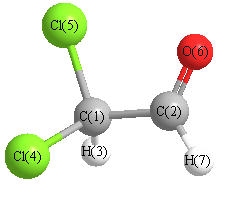 More geometry information
Calculated Bond Angles
| atom1 |
atom2 |
atom3 |
angle |
|
atom1 |
atom2 |
atom3 |
angle |
| C1 |
C2 |
O6 |
121.804 |
|
C1 |
C2 |
H7 |
114.905 |
| C2 |
C1 |
H3 |
109.798 |
|
C2 |
C1 |
Cl4 |
108.735 |
| C2 |
C1 |
Cl5 |
108.735 |
|
H3 |
C1 |
Cl4 |
108.783 |
| H3 |
C1 |
Cl5 |
108.783 |
|
Cl4 |
C1 |
Cl5 |
111.991 |
| O6 |
C2 |
H7 |
123.291 |
|
Electronic energy levels
Charges, Dipole, Quadrupole and Polarizability
Jump to
S1C1
Energy calculated at CID/6-31G*
| | hartrees |
|---|
| Energy at 0K | -1071.304623 |
| Energy at 298.15K | |
| HF Energy | -1070.698108 |
| Nuclear repulsion energy | 267.381198 |
The energy at 298.15K was derived from the energy at 0K
and an integrated heat capacity that used the calculated vibrational frequencies.
Vibrational Frequencies calculated at CID/6-31G*
| Mode Number |
Symmetry |
Frequency
(cm-1) |
Scaled Frequency
(cm-1) |
IR Intensities
(km mol-1) |
Raman Act
(Å4/u) |
Dep P |
Dep U |
|---|
| 1 |
A |
3255 |
3006 |
4.61 |
|
|
|
| 2 |
A |
3138 |
2899 |
42.67 |
|
|
|
| 3 |
A |
1964 |
1814 |
130.40 |
|
|
|
| 4 |
A |
1486 |
1373 |
17.20 |
|
|
|
| 5 |
A |
1371 |
1266 |
12.71 |
|
|
|
| 6 |
A |
1336 |
1234 |
16.22 |
|
|
|
| 7 |
A |
1112 |
1027 |
11.47 |
|
|
|
| 8 |
A |
1009 |
932 |
7.66 |
|
|
|
| 9 |
A |
900 |
832 |
78.47 |
|
|
|
| 10 |
A |
697 |
644 |
37.37 |
|
|
|
| 11 |
A |
649 |
599 |
29.08 |
|
|
|
| 12 |
A |
372 |
344 |
0.81 |
|
|
|
| 13 |
A |
295 |
273 |
3.82 |
|
|
|
| 14 |
A |
236 |
218 |
3.59 |
|
|
|
| 15 |
A |
83 |
77 |
13.23 |
|
|
|
Unscaled Zero Point Vibrational Energy (zpe) 8951.8 cm
-1
Scaled (by 0.9237) Zero Point Vibrational Energy (zpe) 8268.8 cm
-1
See section
III.C.1 List or set vibrational scaling factors
to change the scale factors used here.
See section
III.C.2
Calculate a vibrational scaling factor for a given set of molecules
to determine the least squares best scaling factor.
Geometric Data calculated at CID/6-31G*
Point Group is C1
Cartesians (Å)
| Atom |
x (Å) |
y (Å) |
z (Å) |
|---|
| C1 |
0.100 |
-0.037 |
0.504 |
| C2 |
-0.739 |
-1.265 |
0.167 |
| H3 |
0.210 |
0.027 |
1.581 |
| Cl4 |
1.728 |
-0.288 |
-0.160 |
| Cl5 |
-0.635 |
1.451 |
-0.057 |
| O6 |
-1.840 |
-1.223 |
-0.291 |
| H7 |
-0.233 |
-2.210 |
0.406 |
Atom - Atom Distances (Å)
| |
C1 |
C2 |
H3 |
Cl4 |
Cl5 |
O6 |
H7 |
| C1 | | 1.5253 | 1.0852 | 1.7752 | 1.7519 | 2.4089 | 2.2002 |
C2 | 1.5253 | | 2.1383 | 2.6734 | 2.7274 | 1.1932 | 1.0979 | H3 | 1.0852 | 2.1383 | | 2.3312 | 2.3291 | 3.0448 | 2.5654 | Cl4 | 1.7752 | 2.6734 | 2.3312 | | 2.9352 | 3.6907 | 2.8033 | Cl5 | 1.7519 | 2.7274 | 2.3291 | 2.9352 | | 2.9423 | 3.7117 | O6 | 2.4089 | 1.1932 | 3.0448 | 3.6907 | 2.9423 | | 2.0107 | H7 | 2.2002 | 1.0979 | 2.5654 | 2.8033 | 3.7117 | 2.0107 | |
More geometry information
Calculated Bond Angles
| atom1 |
atom2 |
atom3 |
angle |
|
atom1 |
atom2 |
atom3 |
angle |
| C1 |
C2 |
O6 |
124.330 |
|
C1 |
C2 |
H7 |
113.009 |
| C2 |
C1 |
H3 |
108.826 |
|
C2 |
C1 |
Cl4 |
107.954 |
| C2 |
C1 |
Cl5 |
112.478 |
|
H3 |
C1 |
Cl4 |
106.677 |
| H3 |
C1 |
Cl5 |
108.046 |
|
Cl4 |
C1 |
Cl5 |
112.647 |
| O6 |
C2 |
H7 |
122.652 |
|
Electronic energy levels
Charges, Dipole, Quadrupole and Polarizability
