Jump to
S1C2
Energy calculated at QCISD/6-31G*
| | hartrees |
|---|
| Energy at 0K | -1071.431934 |
| Energy at 298.15K | -1071.434470 |
| HF Energy | -1070.699001 |
| Nuclear repulsion energy | 262.925044 |
The energy at 298.15K was derived from the energy at 0K
and an integrated heat capacity that used the calculated vibrational frequencies.
Vibrational Frequencies calculated at QCISD/6-31G*
| Mode Number |
Symmetry |
Frequency
(cm-1) |
Scaled Frequency
(cm-1) |
IR Intensities
(km mol-1) |
Raman Act
(Å4/u) |
Dep P |
Dep U |
|---|
| 1 |
A' |
3202 |
3049 |
0.89 |
|
|
|
| 2 |
A' |
3036 |
2892 |
41.29 |
|
|
|
| 3 |
A' |
1835 |
1748 |
118.00 |
|
|
|
| 4 |
A' |
1435 |
1367 |
3.72 |
|
|
|
| 5 |
A' |
1264 |
1203 |
8.90 |
|
|
|
| 6 |
A' |
1106 |
1053 |
22.49 |
|
|
|
| 7 |
A' |
818 |
779 |
23.42 |
|
|
|
| 8 |
A' |
448 |
426 |
4.61 |
|
|
|
| 9 |
A' |
335 |
319 |
25.06 |
|
|
|
| 10 |
A' |
265 |
252 |
2.11 |
|
|
|
| 11 |
A" |
1308 |
1246 |
28.39 |
|
|
|
| 12 |
A" |
1031 |
982 |
22.21 |
|
|
|
| 13 |
A" |
784 |
747 |
97.32 |
|
|
|
| 14 |
A" |
287 |
274 |
2.45 |
|
|
|
| 15 |
A" |
71 |
68 |
8.97 |
|
|
|
Unscaled Zero Point Vibrational Energy (zpe) 8612.2 cm
-1
Scaled (by 0.9523) Zero Point Vibrational Energy (zpe) 8201.4 cm
-1
See section
III.C.1 List or set vibrational scaling factors
to change the scale factors used here.
See section
III.C.2
Calculate a vibrational scaling factor for a given set of molecules
to determine the least squares best scaling factor.
Geometric Data calculated at QCISD/6-31G*
Point Group is Cs
Cartesians (Å)
| Atom |
x (Å) |
y (Å) |
z (Å) |
|---|
| C1 |
0.381 |
-0.021 |
0.000 |
| C2 |
-0.173 |
1.401 |
0.000 |
| H3 |
1.471 |
0.006 |
0.000 |
| Cl4 |
-0.173 |
-0.845 |
1.474 |
| Cl5 |
-0.173 |
-0.845 |
-1.474 |
| O6 |
0.553 |
2.372 |
0.000 |
| H7 |
-1.277 |
1.467 |
0.000 |
Atom - Atom Distances (Å)
| |
C1 |
C2 |
H3 |
Cl4 |
Cl5 |
O6 |
H7 |
| C1 | | 1.5255 | 1.0898 | 1.7778 | 1.7778 | 2.3985 | 2.2279 |
C2 | 1.5255 | | 2.1553 | 2.6866 | 2.6866 | 1.2124 | 1.1062 | H3 | 1.0898 | 2.1553 | | 2.3663 | 2.3663 | 2.5369 | 3.1119 | Cl4 | 1.7778 | 2.6866 | 2.3663 | | 2.9488 | 3.6123 | 2.9565 | Cl5 | 1.7778 | 2.6866 | 2.3663 | 2.9488 | | 3.6123 | 2.9565 | O6 | 2.3985 | 1.2124 | 2.5369 | 3.6123 | 3.6123 | | 2.0416 | H7 | 2.2279 | 1.1062 | 3.1119 | 2.9565 | 2.9565 | 2.0416 | |
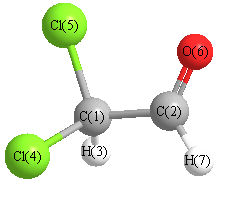 More geometry information
Calculated Bond Angles
| atom1 |
atom2 |
atom3 |
angle |
|
atom1 |
atom2 |
atom3 |
angle |
| C1 |
C2 |
O6 |
121.914 |
|
C1 |
C2 |
H7 |
114.739 |
| C2 |
C1 |
H3 |
109.873 |
|
C2 |
C1 |
Cl4 |
108.603 |
| C2 |
C1 |
Cl5 |
108.603 |
|
H3 |
C1 |
Cl4 |
108.841 |
| H3 |
C1 |
Cl5 |
108.841 |
|
Cl4 |
C1 |
Cl5 |
112.066 |
| O6 |
C2 |
H7 |
123.346 |
|
Electronic energy levels
Charges, Dipole, Quadrupole and Polarizability
Jump to
S1C1
Energy calculated at QCISD/6-31G*
| | hartrees |
|---|
| Energy at 0K | -1071.429748 |
| Energy at 298.15K | |
| HF Energy | -1070.696232 |
| Nuclear repulsion energy | 265.615032 |
The energy at 298.15K was derived from the energy at 0K
and an integrated heat capacity that used the calculated vibrational frequencies.
Vibrational Frequencies calculated at QCISD/6-31G*
| Mode Number |
Symmetry |
Frequency
(cm-1) |
Scaled Frequency
(cm-1) |
IR Intensities
(km mol-1) |
Raman Act
(Å4/u) |
Dep P |
Dep U |
|---|
| 1 |
A |
3149 |
2999 |
4.41 |
|
|
|
| 2 |
A |
3023 |
2879 |
48.86 |
|
|
|
| 3 |
A |
1842 |
1754 |
99.40 |
|
|
|
| 4 |
A |
1434 |
1366 |
12.84 |
|
|
|
| 5 |
A |
1319 |
1256 |
14.64 |
|
|
|
| 6 |
A |
1291 |
1229 |
12.92 |
|
|
|
| 7 |
A |
1061 |
1011 |
12.75 |
|
|
|
| 8 |
A |
968 |
922 |
6.87 |
|
|
|
| 9 |
A |
860 |
819 |
72.22 |
|
|
|
| 10 |
A |
672 |
640 |
33.03 |
|
|
|
| 11 |
A |
622 |
593 |
26.28 |
|
|
|
| 12 |
A |
359 |
342 |
0.85 |
|
|
|
| 13 |
A |
285 |
271 |
3.39 |
|
|
|
| 14 |
A |
229 |
218 |
3.19 |
|
|
|
| 15 |
A |
79 |
75 |
11.47 |
|
|
|
Unscaled Zero Point Vibrational Energy (zpe) 8596.0 cm
-1
Scaled (by 0.9523) Zero Point Vibrational Energy (zpe) 8185.9 cm
-1
See section
III.C.1 List or set vibrational scaling factors
to change the scale factors used here.
See section
III.C.2
Calculate a vibrational scaling factor for a given set of molecules
to determine the least squares best scaling factor.
Geometric Data calculated at QCISD/6-31G*
Point Group is C1
Cartesians (Å)
| Atom |
x (Å) |
y (Å) |
z (Å) |
|---|
| C1 |
0.104 |
-0.036 |
0.509 |
| C2 |
-0.738 |
-1.272 |
0.167 |
| H3 |
0.216 |
0.031 |
1.595 |
| Cl4 |
1.740 |
-0.287 |
-0.162 |
| Cl5 |
-0.642 |
1.456 |
-0.058 |
| O6 |
-1.857 |
-1.230 |
-0.291 |
| H7 |
-0.223 |
-2.224 |
0.400 |
Atom - Atom Distances (Å)
| |
C1 |
C2 |
H3 |
Cl4 |
Cl5 |
O6 |
H7 |
| C1 | | 1.5337 | 1.0937 | 1.7859 | 1.7618 | 2.4306 | 2.2150 |
C2 | 1.5337 | | 2.1552 | 2.6862 | 2.7389 | 1.2098 | 1.1070 | H3 | 1.0937 | 2.1552 | | 2.3473 | 2.3448 | 3.0722 | 2.5894 | Cl4 | 1.7859 | 2.6862 | 2.3473 | | 2.9532 | 3.7203 | 2.8145 | Cl5 | 1.7618 | 2.7389 | 2.3448 | 2.9532 | | 2.9569 | 3.7320 | O6 | 2.4306 | 1.2098 | 3.0722 | 3.7203 | 2.9569 | | 2.0332 | H7 | 2.2150 | 1.1070 | 2.5894 | 2.8145 | 3.7320 | 2.0332 | |
More geometry information
Calculated Bond Angles
| atom1 |
atom2 |
atom3 |
angle |
|
atom1 |
atom2 |
atom3 |
angle |
| C1 |
C2 |
O6 |
124.309 |
|
C1 |
C2 |
H7 |
113.030 |
| C2 |
C1 |
H3 |
109.078 |
|
C2 |
C1 |
Cl4 |
107.791 |
| C2 |
C1 |
Cl5 |
112.241 |
|
H3 |
C1 |
Cl4 |
106.728 |
| H3 |
C1 |
Cl5 |
108.117 |
|
Cl4 |
C1 |
Cl5 |
112.698 |
| O6 |
C2 |
H7 |
122.651 |
|
Electronic energy levels
Charges, Dipole, Quadrupole and Polarizability
