return to home page Computational Chemistry Comparison and Benchmark DataBase Release 22 (May 2022) Standard Reference Database 101 National Institute of Standards and Technology
You are here: Calculated > Energy > Optimized > Energy

All results from a given calculation for C3H4O2 (propenalol)

using model chemistry: CID/6-31G*

19 10 17 12 22

States and conformations

State Conformation minimum conformation conformer description state description
1 1 yes CS 1A'
Energy calculated at CID/6-31G*
 hartrees
Energy at 0K-266.264995
Energy at 298.15K-266.270126
HF Energy-265.630867
Nuclear repulsion energy164.800154
The energy at 298.15K was derived from the energy at 0K and an integrated heat capacity that used the calculated vibrational frequencies.
Vibrational Frequencies calculated at CID/6-31G*
Mode Number Symmetry Frequency
(cm-1)
Scaled Frequency
(cm-1)
IR Intensities
(km mol-1)
Raman Act
(Å4/u)
Dep P Dep U
1 A' 3639 3362 137.11      
2 A' 3356 3100 4.73      
3 A' 3325 3071 13.52      
4 A' 3142 2902 102.97      
5 A' 1865 1723 190.92      
6 A' 1750 1617 432.49      
7 A' 1560 1441 46.18      
8 A' 1499 1384 51.54      
9 A' 1486 1372 39.69      
10 A' 1351 1248 180.93      
11 A' 1182 1092 26.74      
12 A' 1034 955 78.47      
13 A' 932 861 15.50      
14 A' 522 482 23.59      
15 A' 291 269 4.74      
16 A" 1109 1024 9.32      
17 A" 1050 970 0.81      
18 A" 861 795 105.00      
19 A" 807 746 87.99      
20 A" 400 369 5.29      
21 A" 259 239 6.12      

Unscaled Zero Point Vibrational Energy (zpe) 15709.3 cm-1
Scaled (by 0.9237) Zero Point Vibrational Energy (zpe) 14510.7 cm-1
See section III.C.1 List or set vibrational scaling factors to change the scale factors used here.
See section III.C.2 Calculate a vibrational scaling factor for a given set of molecules to determine the least squares best scaling factor.
Rotational Constants (cm-1) from geometry optimized at CID/6-31G*
ABC
0.33429 0.16643 0.11111

See section I.F.4 to change rotational constant units
Geometric Data calculated at CID/6-31G*

Point Group is Cs

Cartesians (Å)
Atom x (Å) y (Å) z (Å)
C1 0.000 1.085 0.000
C2 1.249 0.354 0.000
C3 -1.178 0.430 0.000
O4 1.326 -0.867 0.000
O5 -1.331 -0.883 0.000
H6 -0.441 -1.287 0.000
H7 0.011 2.162 0.000
H8 2.172 0.946 0.000
H9 -2.123 0.954 0.000

Atom - Atom Distances (Å)
  C1 C2 C3 O4 O5 H6 H7 H8 H9
C11.44701.34762.35942.37592.41301.07722.17612.1271
C21.44702.42751.22312.86102.35572.19131.09673.4247
C31.34762.42752.81901.32181.86842.10083.38881.0809
O42.35941.22312.81902.65671.81613.30192.00073.8996
O52.37592.86101.32182.65670.97753.32773.95162.0002
H62.41302.35571.86841.81610.97753.47903.43742.8020
H71.07722.19132.10083.30193.32773.47902.47942.4523
H82.17611.09673.38882.00073.95163.43742.47944.2947
H92.12713.42471.08093.89962.00022.80202.45234.2947

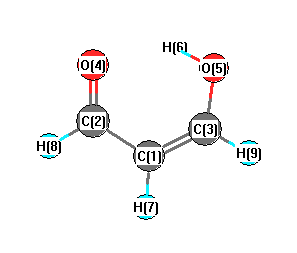
picture of propenalol state 1 conformation 1
More geometry information
Calculated Bond Angles
atom1 atom2 atom3 angle atom1 atom2 atom3 angle
C1 C2 O4 123.954 C1 C2 H8 116.957
C1 C3 O5 125.760 C1 C3 H9 121.915
C2 C1 C3 120.559 C2 C1 H7 119.771
C3 C1 H7 119.670 C3 O5 H6 107.766
O4 C2 H8 119.089 O5 C3 H9 112.325
Electronic energy levels
Charges, Dipole, Quadrupole and Polarizability
Charges from optimized geometry at CID/6-31G* Charges (e)
Number Element Mulliken CHELPG AIM ESP
1 C -0.450      
2 C 0.353      
3 C 0.271      
4 O -0.598      
5 O -0.710      
6 H 0.526      
7 H 0.212      
8 H 0.173      
9 H 0.223      


Electric dipole moments


Electric Quadrupole moment
Quadrupole components in D Å


Polarizabilities
Components of the polarizability tensor.
Units are Å3 (Angstrom cubed)
Change units.
  x y z
x 0.000 0.000 0.000
y 0.000 0.000 0.000
z 0.000 0.000 0.000


<r2> (average value of r2) Å2
<r2> 102.806
(<r2>)1/2 10.139