Jump to
S2C1
Energy calculated at MP2/CEP-31G
| | hartrees |
|---|
| Energy at 0K | -21.828666 |
| Energy at 298.15K | |
| HF Energy | -21.572103 |
| Nuclear repulsion energy | 26.815004 |
The energy at 298.15K was derived from the energy at 0K
and an integrated heat capacity that used the calculated vibrational frequencies.
Vibrational Frequencies calculated at MP2/CEP-31G
| Mode Number |
Symmetry |
Frequency
(cm-1) |
Scaled Frequency
(cm-1) |
IR Intensities
(km mol-1) |
Raman Act
(Å4/u) |
Dep P |
Dep U |
|---|
| 1 |
Σg |
2024 |
1956 |
0.00 |
122.38 |
0.43 |
0.60 |
| 2 |
Σg |
872 |
842 |
0.00 |
151.10 |
0.28 |
0.43 |
| 3 |
Σu |
1432 |
1384 |
637.87 |
0.00 |
0.33 |
0.50 |
| 4 |
Πg |
151 |
146 |
0.00 |
3.25 |
0.75 |
0.86 |
| 4 |
Πg |
151 |
146 |
0.00 |
3.25 |
0.75 |
0.86 |
| 5 |
Πu |
166 |
160 |
11.49 |
0.00 |
0.75 |
0.86 |
| 5 |
Πu |
166 |
160 |
11.49 |
0.00 |
0.75 |
0.86 |
Unscaled Zero Point Vibrational Energy (zpe) 2481.1 cm
-1
Scaled (by 0.9663) Zero Point Vibrational Energy (zpe) 2397.5 cm
-1
See section
III.C.1 List or set vibrational scaling factors
to change the scale factors used here.
See section
III.C.2
Calculate a vibrational scaling factor for a given set of molecules
to determine the least squares best scaling factor.
Geometric Data calculated at MP2/CEP-31G
Point Group is D∞h
Cartesians (Å)
| Atom |
x (Å) |
y (Å) |
z (Å) |
|---|
| C1 |
0.000 |
0.000 |
0.675 |
| C2 |
0.000 |
0.000 |
-0.675 |
| C3 |
0.000 |
0.000 |
2.054 |
| C4 |
0.000 |
0.000 |
-2.054 |
Atom - Atom Distances (Å)
| |
C1 |
C2 |
C3 |
C4 |
| C1 | | 1.3492 | 1.3797 | 2.7289 |
C2 | 1.3492 | | 2.7289 | 1.3797 | C3 | 1.3797 | 2.7289 | | 4.1086 | C4 | 2.7289 | 1.3797 | 4.1086 | |
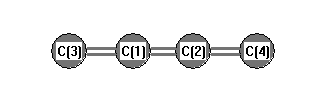 More geometry information
Calculated Bond Angles
| atom1 |
atom2 |
atom3 |
angle |
|
atom1 |
atom2 |
atom3 |
angle |
| C1 |
C2 |
C4 |
180.000 |
|
C2 |
C1 |
C3 |
180.000 |
Electronic energy levels
Charges, Dipole, Quadrupole and Polarizability
Jump to
S1C1
Energy calculated at MP2/CEP-31G
| | hartrees |
|---|
| Energy at 0K | -21.816938 |
| Energy at 298.15K | |
| HF Energy | -21.528117 |
| Nuclear repulsion energy | 26.655648 |
The energy at 298.15K was derived from the energy at 0K
and an integrated heat capacity that used the calculated vibrational frequencies.
Vibrational Frequencies calculated at MP2/CEP-31G
| Mode Number |
Symmetry |
Frequency
(cm-1) |
Scaled Frequency
(cm-1) |
IR Intensities
(km mol-1) |
Raman Act
(Å4/u) |
Dep P |
Dep U |
|---|
| 1 |
Σg |
1985 |
1918 |
0.00 |
0.75 |
0.75 |
0.86 |
| 2 |
Σg |
840 |
812 |
0.00 |
32.24 |
0.36 |
0.53 |
| 3 |
Σu |
1430 |
1382 |
458.33 |
0.00 |
0.33 |
0.50 |
| 4 |
Πg |
211 |
204 |
0.00 |
1.06 |
0.75 |
0.86 |
| 4 |
Πg |
254i |
245i |
0.00 |
7.04 |
0.75 |
0.86 |
| 5 |
Πu |
176 |
170 |
24.90 |
0.00 |
0.75 |
0.86 |
| 5 |
Πu |
160 |
154 |
2.34 |
0.00 |
0.00 |
0.00 |
Unscaled Zero Point Vibrational Energy (zpe) 2274.0 cm
-1
Scaled (by 0.9663) Zero Point Vibrational Energy (zpe) 2197.4 cm
-1
See section
III.C.1 List or set vibrational scaling factors
to change the scale factors used here.
See section
III.C.2
Calculate a vibrational scaling factor for a given set of molecules
to determine the least squares best scaling factor.
Geometric Data calculated at MP2/CEP-31G
Point Group is D∞h
Cartesians (Å)
| Atom |
x (Å) |
y (Å) |
z (Å) |
|---|
| C1 |
0.000 |
0.000 |
0.680 |
| C2 |
0.000 |
0.000 |
-0.680 |
| C3 |
0.000 |
0.000 |
2.066 |
| C4 |
0.000 |
0.000 |
-2.066 |
Atom - Atom Distances (Å)
| |
C1 |
C2 |
C3 |
C4 |
| C1 | | 1.3598 | 1.3864 | 2.7462 |
C2 | 1.3598 | | 2.7462 | 1.3864 | C3 | 1.3864 | 2.7462 | | 4.1326 | C4 | 2.7462 | 1.3864 | 4.1326 | |
More geometry information
Electronic energy levels
Charges, Dipole, Quadrupole and Polarizability
