Jump to
S2C1
Energy calculated at MP2/CEP-31G
| | hartrees |
|---|
| Energy at 0K | -20.680096 |
| Energy at 298.15K | -20.679911 |
| HF Energy | -20.582067 |
| Nuclear repulsion energy | 11.482022 |
The energy at 298.15K was derived from the energy at 0K
and an integrated heat capacity that used the calculated vibrational frequencies.
Geometric Data calculated at MP2/CEP-31G
Point Group is Cs
Cartesians (Å)
| Atom |
x (Å) |
y (Å) |
z (Å) |
|---|
| C1 |
0.047 |
1.297 |
0.000 |
| Cl2 |
0.047 |
-0.547 |
0.000 |
| H3 |
-1.070 |
1.511 |
0.000 |
Atom - Atom Distances (Å)
| |
C1 |
Cl2 |
H3 |
| C1 | | 1.8431 | 1.1375 |
Cl2 | 1.8431 | | 2.3414 | H3 | 1.1375 | 2.3414 | |
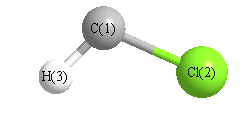 More geometry information
Calculated Bond Angles
| atom1 |
atom2 |
atom3 |
angle |
|
atom1 |
atom2 |
atom3 |
angle |
| Cl2 |
C1 |
H3 |
100.880 |
|
Electronic energy levels
Charges, Dipole, Quadrupole and Polarizability
Jump to
S1C1
Energy calculated at MP2/CEP-31G
| | hartrees |
|---|
| Energy at 0K | -20.692319 |
| Energy at 298.15K | -20.692145 |
| HF Energy | -20.615221 |
| Nuclear repulsion energy | 11.623837 |
The energy at 298.15K was derived from the energy at 0K
and an integrated heat capacity that used the calculated vibrational frequencies.
Geometric Data calculated at MP2/CEP-31G
Point Group is Cs
Cartesians (Å)
| Atom |
x (Å) |
y (Å) |
z (Å) |
|---|
| C1 |
0.038 |
1.244 |
0.000 |
| Cl2 |
0.038 |
-0.549 |
0.000 |
| H3 |
-0.874 |
1.862 |
0.000 |
Atom - Atom Distances (Å)
| |
C1 |
Cl2 |
H3 |
| C1 | | 1.7924 | 1.1022 |
Cl2 | 1.7924 | | 2.5777 | H3 | 1.1022 | 2.5777 | |
More geometry information
Calculated Bond Angles
| atom1 |
atom2 |
atom3 |
angle |
|
atom1 |
atom2 |
atom3 |
angle |
| Cl2 |
C1 |
H3 |
124.133 |
|
Electronic energy levels
Charges, Dipole, Quadrupole and Polarizability
