Jump to
S1C2
Energy calculated at HF/CEP-31G*
| | hartrees |
|---|
| Energy at 0K | -30.972244 |
| Energy at 298.15K | -30.974743 |
| HF Energy | -30.972244 |
| Nuclear repulsion energy | 33.094330 |
The energy at 298.15K was derived from the energy at 0K
and an integrated heat capacity that used the calculated vibrational frequencies.
Vibrational Frequencies calculated at HF/CEP-31G*
| Mode Number |
Symmetry |
Frequency
(cm-1) |
Scaled Frequency
(cm-1) |
IR Intensities
(km mol-1) |
Raman Act
(Å4/u) |
Dep P |
Dep U |
|---|
| 1 |
A |
2887 |
2593 |
1.59 |
|
|
|
| 2 |
A |
989 |
888 |
0.74 |
|
|
|
| 3 |
A |
545 |
490 |
0.95 |
|
|
|
| 4 |
A |
308 |
277 |
37.04 |
|
|
|
| 5 |
A |
222 |
199 |
0.10 |
|
|
|
| 6 |
B |
2887 |
2593 |
21.09 |
|
|
|
| 7 |
B |
979 |
879 |
20.61 |
|
|
|
| 8 |
B |
569 |
511 |
14.46 |
|
|
|
| 9 |
B |
339 |
304 |
25.83 |
|
|
|
Unscaled Zero Point Vibrational Energy (zpe) 4862.3 cm
-1
Scaled (by 0.898) Zero Point Vibrational Energy (zpe) 4366.4 cm
-1
See section
III.C.1 List or set vibrational scaling factors
to change the scale factors used here.
See section
III.C.2
Calculate a vibrational scaling factor for a given set of molecules
to determine the least squares best scaling factor.
Geometric Data calculated at HF/CEP-31G*
Point Group is C2
Cartesians (Å)
| Atom |
x (Å) |
y (Å) |
z (Å) |
|---|
| S1 |
0.000 |
0.000 |
0.852 |
| S2 |
0.000 |
1.664 |
-0.388 |
| S3 |
0.000 |
-1.664 |
-0.388 |
| H4 |
-1.318 |
1.754 |
-0.602 |
| H5 |
1.318 |
-1.754 |
-0.602 |
Atom - Atom Distances (Å)
| |
S1 |
S2 |
S3 |
H4 |
H5 |
| S1 | | 2.0750 | 2.0750 | 2.6325 | 2.6325 |
S2 | 2.0750 | | 3.3272 | 1.3387 | 3.6695 | S3 | 2.0750 | 3.3272 | | 3.6695 | 1.3387 | H4 | 2.6325 | 1.3387 | 3.6695 | | 4.3888 | H5 | 2.6325 | 3.6695 | 1.3387 | 4.3888 | |
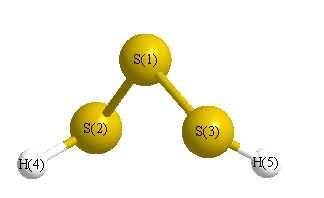 More geometry information
Calculated Bond Angles
| atom1 |
atom2 |
atom3 |
angle |
|
atom1 |
atom2 |
atom3 |
angle |
| S1 |
S2 |
H4 |
98.616 |
|
S1 |
S3 |
H5 |
98.616 |
| S2 |
S1 |
S3 |
106.593 |
|
Electronic energy levels
Charges, Dipole, Quadrupole and Polarizability
Charges from optimized geometry at HF/CEP-31G*
Charges (e)
| Number |
Element |
Mulliken |
CHELPG |
AIM |
ESP |
| 1 |
S |
-0.030 |
|
|
|
| 2 |
S |
-0.109 |
|
|
|
| 3 |
S |
-0.109 |
|
|
|
| 4 |
H |
0.124 |
|
|
|
| 5 |
H |
0.124 |
|
|
|
Electric dipole moments
Electric dipole components in Debye
(What's a Debye? See section
VII.A.3)
| |
x |
y |
z |
Total |
| |
0.000 |
0.000 |
-0.764 |
0.764 |
| CHELPG |
|
|
|
|
| AIM |
|
|
|
|
| ESP |
|
|
|
|
Electric Quadrupole moment
Quadrupole components in D Å
| Primitive |
|---|
| | x | y | z |
|---|
| x |
-35.023 |
-4.767 |
0.000 |
| y |
-4.767 |
-38.160 |
0.000 |
| z |
0.000 |
0.000 |
-40.000 |
|
| Traceless |
|---|
| | x | y | z |
|---|
| x |
4.057 |
-4.767 |
0.000 |
| y |
-4.767 |
-0.648 |
0.000 |
| z |
0.000 |
0.000 |
-3.409 |
|
| Polar |
|---|
| 3z2-r2 | -6.818 |
|---|
| x2-y2 | 3.137 |
|---|
| xy | -4.767 |
|---|
| xz | 0.000 |
|---|
| yz | 0.000 |
|---|
|
Polarizabilities
Components of the polarizability tensor.
Units are
Å
3 (Angstrom cubed)
Change units.
| |
x |
y |
z |
| x |
4.767 |
-0.608 |
0.000 |
| y |
-0.608 |
10.033 |
0.000 |
| z |
0.000 |
0.000 |
5.570 |
<r2> (average value of r
2) Å
2
| <r2> |
73.295 |
| (<r2>)1/2 |
8.561 |
Jump to
S1C1
Energy calculated at HF/CEP-31G*
| | hartrees |
|---|
| Energy at 0K | -30.971603 |
| Energy at 298.15K | -30.974100 |
| HF Energy | -30.971603 |
| Nuclear repulsion energy | 33.091948 |
The energy at 298.15K was derived from the energy at 0K
and an integrated heat capacity that used the calculated vibrational frequencies.
Vibrational Frequencies calculated at HF/CEP-31G*
| Mode Number |
Symmetry |
Frequency
(cm-1) |
Scaled Frequency
(cm-1) |
IR Intensities
(km mol-1) |
Raman Act
(Å4/u) |
Dep P |
Dep U |
|---|
| 1 |
A' |
2883 |
2589 |
28.94 |
|
|
|
| 2 |
A' |
992 |
890 |
14.89 |
|
|
|
| 3 |
A' |
545 |
489 |
0.73 |
|
|
|
| 4 |
A' |
338 |
303 |
27.81 |
|
|
|
| 5 |
A' |
225 |
202 |
0.23 |
|
|
|
| 6 |
A" |
2885 |
2590 |
2.77 |
|
|
|
| 7 |
A" |
983 |
883 |
10.15 |
|
|
|
| 8 |
A" |
569 |
511 |
15.92 |
|
|
|
| 9 |
A" |
302 |
271 |
15.06 |
|
|
|
Unscaled Zero Point Vibrational Energy (zpe) 4860.6 cm
-1
Scaled (by 0.898) Zero Point Vibrational Energy (zpe) 4364.8 cm
-1
See section
III.C.1 List or set vibrational scaling factors
to change the scale factors used here.
See section
III.C.2
Calculate a vibrational scaling factor for a given set of molecules
to determine the least squares best scaling factor.
Geometric Data calculated at HF/CEP-31G*
Point Group is Cs
Cartesians (Å)
| Atom |
x (Å) |
y (Å) |
z (Å) |
|---|
| S1 |
-0.053 |
0.848 |
0.000 |
| S2 |
-0.053 |
-0.391 |
1.665 |
| S3 |
-0.053 |
-0.391 |
-1.665 |
| H4 |
1.271 |
-0.523 |
1.815 |
| H5 |
1.271 |
-0.523 |
-1.815 |
Atom - Atom Distances (Å)
| |
S1 |
S2 |
S3 |
H4 |
H5 |
| S1 | | 2.0748 | 2.0748 | 2.6315 | 2.6315 |
S2 | 2.0748 | | 3.3290 | 1.3390 | 3.7252 | S3 | 2.0748 | 3.3290 | | 3.7252 | 1.3390 | H4 | 2.6315 | 1.3390 | 3.7252 | | 3.6300 | H5 | 2.6315 | 3.7252 | 1.3390 | 3.6300 | |
More geometry information
Calculated Bond Angles
| atom1 |
atom2 |
atom3 |
angle |
|
atom1 |
atom2 |
atom3 |
angle |
| S1 |
S2 |
H4 |
98.560 |
|
S1 |
S3 |
H5 |
98.560 |
| S2 |
S1 |
S3 |
106.689 |
|
Electronic energy levels
Charges, Dipole, Quadrupole and Polarizability
Charges from optimized geometry at HF/CEP-31G*
Charges (e)
| Number |
Element |
Mulliken |
CHELPG |
AIM |
ESP |
| 1 |
S |
-0.031 |
|
|
|
| 2 |
S |
-0.100 |
|
|
|
| 3 |
S |
-0.100 |
|
|
|
| 4 |
H |
0.116 |
|
|
|
| 5 |
H |
0.116 |
|
|
|
Electric dipole moments
Electric dipole components in Debye
(What's a Debye? See section
VII.A.3)
| |
x |
y |
z |
Total |
| |
2.304 |
-0.615 |
0.000 |
2.384 |
| CHELPG |
|
|
|
|
| AIM |
|
|
|
|
| ESP |
|
|
|
|
Electric Quadrupole moment
Quadrupole components in D Å
| Primitive |
|---|
| | x | y | z |
|---|
| x |
-35.257 |
-1.785 |
0.000 |
| y |
-1.785 |
-40.247 |
0.000 |
| z |
0.000 |
0.000 |
-37.746 |
|
| Traceless |
|---|
| | x | y | z |
|---|
| x |
3.740 |
-1.785 |
0.000 |
| y |
-1.785 |
-3.745 |
0.000 |
| z |
0.000 |
0.000 |
0.006 |
|
| Polar |
|---|
| 3z2-r2 | 0.011 |
|---|
| x2-y2 | 4.990 |
|---|
| xy | -1.785 |
|---|
| xz | 0.000 |
|---|
| yz | 0.000 |
|---|
|
Polarizabilities
Components of the polarizability tensor.
Units are
Å
3 (Angstrom cubed)
Change units.
| |
x |
y |
z |
| x |
4.757 |
-0.348 |
0.000 |
| y |
-0.348 |
5.509 |
0.000 |
| z |
0.000 |
0.000 |
10.080 |
<r2> (average value of r
2) Å
2
| <r2> |
73.387 |
| (<r2>)1/2 |
8.567 |
