Jump to
S1C2
S1C3
Energy calculated at B3LYP/CEP-31G*
| | hartrees |
|---|
| Energy at 0K | -15.743880 |
| Energy at 298.15K | -15.743162 |
| HF Energy | -15.743880 |
| Nuclear repulsion energy | 10.552804 |
The energy at 298.15K was derived from the energy at 0K
and an integrated heat capacity that used the calculated vibrational frequencies.
Geometric Data calculated at B3LYP/CEP-31G*
Point Group is C∞v
Cartesians (Å)
| Atom |
x (Å) |
y (Å) |
z (Å) |
|---|
| C1 |
0.000 |
0.000 |
-0.708 |
| N2 |
0.000 |
0.000 |
-1.900 |
| Na3 |
0.000 |
0.000 |
1.595 |
Atom - Atom Distances (Å)
| |
C1 |
N2 |
Na3 |
| C1 | | 1.1923 | 2.3025 |
N2 | 1.1923 | | 3.4948 | Na3 | 2.3025 | 3.4948 | |
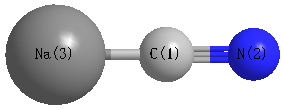 More geometry information
Calculated Bond Angles
| atom1 |
atom2 |
atom3 |
angle |
|
atom1 |
atom2 |
atom3 |
angle |
| C1 |
N2 |
Na3 |
0.000 |
|
C1 |
Na3 |
N2 |
0.000 |
| N2 |
C1 |
Na3 |
180.000 |
|
Electronic energy levels
Charges, Dipole, Quadrupole and Polarizability
Charges from optimized geometry at B3LYP/CEP-31G*
Charges (e)
| Number |
Element |
Mulliken |
CHELPG |
AIM |
ESP |
| 1 |
C |
-0.713 |
|
|
|
| 2 |
N |
0.168 |
|
|
|
| 3 |
Na |
0.545 |
|
|
|
Electric dipole moments
Electric dipole components in Debye
(What's a Debye? See section
VII.A.3)
| |
x |
y |
z |
Total |
| |
0.000 |
0.000 |
11.050 |
11.050 |
| CHELPG |
|
|
|
|
| AIM |
|
|
|
|
| ESP |
|
|
|
|
Electric Quadrupole moment
Quadrupole components in D Å
| Primitive |
|---|
| | x | y | z |
|---|
| x |
-14.510 |
0.000 |
0.000 |
| y |
0.000 |
-14.510 |
0.000 |
| z |
0.000 |
0.000 |
-9.930 |
|
| Traceless |
|---|
| | x | y | z |
|---|
| x |
-2.290 |
0.000 |
0.000 |
| y |
0.000 |
-2.290 |
0.000 |
| z |
0.000 |
0.000 |
4.580 |
|
| Polar |
|---|
| 3z2-r2 | 9.159 |
|---|
| x2-y2 | 0.000 |
|---|
| xy | 0.000 |
|---|
| xz | 0.000 |
|---|
| yz | 0.000 |
|---|
|
Polarizabilities
Components of the polarizability tensor.
Units are
Å
3 (Angstrom cubed)
Change units.
| |
x |
y |
z |
| x |
2.770 |
0.000 |
0.000 |
| y |
0.000 |
2.770 |
0.000 |
| z |
0.000 |
0.000 |
5.768 |
<r2> (average value of r
2) Å
2
| <r2> |
30.703 |
| (<r2>)1/2 |
5.541 |
Jump to
S1C1
S1C3
Energy calculated at B3LYP/CEP-31G*
| | hartrees |
|---|
| Energy at 0K | -15.750271 |
| Energy at 298.15K | -15.749970 |
| HF Energy | -15.750271 |
| Nuclear repulsion energy | 10.833298 |
The energy at 298.15K was derived from the energy at 0K
and an integrated heat capacity that used the calculated vibrational frequencies.
Geometric Data calculated at B3LYP/CEP-31G*
Point Group is Cs
Cartesians (Å)
| Atom |
x (Å) |
y (Å) |
z (Å) |
|---|
| C1 |
1.121 |
0.678 |
0.000 |
| N2 |
0.000 |
1.109 |
0.000 |
| Na3 |
-0.612 |
-1.076 |
0.000 |
Atom - Atom Distances (Å)
| |
C1 |
N2 |
Na3 |
| C1 | | 1.2015 | 2.4653 |
N2 | 1.2015 | | 2.2687 | Na3 | 2.4653 | 2.2687 | |
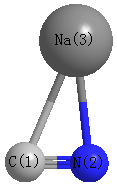 More geometry information
Calculated Bond Angles
| atom1 |
atom2 |
atom3 |
angle |
|
atom1 |
atom2 |
atom3 |
angle |
| C1 |
N2 |
Na3 |
84.602 |
|
C1 |
Na3 |
N2 |
29.027 |
| N2 |
C1 |
Na3 |
66.371 |
|
Electronic energy levels
Charges, Dipole, Quadrupole and Polarizability
Charges from optimized geometry at B3LYP/CEP-31G*
Charges (e)
| Number |
Element |
Mulliken |
CHELPG |
AIM |
ESP |
| 1 |
C |
-0.491 |
|
|
|
| 2 |
N |
-0.024 |
|
|
|
| 3 |
Na |
0.515 |
|
|
|
Electric dipole moments
Electric dipole components in Debye
(What's a Debye? See section
VII.A.3)
| |
x |
y |
z |
Total |
| |
-4.823 |
-7.717 |
0.000 |
9.100 |
| CHELPG |
|
|
|
|
| AIM |
|
|
|
|
| ESP |
|
|
|
|
Electric Quadrupole moment
Quadrupole components in D Å
| Primitive |
|---|
| | x | y | z |
|---|
| x |
-17.141 |
3.441 |
0.000 |
| y |
3.441 |
-11.215 |
0.000 |
| z |
0.000 |
0.000 |
-14.674 |
|
| Traceless |
|---|
| | x | y | z |
|---|
| x |
-4.197 |
3.441 |
0.000 |
| y |
3.441 |
4.693 |
0.000 |
| z |
0.000 |
0.000 |
-0.496 |
|
| Polar |
|---|
| 3z2-r2 | -0.991 |
|---|
| x2-y2 | -5.926 |
|---|
| xy | 3.441 |
|---|
| xz | 0.000 |
|---|
| yz | 0.000 |
|---|
|
Polarizabilities
Components of the polarizability tensor.
Units are
Å
3 (Angstrom cubed)
Change units.
| |
x |
y |
z |
| x |
4.308 |
-0.048 |
0.000 |
| y |
-0.048 |
3.714 |
0.000 |
| z |
0.000 |
0.000 |
3.080 |
<r2> (average value of r
2) Å
2
| <r2> |
23.508 |
| (<r2>)1/2 |
4.849 |
Jump to
S1C1
S1C2
Energy calculated at B3LYP/CEP-31G*
| | hartrees |
|---|
| Energy at 0K | -15.746176 |
| Energy at 298.15K | |
| HF Energy | -15.746176 |
| Nuclear repulsion energy | 10.649702 |
The energy at 298.15K was derived from the energy at 0K
and an integrated heat capacity that used the calculated vibrational frequencies.
Geometric Data calculated at B3LYP/CEP-31G*
Point Group is C∞v
Cartesians (Å)
| Atom |
x (Å) |
y (Å) |
z (Å) |
|---|
| C1 |
0.000 |
0.000 |
-1.896 |
| N2 |
0.000 |
0.000 |
-0.694 |
| Na3 |
0.000 |
0.000 |
1.476 |
Atom - Atom Distances (Å)
| |
C1 |
N2 |
Na3 |
| C1 | | 1.2023 | 3.3727 |
N2 | 1.2023 | | 2.1705 | Na3 | 3.3727 | 2.1705 | |
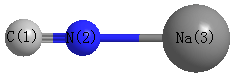 More geometry information
Calculated Bond Angles
| atom1 |
atom2 |
atom3 |
angle |
|
atom1 |
atom2 |
atom3 |
angle |
| C1 |
N2 |
Na3 |
180.000 |
|
C1 |
Na3 |
N2 |
0.000 |
| N2 |
C1 |
Na3 |
0.000 |
|
Electronic energy levels
Charges, Dipole, Quadrupole and Polarizability
Charges from optimized geometry at B3LYP/CEP-31G*
Charges (e)
| Number |
Element |
Mulliken |
CHELPG |
AIM |
ESP |
| 1 |
C |
-0.518 |
|
|
|
| 2 |
N |
-0.090 |
|
|
|
| 3 |
Na |
0.607 |
|
|
|
Electric dipole moments
Electric dipole components in Debye
(What's a Debye? See section
VII.A.3)
| |
x |
y |
z |
Total |
| |
0.000 |
0.000 |
11.145 |
11.145 |
| CHELPG |
|
|
|
|
| AIM |
|
|
|
|
| ESP |
|
|
|
|
Electric Quadrupole moment
Quadrupole components in D Å
| Primitive |
|---|
| | x | y | z |
|---|
| x |
-14.343 |
0.000 |
0.000 |
| y |
0.000 |
-14.343 |
0.000 |
| z |
0.000 |
0.000 |
-12.828 |
|
| Traceless |
|---|
| | x | y | z |
|---|
| x |
-0.758 |
0.000 |
0.000 |
| y |
0.000 |
-0.758 |
0.000 |
| z |
0.000 |
0.000 |
1.515 |
|
| Polar |
|---|
| 3z2-r2 | 3.031 |
|---|
| x2-y2 | 0.000 |
|---|
| xy | 0.000 |
|---|
| xz | 0.000 |
|---|
| yz | 0.000 |
|---|
|
Polarizabilities
Components of the polarizability tensor.
Units are
Å
3 (Angstrom cubed)
Change units.
| |
x |
y |
z |
| x |
2.683 |
0.000 |
-0.000 |
| y |
0.000 |
2.683 |
0.000 |
| z |
-0.000 |
0.000 |
5.763 |
<r2> (average value of r
2) Å
2
| <r2> |
27.619 |
| (<r2>)1/2 |
5.255 |
