Jump to
S1C2
Energy calculated at B3LYP/CEP-31G*
| | hartrees |
|---|
| Energy at 0K | -22.718955 |
| Energy at 298.15K | -22.720360 |
| HF Energy | -22.718955 |
| Nuclear repulsion energy | 17.602970 |
The energy at 298.15K was derived from the energy at 0K
and an integrated heat capacity that used the calculated vibrational frequencies.
Vibrational Frequencies calculated at B3LYP/CEP-31G*
| Mode Number |
Symmetry |
Frequency
(cm-1) |
Scaled Frequency
(cm-1) |
IR Intensities
(km mol-1) |
Raman Act
(Å4/u) |
Dep P |
Dep U |
|---|
| 1 |
A' |
3709 |
3581 |
49.12 |
|
|
|
| 2 |
A' |
2873 |
2775 |
168.24 |
|
|
|
| 3 |
A' |
1515 |
1463 |
43.92 |
|
|
|
| 4 |
A' |
1297 |
1253 |
84.55 |
|
|
|
| 5 |
A' |
1210 |
1169 |
129.35 |
|
|
|
| 6 |
A" |
1076 |
1039 |
135.38 |
|
|
|
Unscaled Zero Point Vibrational Energy (zpe) 5840.2 cm
-1
Scaled (by 0.9657) Zero Point Vibrational Energy (zpe) 5639.9 cm
-1
See section
III.C.1 List or set vibrational scaling factors
to change the scale factors used here.
See section
III.C.2
Calculate a vibrational scaling factor for a given set of molecules
to determine the least squares best scaling factor.
Geometric Data calculated at B3LYP/CEP-31G*
Point Group is Cs
Cartesians (Å)
| Atom |
x (Å) |
y (Å) |
z (Å) |
|---|
| C1 |
0.011 |
0.757 |
0.000 |
| O2 |
0.011 |
-0.580 |
0.000 |
| H3 |
-1.095 |
0.976 |
0.000 |
| H4 |
0.945 |
-0.874 |
0.000 |
Atom - Atom Distances (Å)
| |
C1 |
O2 |
H3 |
H4 |
| C1 | | 1.3366 | 1.1272 | 1.8796 |
O2 | 1.3366 | | 1.9089 | 0.9795 | H3 | 1.1272 | 1.9089 | | 2.7541 | H4 | 1.8796 | 0.9795 | 2.7541 | |
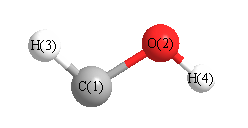 More geometry information
Calculated Bond Angles
| atom1 |
atom2 |
atom3 |
angle |
|
atom1 |
atom2 |
atom3 |
angle |
| C1 |
O2 |
H4 |
107.488 |
|
O2 |
C1 |
H3 |
101.227 |
Electronic energy levels
Charges, Dipole, Quadrupole and Polarizability
Charges from optimized geometry at B3LYP/CEP-31G*
Charges (e)
| Number |
Element |
Mulliken |
CHELPG |
AIM |
ESP |
| 1 |
C |
-0.304 |
|
|
|
| 2 |
O |
-0.257 |
|
|
|
| 3 |
H |
0.147 |
|
|
|
| 4 |
H |
0.414 |
|
|
|
Electric dipole moments
Electric dipole components in Debye
(What's a Debye? See section
VII.A.3)
| |
x |
y |
z |
Total |
| |
0.154 |
-1.585 |
0.000 |
1.592 |
| CHELPG |
|
|
|
|
| AIM |
|
|
|
|
| ESP |
|
|
|
|
Electric Quadrupole moment
Quadrupole components in D Å
| Primitive |
|---|
| | x | y | z |
|---|
| x |
-10.832 |
-3.945 |
0.000 |
| y |
-3.945 |
-13.841 |
0.000 |
| z |
0.000 |
0.000 |
-11.990 |
|
| Traceless |
|---|
| | x | y | z |
|---|
| x |
2.083 |
-3.945 |
0.000 |
| y |
-3.945 |
-2.430 |
0.000 |
| z |
0.000 |
0.000 |
0.346 |
|
| Polar |
|---|
| 3z2-r2 | 0.693 |
|---|
| x2-y2 | 3.009 |
|---|
| xy | -3.945 |
|---|
| xz | 0.000 |
|---|
| yz | 0.000 |
|---|
|
Polarizabilities
Components of the polarizability tensor.
Units are
Å
3 (Angstrom cubed)
Change units.
| |
x |
y |
z |
| x |
2.302 |
-0.537 |
0.000 |
| y |
-0.537 |
2.583 |
0.000 |
| z |
0.000 |
0.000 |
1.640 |
<r2> (average value of r
2) Å
2
| <r2> |
15.751 |
| (<r2>)1/2 |
3.969 |
Jump to
S1C1
Energy calculated at B3LYP/CEP-31G*
| | hartrees |
|---|
| Energy at 0K | -22.708880 |
| Energy at 298.15K | -22.710267 |
| HF Energy | -22.708880 |
| Nuclear repulsion energy | 17.545723 |
The energy at 298.15K was derived from the energy at 0K
and an integrated heat capacity that used the calculated vibrational frequencies.
Vibrational Frequencies calculated at B3LYP/CEP-31G*
| Mode Number |
Symmetry |
Frequency
(cm-1) |
Scaled Frequency
(cm-1) |
IR Intensities
(km mol-1) |
Raman Act
(Å4/u) |
Dep P |
Dep U |
|---|
| 1 |
A' |
3510 |
3389 |
20.19 |
|
|
|
| 2 |
A' |
2773 |
2678 |
255.57 |
|
|
|
| 3 |
A' |
1469 |
1419 |
60.52 |
|
|
|
| 4 |
A' |
1299 |
1255 |
75.49 |
|
|
|
| 5 |
A' |
1201 |
1160 |
29.00 |
|
|
|
| 6 |
A" |
984 |
950 |
30.30 |
|
|
|
Unscaled Zero Point Vibrational Energy (zpe) 5618.1 cm
-1
Scaled (by 0.9657) Zero Point Vibrational Energy (zpe) 5425.4 cm
-1
See section
III.C.1 List or set vibrational scaling factors
to change the scale factors used here.
See section
III.C.2
Calculate a vibrational scaling factor for a given set of molecules
to determine the least squares best scaling factor.
Geometric Data calculated at B3LYP/CEP-31G*
Point Group is Cs
Cartesians (Å)
| Atom |
x (Å) |
y (Å) |
z (Å) |
|---|
| C1 |
0.124 |
0.756 |
0.000 |
| O2 |
0.124 |
-0.575 |
0.000 |
| H3 |
-0.966 |
1.075 |
0.000 |
| H4 |
-0.764 |
-1.010 |
0.000 |
Atom - Atom Distances (Å)
| |
C1 |
O2 |
H3 |
H4 |
| C1 | | 1.3314 | 1.1351 | 1.9769 |
O2 | 1.3314 | | 1.9773 | 0.9882 | H3 | 1.1351 | 1.9773 | | 2.0950 | H4 | 1.9769 | 0.9882 | 2.0950 | |
More geometry information
Calculated Bond Angles
| atom1 |
atom2 |
atom3 |
angle |
|
atom1 |
atom2 |
atom3 |
angle |
| C1 |
O2 |
H4 |
116.124 |
|
O2 |
C1 |
H3 |
106.307 |
Electronic energy levels
Charges, Dipole, Quadrupole and Polarizability
Charges from optimized geometry at B3LYP/CEP-31G*
Charges (e)
| Number |
Element |
Mulliken |
CHELPG |
AIM |
ESP |
| 1 |
C |
-0.239 |
|
|
|
| 2 |
O |
-0.243 |
|
|
|
| 3 |
H |
0.108 |
|
|
|
| 4 |
H |
0.374 |
|
|
|
Electric dipole moments
Electric dipole components in Debye
(What's a Debye? See section
VII.A.3)
| |
x |
y |
z |
Total |
| |
-3.311 |
-1.652 |
0.000 |
3.700 |
| CHELPG |
|
|
|
|
| AIM |
|
|
|
|
| ESP |
|
|
|
|
Electric Quadrupole moment
Quadrupole components in D Å
| Primitive |
|---|
| | x | y | z |
|---|
| x |
-12.196 |
-0.272 |
0.000 |
| y |
-0.272 |
-13.221 |
0.000 |
| z |
0.000 |
0.000 |
-11.921 |
|
| Traceless |
|---|
| | x | y | z |
|---|
| x |
0.375 |
-0.272 |
0.000 |
| y |
-0.272 |
-1.163 |
0.000 |
| z |
0.000 |
0.000 |
0.788 |
|
| Polar |
|---|
| 3z2-r2 | 1.576 |
|---|
| x2-y2 | 1.025 |
|---|
| xy | -0.272 |
|---|
| xz | 0.000 |
|---|
| yz | 0.000 |
|---|
|
Polarizabilities
Components of the polarizability tensor.
Units are
Å
3 (Angstrom cubed)
Change units.
| |
x |
y |
z |
| x |
2.245 |
0.078 |
0.000 |
| y |
0.078 |
3.020 |
0.000 |
| z |
0.000 |
0.000 |
1.670 |
<r2> (average value of r
2) Å
2
| <r2> |
15.891 |
| (<r2>)1/2 |
3.986 |
