Jump to
S2C1
Energy calculated at B3LYP/CEP-31G*
| | hartrees |
|---|
| Energy at 0K | -12.347170 |
| Energy at 298.15K | -12.346883 |
| Nuclear repulsion energy | 12.436096 |
The energy at 298.15K was derived from the energy at 0K
and an integrated heat capacity that used the calculated vibrational frequencies.
Vibrational Frequencies calculated at B3LYP/CEP-31G*
| Mode Number |
Symmetry |
Frequency
(cm-1) |
Scaled Frequency
(cm-1) |
IR Intensities
(km mol-1) |
Raman Act
(Å4/u) |
Dep P |
Dep U |
|---|
| 1 |
A1 |
3129 |
3021 |
24.62 |
|
|
|
| 2 |
A1 |
1704 |
1646 |
75.04 |
|
|
|
| 3 |
A1 |
1218 |
1177 |
19.21 |
|
|
|
| 4 |
B1 |
736 |
711 |
130.98 |
|
|
|
| 5 |
B2 |
3208 |
3098 |
2.64 |
|
|
|
| 6 |
B2 |
375 |
362 |
3.98 |
|
|
|
Unscaled Zero Point Vibrational Energy (zpe) 5184.9 cm
-1
Scaled (by 0.9657) Zero Point Vibrational Energy (zpe) 5007.1 cm
-1
See section
III.C.1 List or set vibrational scaling factors
to change the scale factors used here.
See section
III.C.2
Calculate a vibrational scaling factor for a given set of molecules
to determine the least squares best scaling factor.
Geometric Data calculated at B3LYP/CEP-31G*
Point Group is C2v
Cartesians (Å)
| Atom |
x (Å) |
y (Å) |
z (Å) |
|---|
| C1 |
0.000 |
0.000 |
-0.496 |
| C2 |
0.000 |
0.000 |
0.846 |
| H3 |
0.000 |
0.950 |
-1.051 |
| H4 |
0.000 |
-0.950 |
-1.051 |
Atom - Atom Distances (Å)
| |
C1 |
C2 |
H3 |
H4 |
| C1 | | 1.3413 | 1.0999 | 1.0999 |
C2 | 1.3413 | | 2.1208 | 2.1208 | H3 | 1.0999 | 2.1208 | | 1.8991 | H4 | 1.0999 | 2.1208 | 1.8991 | |
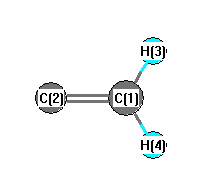 More geometry information
Calculated Bond Angles
| atom1 |
atom2 |
atom3 |
angle |
|
atom1 |
atom2 |
atom3 |
angle |
| C2 |
C1 |
H3 |
120.310 |
|
C2 |
C1 |
H4 |
120.310 |
| H3 |
C1 |
H4 |
119.380 |
|
Electronic energy levels
Charges, Dipole, Quadrupole and Polarizability
Charges from optimized geometry at B3LYP/CEP-31G*
Charges (e)
| Number |
Element |
Mulliken |
CHELPG |
AIM |
ESP |
| 1 |
C |
-0.343 |
|
|
|
| 2 |
C |
-0.143 |
|
|
|
| 3 |
H |
0.243 |
|
|
|
| 4 |
H |
0.243 |
|
|
|
Electric dipole moments
Electric dipole components in Debye
(What's a Debye? See section
VII.A.3)
| |
x |
y |
z |
Total |
| |
0.000 |
0.000 |
-2.387 |
2.387 |
| CHELPG |
|
|
|
|
| AIM |
|
|
|
|
| ESP |
|
|
|
|
Electric Quadrupole moment
Quadrupole components in D Å
| Primitive |
|---|
| | x | y | z |
|---|
| x |
-14.269 |
0.000 |
0.000 |
| y |
0.000 |
-9.986 |
0.000 |
| z |
0.000 |
0.000 |
-14.142 |
|
| Traceless |
|---|
| | x | y | z |
|---|
| x |
-2.206 |
0.000 |
0.000 |
| y |
0.000 |
4.220 |
0.000 |
| z |
0.000 |
0.000 |
-2.015 |
|
| Polar |
|---|
| 3z2-r2 | -4.029 |
|---|
| x2-y2 | -4.284 |
|---|
| xy | 0.000 |
|---|
| xz | 0.000 |
|---|
| yz | 0.000 |
|---|
|
Polarizabilities
Components of the polarizability tensor.
Units are
Å
3 (Angstrom cubed)
Change units.
| |
x |
y |
z |
| x |
1.725 |
0.000 |
0.000 |
| y |
0.000 |
2.405 |
0.000 |
| z |
0.000 |
0.000 |
4.299 |
<r2> (average value of r
2) Å
2
| <r2> |
0.000 |
| (<r2>)1/2 |
0.000 |
Jump to
S1C1
Energy calculated at B3LYP/CEP-31G*
| | hartrees |
|---|
| Energy at 0K | -12.276406 |
| Energy at 298.15K | -12.276548 |
| HF Energy | -12.276406 |
| Nuclear repulsion energy | 12.322273 |
The energy at 298.15K was derived from the energy at 0K
and an integrated heat capacity that used the calculated vibrational frequencies.
Vibrational Frequencies calculated at B3LYP/CEP-31G*
| Mode Number |
Symmetry |
Frequency
(cm-1) |
Scaled Frequency
(cm-1) |
IR Intensities
(km mol-1) |
Raman Act
(Å4/u) |
Dep P |
Dep U |
|---|
| 1 |
A1 |
3061 |
2956 |
5.64 |
|
|
|
| 2 |
A1 |
1565 |
1512 |
5.10 |
|
|
|
| 3 |
A1 |
1376 |
1329 |
1.05 |
|
|
|
| 4 |
B1 |
1243 |
1201 |
1058.08 |
|
|
|
| 5 |
B2 |
3149 |
3041 |
10.11 |
|
|
|
| 6 |
B2 |
967 |
934 |
5.81 |
|
|
|
Unscaled Zero Point Vibrational Energy (zpe) 5680.7 cm
-1
Scaled (by 0.9657) Zero Point Vibrational Energy (zpe) 5485.9 cm
-1
See section
III.C.1 List or set vibrational scaling factors
to change the scale factors used here.
See section
III.C.2
Calculate a vibrational scaling factor for a given set of molecules
to determine the least squares best scaling factor.
Geometric Data calculated at B3LYP/CEP-31G*
Point Group is C2v
Cartesians (Å)
| Atom |
x (Å) |
y (Å) |
z (Å) |
|---|
| C1 |
0.000 |
0.000 |
-0.503 |
| C2 |
0.000 |
0.000 |
0.857 |
| H3 |
0.000 |
0.950 |
-1.061 |
| H4 |
0.000 |
-0.950 |
-1.061 |
Atom - Atom Distances (Å)
| |
C1 |
C2 |
H3 |
H4 |
| C1 | | 1.3601 | 1.1021 | 1.1021 |
C2 | 1.3601 | | 2.1408 | 2.1408 | H3 | 1.1021 | 2.1408 | | 1.9006 | H4 | 1.1021 | 2.1408 | 1.9006 | |
More geometry information
Electronic energy levels
Charges, Dipole, Quadrupole and Polarizability
Charges from optimized geometry at B3LYP/CEP-31G*
Charges (e)
| Number |
Element |
Mulliken |
CHELPG |
AIM |
ESP |
| 1 |
C |
-0.329 |
|
|
|
| 2 |
C |
-0.089 |
|
|
|
| 3 |
H |
0.209 |
|
|
|
| 4 |
H |
0.209 |
|
|
|
Electric dipole moments
Electric dipole components in Debye
(What's a Debye? See section
VII.A.3)
| |
x |
y |
z |
Total |
| |
0.000 |
0.000 |
-0.782 |
0.782 |
| CHELPG |
|
|
|
|
| AIM |
|
|
|
|
| ESP |
|
|
|
|
Electric Quadrupole moment
Quadrupole components in D Å
| Primitive |
|---|
| | x | y | z |
|---|
| x |
-13.986 |
0.000 |
0.000 |
| y |
0.000 |
-11.701 |
0.000 |
| z |
0.000 |
0.000 |
-11.087 |
|
| Traceless |
|---|
| | x | y | z |
|---|
| x |
-2.592 |
0.000 |
0.000 |
| y |
0.000 |
0.836 |
0.000 |
| z |
0.000 |
0.000 |
1.756 |
|
| Polar |
|---|
| 3z2-r2 | 3.512 |
|---|
| x2-y2 | -2.285 |
|---|
| xy | 0.000 |
|---|
| xz | 0.000 |
|---|
| yz | 0.000 |
|---|
|
Polarizabilities
Components of the polarizability tensor.
Units are
Å
3 (Angstrom cubed)
Change units.
| |
x |
y |
z |
| x |
-1.063 |
0.000 |
0.000 |
| y |
0.000 |
1.936 |
0.000 |
| z |
0.000 |
0.000 |
4.394 |
<r2> (average value of r
2) Å
2
| <r2> |
15.665 |
| (<r2>)1/2 |
3.958 |
