Jump to
S1C2
S2C1
S2C2
Energy calculated at MP2/CEP-31G*
| | hartrees |
|---|
| Energy at 0K | -21.445960 |
| Energy at 298.15K | -21.445557 |
| HF Energy | -21.138303 |
| Nuclear repulsion energy | 22.772858 |
The energy at 298.15K was derived from the energy at 0K
and an integrated heat capacity that used the calculated vibrational frequencies.
Vibrational Frequencies calculated at MP2/CEP-31G*
| Mode Number |
Symmetry |
Frequency
(cm-1) |
Scaled Frequency
(cm-1) |
IR Intensities
(km mol-1) |
Raman Act
(Å4/u) |
Dep P |
Dep U |
|---|
| 1 |
A' |
3337 |
3168 |
4.37 |
|
|
|
| 2 |
A' |
2356 |
2237 |
0.21 |
|
|
|
| 3 |
A' |
1058 |
1004 |
30.22 |
|
|
|
| 4 |
A' |
892 |
847 |
6.11 |
|
|
|
| 5 |
A' |
439 |
417 |
5.07 |
|
|
|
| 6 |
A" |
517 |
491 |
7.00 |
|
|
|
Unscaled Zero Point Vibrational Energy (zpe) 4299.4 cm
-1
Scaled (by 0.9494) Zero Point Vibrational Energy (zpe) 4081.8 cm
-1
See section
III.C.1 List or set vibrational scaling factors
to change the scale factors used here.
See section
III.C.2
Calculate a vibrational scaling factor for a given set of molecules
to determine the least squares best scaling factor.
Geometric Data calculated at MP2/CEP-31G*
Point Group is Cs
Cartesians (Å)
| Atom |
x (Å) |
y (Å) |
z (Å) |
|---|
| C1 |
-0.323 |
-1.255 |
0.000 |
| C2 |
0.000 |
0.130 |
0.000 |
| N3 |
0.234 |
1.271 |
0.000 |
| H4 |
0.302 |
-2.147 |
0.000 |
Atom - Atom Distances (Å)
| |
C1 |
C2 |
N3 |
H4 |
| C1 | | 1.4221 | 2.5865 | 1.0890 |
C2 | 1.4221 | | 1.1646 | 2.2967 | N3 | 2.5865 | 1.1646 | | 3.4183 | H4 | 1.0890 | 2.2967 | 3.4183 | |
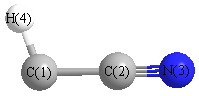 More geometry information
Calculated Bond Angles
| atom1 |
atom2 |
atom3 |
angle |
|
atom1 |
atom2 |
atom3 |
angle |
| C1 |
C2 |
N3 |
178.448 |
|
C2 |
C1 |
H4 |
131.843 |
Electronic energy levels
Charges, Dipole, Quadrupole and Polarizability
Jump to
S1C1
S2C1
S2C2
Energy calculated at MP2/CEP-31G*
| | hartrees |
|---|
| Energy at 0K | -21.438185 |
| Energy at 298.15K | |
| HF Energy | -21.136599 |
| Nuclear repulsion energy | 22.881357 |
The energy at 298.15K was derived from the energy at 0K
and an integrated heat capacity that used the calculated vibrational frequencies.
Vibrational Frequencies calculated at MP2/CEP-31G*
| Mode Number |
Symmetry |
Frequency
(cm-1) |
Scaled Frequency
(cm-1) |
IR Intensities
(km mol-1) |
Raman Act
(Å4/u) |
Dep P |
Dep U |
|---|
| 1 |
Σ |
3456 |
3281 |
74.75 |
|
|
|
| 2 |
Σ |
1787 |
1697 |
23.24 |
|
|
|
| 3 |
Σ |
1196 |
1136 |
31.38 |
|
|
|
| 4 |
Π |
496 |
471 |
0.30 |
|
|
|
| 4 |
Π |
496 |
471 |
0.30 |
|
|
|
| 5 |
Π |
575i |
546i |
82.59 |
|
|
|
| 5 |
Π |
575i |
546i |
82.59 |
|
|
|
Unscaled Zero Point Vibrational Energy (zpe) 3141.2 cm
-1
Scaled (by 0.9494) Zero Point Vibrational Energy (zpe) 2982.3 cm
-1
See section
III.C.1 List or set vibrational scaling factors
to change the scale factors used here.
See section
III.C.2
Calculate a vibrational scaling factor for a given set of molecules
to determine the least squares best scaling factor.
Geometric Data calculated at MP2/CEP-31G*
Point Group is C∞v
Cartesians (Å)
| Atom |
x (Å) |
y (Å) |
z (Å) |
|---|
| C1 |
0.000 |
0.000 |
-1.242 |
| C2 |
0.000 |
0.000 |
0.111 |
| N3 |
0.000 |
0.000 |
1.301 |
| H4 |
0.000 |
0.000 |
-2.319 |
Atom - Atom Distances (Å)
| |
C1 |
C2 |
N3 |
H4 |
| C1 | | 1.3524 | 2.5428 | 1.0767 |
C2 | 1.3524 | | 1.1905 | 2.4291 | N3 | 2.5428 | 1.1905 | | 3.6196 | H4 | 1.0767 | 2.4291 | 3.6196 | |
More geometry information
Calculated Bond Angles
| atom1 |
atom2 |
atom3 |
angle |
|
atom1 |
atom2 |
atom3 |
angle |
| C1 |
C2 |
N3 |
180.000 |
|
C2 |
C1 |
H4 |
180.000 |
Electronic energy levels
Charges, Dipole, Quadrupole and Polarizability
Charges from optimized geometry at MP2/CEP-31G*
Charges (e)
| Number |
Element |
Mulliken |
CHELPG |
AIM |
ESP |
| 1 |
C |
-0.262 |
|
|
|
| 2 |
C |
-0.485 |
|
|
|
| 3 |
N |
0.354 |
|
|
|
| 4 |
H |
0.392 |
|
|
|
Electric dipole moments
Electric dipole components in Debye
(What's a Debye? See section
VII.A.3)
| |
x |
y |
z |
Total |
| |
0.000 |
0.000 |
-3.831 |
3.831 |
| CHELPG |
|
|
|
|
| AIM |
|
|
|
|
| ESP |
|
|
|
|
Electric Quadrupole moment
Quadrupole components in D Å
| Primitive |
|---|
| | x | y | z |
|---|
| x |
-17.619 |
0.000 |
0.000 |
| y |
0.000 |
-17.619 |
0.000 |
| z |
0.000 |
0.000 |
-15.505 |
|
| Traceless |
|---|
| | x | y | z |
|---|
| x |
-1.057 |
0.000 |
0.000 |
| y |
0.000 |
-1.057 |
0.000 |
| z |
0.000 |
0.000 |
2.114 |
|
| Polar |
|---|
| 3z2-r2 | 4.228 |
|---|
| x2-y2 | 0.000 |
|---|
| xy | 0.000 |
|---|
| xz | 0.000 |
|---|
| yz | 0.000 |
|---|
|
Polarizabilities
Components of the polarizability tensor.
Units are
Å
3 (Angstrom cubed)
Change units.
| |
x |
y |
z |
| x |
1.926 |
0.000 |
0.000 |
| y |
0.000 |
1.926 |
0.000 |
| z |
0.000 |
0.000 |
6.567 |
<r2> (average value of r
2) Å
2
| <r2> |
30.621 |
| (<r2>)1/2 |
5.534 |
Jump to
S1C1
S1C2
S2C2
Energy calculated at MP2/CEP-31G*
| | hartrees |
|---|
| Energy at 0K | -21.444162 |
| Energy at 298.15K | -21.443555 |
| HF Energy | -21.080450 |
| Nuclear repulsion energy | 22.365871 |
The energy at 298.15K was derived from the energy at 0K
and an integrated heat capacity that used the calculated vibrational frequencies.
Vibrational Frequencies calculated at MP2/CEP-31G*
| Mode Number |
Symmetry |
Frequency
(cm-1) |
Scaled Frequency
(cm-1) |
IR Intensities
(km mol-1) |
Raman Act
(Å4/u) |
Dep P |
Dep U |
|---|
| 1 |
A' |
3096 |
2940 |
33.80 |
|
|
|
| 2 |
A' |
2244 |
2130 |
8.88 |
|
|
|
| 3 |
A' |
1112 |
1056 |
58.31 |
|
|
|
| 4 |
A' |
973 |
924 |
19.37 |
|
|
|
| 5 |
A' |
379 |
360 |
16.23 |
|
|
|
| 6 |
A" |
330 |
313 |
9.07 |
|
|
|
Unscaled Zero Point Vibrational Energy (zpe) 4067.4 cm
-1
Scaled (by 0.9494) Zero Point Vibrational Energy (zpe) 3861.5 cm
-1
See section
III.C.1 List or set vibrational scaling factors
to change the scale factors used here.
See section
III.C.2
Calculate a vibrational scaling factor for a given set of molecules
to determine the least squares best scaling factor.
Geometric Data calculated at MP2/CEP-31G*
Point Group is Cs
Cartesians (Å)
| Atom |
x (Å) |
y (Å) |
z (Å) |
|---|
| C1 |
0.088 |
-1.342 |
0.000 |
| C2 |
0.000 |
0.105 |
0.000 |
| N3 |
-0.243 |
1.286 |
0.000 |
| H4 |
1.177 |
-1.578 |
0.000 |
Atom - Atom Distances (Å)
| |
C1 |
C2 |
N3 |
H4 |
| C1 | | 1.4495 | 2.6493 | 1.1143 |
C2 | 1.4495 | | 1.2066 | 2.0533 | N3 | 2.6493 | 1.2066 | | 3.1971 | H4 | 1.1143 | 2.0533 | 3.1971 | |
More geometry information
Electronic energy levels
Charges, Dipole, Quadrupole and Polarizability
Jump to
S1C1
S1C2
S2C1
Energy calculated at MP2/CEP-31G*
| | hartrees |
|---|
| Energy at 0K | -21.444162 |
| Energy at 298.15K | -21.443555 |
| HF Energy | -21.080450 |
| Nuclear repulsion energy | 22.365871 |
The energy at 298.15K was derived from the energy at 0K
and an integrated heat capacity that used the calculated vibrational frequencies.
Vibrational Frequencies calculated at MP2/CEP-31G*
Geometric Data calculated at MP2/CEP-31G*
Point Group is Cs
Electronic energy levels
Charges, Dipole, Quadrupole and Polarizability
