Jump to
S1C2
S2C1
S2C2
Energy calculated at B3LYP/CEP-31G*
| | hartrees |
|---|
| Energy at 0K | -21.654485 |
| Energy at 298.15K | -21.653783 |
| HF Energy | -21.654485 |
| Nuclear repulsion energy | 22.662587 |
The energy at 298.15K was derived from the energy at 0K
and an integrated heat capacity that used the calculated vibrational frequencies.
Vibrational Frequencies calculated at B3LYP/CEP-31G*
| Mode Number |
Symmetry |
Frequency
(cm-1) |
Scaled Frequency
(cm-1) |
IR Intensities
(km mol-1) |
Raman Act
(Å4/u) |
Dep P |
Dep U |
|---|
| 1 |
A' |
3336 |
3222 |
22.67 |
|
|
|
| 2 |
A' |
1831 |
1768 |
24.73 |
|
|
|
| 3 |
A' |
1204 |
1163 |
8.49 |
|
|
|
| 4 |
A' |
508 |
490 |
40.90 |
|
|
|
| 5 |
A' |
384 |
371 |
11.76 |
|
|
|
| 6 |
A" |
419 |
404 |
0.06 |
|
|
|
Unscaled Zero Point Vibrational Energy (zpe) 3840.8 cm
-1
Scaled (by 0.9657) Zero Point Vibrational Energy (zpe) 3709.0 cm
-1
See section
III.C.1 List or set vibrational scaling factors
to change the scale factors used here.
See section
III.C.2
Calculate a vibrational scaling factor for a given set of molecules
to determine the least squares best scaling factor.
Geometric Data calculated at B3LYP/CEP-31G*
Point Group is Cs
Cartesians (Å)
| Atom |
x (Å) |
y (Å) |
z (Å) |
|---|
| C1 |
0.155 |
-1.249 |
0.000 |
| C2 |
0.000 |
0.096 |
0.000 |
| N3 |
-0.253 |
1.287 |
0.000 |
| H4 |
0.842 |
-2.088 |
0.000 |
Atom - Atom Distances (Å)
| |
C1 |
C2 |
N3 |
H4 |
| C1 | | 1.3541 | 2.5694 | 1.0838 |
C2 | 1.3541 | | 1.2182 | 2.3404 | N3 | 2.5694 | 1.2182 | | 3.5486 | H4 | 1.0838 | 2.3404 | 3.5486 | |
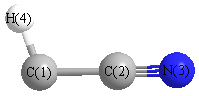 More geometry information
Calculated Bond Angles
| atom1 |
atom2 |
atom3 |
angle |
|
atom1 |
atom2 |
atom3 |
angle |
| C1 |
C2 |
N3 |
174.581 |
|
C2 |
C1 |
H4 |
147.279 |
Electronic energy levels
Charges, Dipole, Quadrupole and Polarizability
Jump to
S1C1
S2C1
S2C2
Energy calculated at B3LYP/CEP-31G*
| | hartrees |
|---|
| Energy at 0K | -21.653447 |
| Energy at 298.15K | |
| HF Energy | -21.653447 |
| Nuclear repulsion energy | 22.693922 |
The energy at 298.15K was derived from the energy at 0K
and an integrated heat capacity that used the calculated vibrational frequencies.
Vibrational Frequencies calculated at B3LYP/CEP-31G*
| Mode Number |
Symmetry |
Frequency
(cm-1) |
Scaled Frequency
(cm-1) |
IR Intensities
(km mol-1) |
Raman Act
(Å4/u) |
Dep P |
Dep U |
|---|
| 1 |
Σ |
3415 |
3298 |
70.82 |
|
|
|
| 2 |
Σ |
1763 |
1702 |
26.07 |
|
|
|
| 3 |
Σ |
1255 |
1212 |
5.30 |
|
|
|
| 4 |
Π |
419 |
405 |
0.20 |
|
|
|
| 4 |
Π |
419 |
405 |
0.20 |
|
|
|
| 5 |
Π |
312i |
301i |
72.78 |
|
|
|
| 5 |
Π |
312i |
301i |
72.78 |
|
|
|
Unscaled Zero Point Vibrational Energy (zpe) 3323.8 cm
-1
Scaled (by 0.9657) Zero Point Vibrational Energy (zpe) 3209.8 cm
-1
See section
III.C.1 List or set vibrational scaling factors
to change the scale factors used here.
See section
III.C.2
Calculate a vibrational scaling factor for a given set of molecules
to determine the least squares best scaling factor.
Geometric Data calculated at B3LYP/CEP-31G*
Point Group is C∞v
Cartesians (Å)
| Atom |
x (Å) |
y (Å) |
z (Å) |
|---|
| C1 |
0.000 |
0.000 |
-1.241 |
| C2 |
0.000 |
0.000 |
0.089 |
| N3 |
0.000 |
0.000 |
1.318 |
| H4 |
0.000 |
0.000 |
-2.317 |
Atom - Atom Distances (Å)
| |
C1 |
C2 |
N3 |
H4 |
| C1 | | 1.3300 | 2.5582 | 1.0765 |
C2 | 1.3300 | | 1.2282 | 2.4065 | N3 | 2.5582 | 1.2282 | | 3.6347 | H4 | 1.0765 | 2.4065 | 3.6347 | |
More geometry information
Calculated Bond Angles
| atom1 |
atom2 |
atom3 |
angle |
|
atom1 |
atom2 |
atom3 |
angle |
| C1 |
C2 |
N3 |
180.000 |
|
C2 |
C1 |
H4 |
180.000 |
Electronic energy levels
Charges, Dipole, Quadrupole and Polarizability
Charges from optimized geometry at B3LYP/CEP-31G*
Charges (e)
| Number |
Element |
Mulliken |
CHELPG |
AIM |
ESP |
| 1 |
C |
-0.274 |
|
|
|
| 2 |
C |
-0.473 |
|
|
|
| 3 |
N |
0.342 |
|
|
|
| 4 |
H |
0.405 |
|
|
|
Electric dipole moments
Electric dipole components in Debye
(What's a Debye? See section
VII.A.3)
| |
x |
y |
z |
Total |
| |
0.000 |
0.000 |
-3.303 |
3.303 |
| CHELPG |
|
|
|
|
| AIM |
|
|
|
|
| ESP |
|
|
|
|
Electric Quadrupole moment
Quadrupole components in D Å
| Primitive |
|---|
| | x | y | z |
|---|
| x |
-17.315 |
0.000 |
0.000 |
| y |
0.000 |
-17.315 |
0.000 |
| z |
0.000 |
0.000 |
-15.120 |
|
| Traceless |
|---|
| | x | y | z |
|---|
| x |
-1.097 |
0.000 |
0.000 |
| y |
0.000 |
-1.097 |
0.000 |
| z |
0.000 |
0.000 |
2.194 |
|
| Polar |
|---|
| 3z2-r2 | 4.388 |
|---|
| x2-y2 | 0.000 |
|---|
| xy | 0.000 |
|---|
| xz | 0.000 |
|---|
| yz | 0.000 |
|---|
|
Polarizabilities
Components of the polarizability tensor.
Units are
Å
3 (Angstrom cubed)
Change units.
| |
x |
y |
z |
| x |
1.966 |
0.000 |
0.000 |
| y |
0.000 |
1.966 |
0.000 |
| z |
0.000 |
0.000 |
6.653 |
<r2> (average value of r
2) Å
2
| <r2> |
30.595 |
| (<r2>)1/2 |
5.531 |
Jump to
S1C1
S1C2
S2C2
Energy calculated at B3LYP/CEP-31G*
| | hartrees |
|---|
| Energy at 0K | -21.632533 |
| Energy at 298.15K | -21.631936 |
| HF Energy | -21.632533 |
| Nuclear repulsion energy | 22.593773 |
The energy at 298.15K was derived from the energy at 0K
and an integrated heat capacity that used the calculated vibrational frequencies.
Vibrational Frequencies calculated at B3LYP/CEP-31G*
| Mode Number |
Symmetry |
Frequency
(cm-1) |
Scaled Frequency
(cm-1) |
IR Intensities
(km mol-1) |
Raman Act
(Å4/u) |
Dep P |
Dep U |
|---|
| 1 |
A' |
3047 |
2943 |
25.26 |
|
|
|
| 2 |
A' |
2109 |
2036 |
17.26 |
|
|
|
| 3 |
A' |
1054 |
1018 |
61.87 |
|
|
|
| 4 |
A' |
995 |
961 |
20.64 |
|
|
|
| 5 |
A' |
422 |
407 |
23.77 |
|
|
|
| 6 |
A" |
307 |
296 |
5.26 |
|
|
|
Unscaled Zero Point Vibrational Energy (zpe) 3966.7 cm
-1
Scaled (by 0.9657) Zero Point Vibrational Energy (zpe) 3830.6 cm
-1
See section
III.C.1 List or set vibrational scaling factors
to change the scale factors used here.
See section
III.C.2
Calculate a vibrational scaling factor for a given set of molecules
to determine the least squares best scaling factor.
Geometric Data calculated at B3LYP/CEP-31G*
Point Group is Cs
Cartesians (Å)
| Atom |
x (Å) |
y (Å) |
z (Å) |
|---|
| C1 |
0.108 |
-1.317 |
0.000 |
| C2 |
0.000 |
0.099 |
0.000 |
| N3 |
-0.263 |
1.269 |
0.000 |
| H4 |
1.192 |
-1.576 |
0.000 |
Atom - Atom Distances (Å)
| |
C1 |
C2 |
N3 |
H4 |
| C1 | | 1.4201 | 2.6128 | 1.1142 |
C2 | 1.4201 | | 1.1995 | 2.0553 | N3 | 2.6128 | 1.1995 | | 3.1951 | H4 | 1.1142 | 2.0553 | 3.1951 | |
More geometry information
Electronic energy levels
Charges, Dipole, Quadrupole and Polarizability
Charges from optimized geometry at B3LYP/CEP-31G*
Charges (e)
| Number |
Element |
Mulliken |
CHELPG |
AIM |
ESP |
| 1 |
C |
-0.224 |
|
|
|
| 2 |
C |
-0.328 |
|
|
|
| 3 |
N |
0.379 |
|
|
|
| 4 |
H |
0.173 |
|
|
|
Electric dipole moments
Electric dipole components in Debye
(What's a Debye? See section
VII.A.3)
| |
x |
y |
z |
Total |
| |
1.925 |
-1.290 |
0.000 |
2.318 |
| CHELPG |
|
|
|
|
| AIM |
|
|
|
|
| ESP |
|
|
|
|
Electric Quadrupole moment
Quadrupole components in D Å
| Primitive |
|---|
| | x | y | z |
|---|
| x |
-16.649 |
-2.586 |
0.000 |
| y |
-2.586 |
-21.427 |
0.000 |
| z |
0.000 |
0.000 |
-15.870 |
|
| Traceless |
|---|
| | x | y | z |
|---|
| x |
2.000 |
-2.586 |
0.000 |
| y |
-2.586 |
-5.168 |
0.000 |
| z |
0.000 |
0.000 |
3.168 |
|
| Polar |
|---|
| 3z2-r2 | 6.335 |
|---|
| x2-y2 | 4.779 |
|---|
| xy | -2.586 |
|---|
| xz | 0.000 |
|---|
| yz | 0.000 |
|---|
|
Polarizabilities
Components of the polarizability tensor.
Units are
Å
3 (Angstrom cubed)
Change units.
| |
x |
y |
z |
| x |
2.610 |
-0.737 |
0.000 |
| y |
-0.737 |
6.569 |
0.000 |
| z |
0.000 |
0.000 |
2.534 |
<r2> (average value of r
2) Å
2
| <r2> |
30.559 |
| (<r2>)1/2 |
5.528 |
Jump to
S1C1
S1C2
S2C1
Energy calculated at B3LYP/CEP-31G*
| | hartrees |
|---|
| Energy at 0K | -21.632533 |
| Energy at 298.15K | -21.631936 |
| HF Energy | -21.632533 |
| Nuclear repulsion energy | 22.593773 |
The energy at 298.15K was derived from the energy at 0K
and an integrated heat capacity that used the calculated vibrational frequencies.
Vibrational Frequencies calculated at B3LYP/CEP-31G*
Geometric Data calculated at B3LYP/CEP-31G*
Point Group is Cs
Electronic energy levels
Charges, Dipole, Quadrupole and Polarizability
