Jump to
S1C2
Energy calculated at B3LYP/CEP-31G*
| | hartrees |
|---|
| Energy at 0K | -26.280279 |
| Energy at 298.15K | -26.280996 |
| HF Energy | -26.280279 |
| Nuclear repulsion energy | 26.704842 |
The energy at 298.15K was derived from the energy at 0K
and an integrated heat capacity that used the calculated vibrational frequencies.
Vibrational Frequencies calculated at B3LYP/CEP-31G*
| Mode Number |
Symmetry |
Frequency
(cm-1) |
Scaled Frequency
(cm-1) |
IR Intensities
(km mol-1) |
Raman Act
(Å4/u) |
Dep P |
Dep U |
|---|
| 1 |
A' |
3626 |
3502 |
166.89 |
|
|
|
| 2 |
A' |
2004 |
1935 |
673.82 |
|
|
|
| 3 |
A' |
866 |
836 |
1.28 |
|
|
|
| 4 |
A' |
670 |
647 |
344.22 |
|
|
|
| 5 |
A' |
437 |
422 |
67.91 |
|
|
|
| 6 |
A" |
470 |
454 |
2.52 |
|
|
|
Unscaled Zero Point Vibrational Energy (zpe) 4036.5 cm
-1
Scaled (by 0.9657) Zero Point Vibrational Energy (zpe) 3898.0 cm
-1
See section
III.C.1 List or set vibrational scaling factors
to change the scale factors used here.
See section
III.C.2
Calculate a vibrational scaling factor for a given set of molecules
to determine the least squares best scaling factor.
Geometric Data calculated at B3LYP/CEP-31G*
Point Group is Cs
Cartesians (Å)
| Atom |
x (Å) |
y (Å) |
z (Å) |
|---|
| N1 |
-0.183 |
1.721 |
0.000 |
| C2 |
0.000 |
0.503 |
0.000 |
| S3 |
0.046 |
-1.094 |
0.000 |
| H4 |
0.543 |
2.437 |
0.000 |
Atom - Atom Distances (Å)
| |
N1 |
C2 |
S3 |
H4 |
| N1 | | 1.2312 | 2.8240 | 1.0198 |
C2 | 1.2312 | | 1.5979 | 2.0086 | S3 | 2.8240 | 1.5979 | | 3.5657 | H4 | 1.0198 | 2.0086 | 3.5657 | |
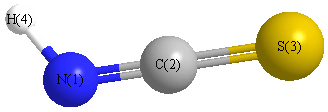 More geometry information
Calculated Bond Angles
| atom1 |
atom2 |
atom3 |
angle |
|
atom1 |
atom2 |
atom3 |
angle |
| N1 |
C2 |
S3 |
173.117 |
|
C2 |
N1 |
H4 |
126.072 |
Electronic energy levels
Charges, Dipole, Quadrupole and Polarizability
Charges from optimized geometry at B3LYP/CEP-31G*
Charges (e)
| Number |
Element |
Mulliken |
CHELPG |
AIM |
ESP |
| 1 |
N |
0.013 |
|
|
|
| 2 |
C |
-0.083 |
|
|
|
| 3 |
S |
-0.273 |
|
|
|
| 4 |
H |
0.342 |
|
|
|
Electric dipole moments
Electric dipole components in Debye
(What's a Debye? See section
VII.A.3)
| |
x |
y |
z |
Total |
| |
1.347 |
1.567 |
0.000 |
2.066 |
| CHELPG |
|
|
|
|
| AIM |
|
|
|
|
| ESP |
|
|
|
|
Electric Quadrupole moment
Quadrupole components in D Å
| Primitive |
|---|
| | x | y | z |
|---|
| x |
-23.625 |
3.472 |
0.000 |
| y |
3.472 |
-18.922 |
0.000 |
| z |
0.000 |
0.000 |
-24.586 |
|
| Traceless |
|---|
| | x | y | z |
|---|
| x |
-1.871 |
3.472 |
0.000 |
| y |
3.472 |
5.183 |
0.000 |
| z |
0.000 |
0.000 |
-3.313 |
|
| Polar |
|---|
| 3z2-r2 | -6.625 |
|---|
| x2-y2 | -4.703 |
|---|
| xy | 3.472 |
|---|
| xz | 0.000 |
|---|
| yz | 0.000 |
|---|
|
Polarizabilities
Components of the polarizability tensor.
Units are
Å
3 (Angstrom cubed)
Change units.
| |
x |
y |
z |
| x |
2.403 |
-0.294 |
0.000 |
| y |
-0.294 |
9.296 |
0.000 |
| z |
0.000 |
0.000 |
2.174 |
<r2> (average value of r
2) Å
2
| <r2> |
43.390 |
| (<r2>)1/2 |
6.587 |
Jump to
S1C1
Energy calculated at B3LYP/CEP-31G*
| | hartrees |
|---|
| Energy at 0K | -26.276274 |
| Energy at 298.15K | |
| HF Energy | -26.276274 |
| Nuclear repulsion energy | 26.794660 |
The energy at 298.15K was derived from the energy at 0K
and an integrated heat capacity that used the calculated vibrational frequencies.
Vibrational Frequencies calculated at B3LYP/CEP-31G*
| Mode Number |
Symmetry |
Frequency
(cm-1) |
Scaled Frequency
(cm-1) |
IR Intensities
(km mol-1) |
Raman Act
(Å4/u) |
Dep P |
Dep U |
|---|
| 1 |
Σ |
3900 |
3766 |
705.33 |
|
|
|
| 2 |
Σ |
2164 |
2089 |
702.87 |
|
|
|
| 3 |
Σ |
838 |
810 |
26.74 |
|
|
|
| 4 |
Π |
466 |
450 |
9.82 |
|
|
|
| 4 |
Π |
466 |
450 |
9.82 |
|
|
|
| 5 |
Π |
354i |
342i |
175.79 |
|
|
|
| 5 |
Π |
354i |
342i |
175.79 |
|
|
|
Unscaled Zero Point Vibrational Energy (zpe) 3562.7 cm
-1
Scaled (by 0.9657) Zero Point Vibrational Energy (zpe) 3440.5 cm
-1
See section
III.C.1 List or set vibrational scaling factors
to change the scale factors used here.
See section
III.C.2
Calculate a vibrational scaling factor for a given set of molecules
to determine the least squares best scaling factor.
Geometric Data calculated at B3LYP/CEP-31G*
Point Group is C∞v
Cartesians (Å)
| Atom |
x (Å) |
y (Å) |
z (Å) |
|---|
| N1 |
0.000 |
0.000 |
-1.705 |
| C2 |
0.000 |
0.000 |
-0.506 |
| S3 |
0.000 |
0.000 |
1.105 |
| H4 |
0.000 |
0.000 |
-2.708 |
Atom - Atom Distances (Å)
| |
N1 |
C2 |
S3 |
H4 |
| N1 | | 1.1988 | 2.8098 | 1.0027 |
C2 | 1.1988 | | 1.6111 | 2.2015 | S3 | 2.8098 | 1.6111 | | 3.8126 | H4 | 1.0027 | 2.2015 | 3.8126 | |
More geometry information
Calculated Bond Angles
| atom1 |
atom2 |
atom3 |
angle |
|
atom1 |
atom2 |
atom3 |
angle |
| N1 |
C2 |
S3 |
180.000 |
|
C2 |
N1 |
H4 |
180.000 |
Electronic energy levels
Charges, Dipole, Quadrupole and Polarizability
Charges from optimized geometry at B3LYP/CEP-31G*
Charges (e)
| Number |
Element |
Mulliken |
CHELPG |
AIM |
ESP |
| 1 |
N |
0.079 |
|
|
|
| 2 |
C |
-0.175 |
|
|
|
| 3 |
S |
-0.286 |
|
|
|
| 4 |
H |
0.383 |
|
|
|
Electric dipole moments
Electric dipole components in Debye
(What's a Debye? See section
VII.A.3)
| |
x |
y |
z |
Total |
| |
0.000 |
0.000 |
-3.199 |
3.199 |
| CHELPG |
|
|
|
|
| AIM |
|
|
|
|
| ESP |
|
|
|
|
Electric Quadrupole moment
Quadrupole components in D Å
| Primitive |
|---|
| | x | y | z |
|---|
| x |
-24.491 |
0.000 |
0.000 |
| y |
0.000 |
-24.491 |
0.000 |
| z |
0.000 |
0.000 |
-14.630 |
|
| Traceless |
|---|
| | x | y | z |
|---|
| x |
-4.930 |
0.000 |
0.000 |
| y |
0.000 |
-4.930 |
0.000 |
| z |
0.000 |
0.000 |
9.860 |
|
| Polar |
|---|
| 3z2-r2 | 19.721 |
|---|
| x2-y2 | 0.000 |
|---|
| xy | 0.000 |
|---|
| xz | 0.000 |
|---|
| yz | 0.000 |
|---|
|
Polarizabilities
Components of the polarizability tensor.
Units are
Å
3 (Angstrom cubed)
Change units.
| |
x |
y |
z |
| x |
2.113 |
0.000 |
0.000 |
| y |
0.000 |
2.113 |
0.000 |
| z |
0.000 |
0.000 |
9.067 |
<r2> (average value of r
2) Å
2
| <r2> |
43.458 |
| (<r2>)1/2 |
6.592 |
