Jump to
S1C2
Energy calculated at MP2/CEP-31G*
| | hartrees |
|---|
| Energy at 0K | -35.753355 |
| Energy at 298.15K | |
| HF Energy | -35.388570 |
| Nuclear repulsion energy | 30.932266 |
The energy at 298.15K was derived from the energy at 0K
and an integrated heat capacity that used the calculated vibrational frequencies.
Vibrational Frequencies calculated at MP2/CEP-31G*
| Mode Number |
Symmetry |
Frequency
(cm-1) |
Scaled Frequency
(cm-1) |
IR Intensities
(km mol-1) |
Raman Act
(Å4/u) |
Dep P |
Dep U |
|---|
| 1 |
A1 |
3320 |
3152 |
1.37 |
|
|
|
| 2 |
A1 |
780 |
740 |
13.86 |
|
|
|
| 3 |
A1 |
314 |
298 |
0.50 |
|
|
|
| 4 |
B1 |
541i |
514i |
87.28 |
|
|
|
| 5 |
B2 |
1271 |
1207 |
62.83 |
|
|
|
| 6 |
B2 |
970 |
920 |
158.91 |
|
|
|
Unscaled Zero Point Vibrational Energy (zpe) 3056.4 cm
-1
Scaled (by 0.9494) Zero Point Vibrational Energy (zpe) 2901.7 cm
-1
See section
III.C.1 List or set vibrational scaling factors
to change the scale factors used here.
See section
III.C.2
Calculate a vibrational scaling factor for a given set of molecules
to determine the least squares best scaling factor.
Geometric Data calculated at MP2/CEP-31G*
Point Group is C2v
Cartesians (Å)
| Atom |
x (Å) |
y (Å) |
z (Å) |
|---|
| C1 |
0.000 |
0.000 |
0.680 |
| H2 |
0.000 |
0.000 |
1.769 |
| Cl3 |
0.000 |
1.490 |
-0.172 |
| Cl4 |
0.000 |
-1.490 |
-0.172 |
Atom - Atom Distances (Å)
| |
C1 |
H2 |
Cl3 |
Cl4 |
| C1 | | 1.0897 | 1.7165 | 1.7165 |
H2 | 1.0897 | | 2.4474 | 2.4474 | Cl3 | 1.7165 | 2.4474 | | 2.9808 | Cl4 | 1.7165 | 2.4474 | 2.9808 | |
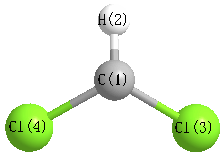 More geometry information
Calculated Bond Angles
| atom1 |
atom2 |
atom3 |
angle |
|
atom1 |
atom2 |
atom3 |
angle |
| Cl3 |
C1 |
H2 |
119.745 |
|
Cl3 |
C1 |
Cl4 |
120.511 |
| Cl4 |
C1 |
H2 |
119.745 |
|
Electronic energy levels
Charges, Dipole, Quadrupole and Polarizability
Jump to
S1C1
Energy calculated at MP2/CEP-31G*
| | hartrees |
|---|
| Energy at 0K | -35.755859 |
| Energy at 298.15K | -35.756769 |
| HF Energy | -35.391036 |
| Nuclear repulsion energy | 30.864934 |
The energy at 298.15K was derived from the energy at 0K
and an integrated heat capacity that used the calculated vibrational frequencies.
Vibrational Frequencies calculated at MP2/CEP-31G*
| Mode Number |
Symmetry |
Frequency
(cm-1) |
Scaled Frequency
(cm-1) |
IR Intensities
(km mol-1) |
Raman Act
(Å4/u) |
Dep P |
Dep U |
|---|
| 1 |
A' |
3267 |
3102 |
9.95 |
|
|
|
| 2 |
A' |
793 |
753 |
25.83 |
|
|
|
| 3 |
A' |
642 |
610 |
17.54 |
|
|
|
| 4 |
A' |
307 |
292 |
0.41 |
|
|
|
| 5 |
A" |
1282 |
1217 |
54.76 |
|
|
|
| 6 |
A" |
923 |
876 |
195.58 |
|
|
|
Unscaled Zero Point Vibrational Energy (zpe) 3607.0 cm
-1
Scaled (by 0.9494) Zero Point Vibrational Energy (zpe) 3424.5 cm
-1
See section
III.C.1 List or set vibrational scaling factors
to change the scale factors used here.
See section
III.C.2
Calculate a vibrational scaling factor for a given set of molecules
to determine the least squares best scaling factor.
Geometric Data calculated at MP2/CEP-31G*
Point Group is Cs
Cartesians (Å)
| Atom |
x (Å) |
y (Å) |
z (Å) |
|---|
| C1 |
0.015 |
0.715 |
0.000 |
| H2 |
-0.585 |
1.630 |
0.000 |
| Cl3 |
0.015 |
-0.174 |
1.485 |
| Cl4 |
0.015 |
-0.174 |
-1.485 |
Atom - Atom Distances (Å)
| |
C1 |
H2 |
Cl3 |
Cl4 |
| C1 | | 1.0945 | 1.7303 | 1.7303 |
H2 | 1.0945 | | 2.4123 | 2.4123 | Cl3 | 1.7303 | 2.4123 | | 2.9691 | Cl4 | 1.7303 | 2.4123 | 2.9691 | |
More geometry information
Calculated Bond Angles
| atom1 |
atom2 |
atom3 |
angle |
|
atom1 |
atom2 |
atom3 |
angle |
| Cl3 |
C1 |
H2 |
115.445 |
|
Cl3 |
C1 |
Cl4 |
118.186 |
| Cl4 |
C1 |
H2 |
115.445 |
|
Electronic energy levels
Charges, Dipole, Quadrupole and Polarizability
