Jump to
S1C2
Energy calculated at B3LYP/CEP-31G*
| | hartrees |
|---|
| Energy at 0K | -36.037268 |
| Energy at 298.15K | |
| HF Energy | -36.037268 |
| Nuclear repulsion energy | 30.694025 |
The energy at 298.15K was derived from the energy at 0K
and an integrated heat capacity that used the calculated vibrational frequencies.
Vibrational Frequencies calculated at B3LYP/CEP-31G*
| Mode Number |
Symmetry |
Frequency
(cm-1) |
Scaled Frequency
(cm-1) |
IR Intensities
(km mol-1) |
Raman Act
(Å4/u) |
Dep P |
Dep U |
|---|
| 1 |
A1 |
3255 |
3143 |
1.84 |
|
|
|
| 2 |
A1 |
735 |
710 |
12.14 |
|
|
|
| 3 |
A1 |
299 |
289 |
0.28 |
|
|
|
| 4 |
B1 |
393i |
380i |
82.14 |
|
|
|
| 5 |
B2 |
1219 |
1177 |
56.08 |
|
|
|
| 6 |
B2 |
898 |
868 |
172.54 |
|
|
|
Unscaled Zero Point Vibrational Energy (zpe) 3006.7 cm
-1
Scaled (by 0.9657) Zero Point Vibrational Energy (zpe) 2903.6 cm
-1
See section
III.C.1 List or set vibrational scaling factors
to change the scale factors used here.
See section
III.C.2
Calculate a vibrational scaling factor for a given set of molecules
to determine the least squares best scaling factor.
Geometric Data calculated at B3LYP/CEP-31G*
Point Group is C2v
Cartesians (Å)
| Atom |
x (Å) |
y (Å) |
z (Å) |
|---|
| C1 |
0.000 |
0.000 |
0.684 |
| H2 |
0.000 |
0.000 |
1.774 |
| Cl3 |
0.000 |
1.504 |
-0.173 |
| Cl4 |
0.000 |
-1.504 |
-0.173 |
Atom - Atom Distances (Å)
| |
C1 |
H2 |
Cl3 |
Cl4 |
| C1 | | 1.0898 | 1.7310 | 1.7310 |
H2 | 1.0898 | | 2.4600 | 2.4600 | Cl3 | 1.7310 | 2.4600 | | 3.0080 | Cl4 | 1.7310 | 2.4600 | 3.0080 | |
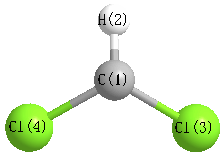 More geometry information
Calculated Bond Angles
| atom1 |
atom2 |
atom3 |
angle |
|
atom1 |
atom2 |
atom3 |
angle |
| Cl3 |
C1 |
H2 |
119.671 |
|
Cl3 |
C1 |
Cl4 |
120.658 |
| Cl4 |
C1 |
H2 |
119.671 |
|
Electronic energy levels
Charges, Dipole, Quadrupole and Polarizability
Charges from optimized geometry at B3LYP/CEP-31G*
Charges (e)
| Number |
Element |
Mulliken |
CHELPG |
AIM |
ESP |
| 1 |
C |
-0.244 |
|
|
|
| 2 |
H |
0.276 |
|
|
|
| 3 |
Cl |
-0.016 |
|
|
|
| 4 |
Cl |
-0.016 |
|
|
|
Electric dipole moments
Electric dipole components in Debye
(What's a Debye? See section
VII.A.3)
| |
x |
y |
z |
Total |
| |
0.000 |
0.000 |
1.013 |
1.013 |
| CHELPG |
|
|
|
|
| AIM |
|
|
|
|
| ESP |
|
|
|
|
Electric Quadrupole moment
Quadrupole components in D Å
| Primitive |
|---|
| | x | y | z |
|---|
| x |
-30.717 |
0.000 |
0.000 |
| y |
0.000 |
-29.670 |
0.000 |
| z |
0.000 |
0.000 |
-27.328 |
|
| Traceless |
|---|
| | x | y | z |
|---|
| x |
-2.218 |
0.000 |
0.000 |
| y |
0.000 |
-0.648 |
0.000 |
| z |
0.000 |
0.000 |
2.866 |
|
| Polar |
|---|
| 3z2-r2 | 5.732 |
|---|
| x2-y2 | -1.047 |
|---|
| xy | 0.000 |
|---|
| xz | 0.000 |
|---|
| yz | 0.000 |
|---|
|
Polarizabilities
Components of the polarizability tensor.
Units are
Å
3 (Angstrom cubed)
Change units.
| |
x |
y |
z |
| x |
2.115 |
0.000 |
0.000 |
| y |
0.000 |
6.877 |
0.000 |
| z |
0.000 |
0.000 |
3.567 |
<r2> (average value of r
2) Å
2
| <r2> |
55.366 |
| (<r2>)1/2 |
7.441 |
Jump to
S1C1
Energy calculated at B3LYP/CEP-31G*
| | hartrees |
|---|
| Energy at 0K | -36.038390 |
| Energy at 298.15K | -36.039156 |
| HF Energy | -36.038390 |
| Nuclear repulsion energy | 30.635225 |
The energy at 298.15K was derived from the energy at 0K
and an integrated heat capacity that used the calculated vibrational frequencies.
Vibrational Frequencies calculated at B3LYP/CEP-31G*
| Mode Number |
Symmetry |
Frequency
(cm-1) |
Scaled Frequency
(cm-1) |
IR Intensities
(km mol-1) |
Raman Act
(Å4/u) |
Dep P |
Dep U |
|---|
| 1 |
A' |
3217 |
3107 |
7.68 |
|
|
|
| 2 |
A' |
743 |
718 |
20.79 |
|
|
|
| 3 |
A' |
507 |
489 |
33.52 |
|
|
|
| 4 |
A' |
293 |
283 |
0.52 |
|
|
|
| 5 |
A" |
1226 |
1184 |
48.06 |
|
|
|
| 6 |
A" |
861 |
831 |
204.06 |
|
|
|
Unscaled Zero Point Vibrational Energy (zpe) 3423.5 cm
-1
Scaled (by 0.9657) Zero Point Vibrational Energy (zpe) 3306.0 cm
-1
See section
III.C.1 List or set vibrational scaling factors
to change the scale factors used here.
See section
III.C.2
Calculate a vibrational scaling factor for a given set of molecules
to determine the least squares best scaling factor.
Geometric Data calculated at B3LYP/CEP-31G*
Point Group is Cs
Cartesians (Å)
| Atom |
x (Å) |
y (Å) |
z (Å) |
|---|
| C1 |
0.013 |
0.712 |
0.000 |
| H2 |
-0.525 |
1.664 |
0.000 |
| Cl3 |
0.013 |
-0.175 |
1.500 |
| Cl4 |
0.013 |
-0.175 |
-1.500 |
Atom - Atom Distances (Å)
| |
C1 |
H2 |
Cl3 |
Cl4 |
| C1 | | 1.0933 | 1.7423 | 1.7423 |
H2 | 1.0933 | | 2.4328 | 2.4328 | Cl3 | 1.7423 | 2.4328 | | 2.9994 | Cl4 | 1.7423 | 2.4328 | 2.9994 | |
More geometry information
Calculated Bond Angles
| atom1 |
atom2 |
atom3 |
angle |
|
atom1 |
atom2 |
atom3 |
angle |
| Cl3 |
C1 |
H2 |
116.298 |
|
Cl3 |
C1 |
Cl4 |
118.805 |
| Cl4 |
C1 |
H2 |
116.298 |
|
Electronic energy levels
Charges, Dipole, Quadrupole and Polarizability
Charges from optimized geometry at B3LYP/CEP-31G*
Charges (e)
| Number |
Element |
Mulliken |
CHELPG |
AIM |
ESP |
| 1 |
C |
-0.204 |
|
|
|
| 2 |
H |
0.252 |
|
|
|
| 3 |
Cl |
-0.024 |
|
|
|
| 4 |
Cl |
-0.024 |
|
|
|
Electric dipole moments
Electric dipole components in Debye
(What's a Debye? See section
VII.A.3)
| |
x |
y |
z |
Total |
| |
-0.657 |
0.897 |
0.000 |
1.112 |
| CHELPG |
|
|
|
|
| AIM |
|
|
|
|
| ESP |
|
|
|
|
Electric Quadrupole moment
Quadrupole components in D Å
| Primitive |
|---|
| | x | y | z |
|---|
| x |
-30.348 |
-1.137 |
0.000 |
| y |
-1.137 |
-27.902 |
0.000 |
| z |
0.000 |
0.000 |
-29.871 |
|
| Traceless |
|---|
| | x | y | z |
|---|
| x |
-1.462 |
-1.137 |
0.000 |
| y |
-1.137 |
2.208 |
0.000 |
| z |
0.000 |
0.000 |
-0.746 |
|
| Polar |
|---|
| 3z2-r2 | -1.492 |
|---|
| x2-y2 | -2.447 |
|---|
| xy | -1.137 |
|---|
| xz | 0.000 |
|---|
| yz | 0.000 |
|---|
|
Polarizabilities
Components of the polarizability tensor.
Units are
Å
3 (Angstrom cubed)
Change units.
| |
x |
y |
z |
| x |
2.156 |
-0.110 |
0.000 |
| y |
-0.110 |
3.668 |
0.000 |
| z |
0.000 |
0.000 |
6.978 |
<r2> (average value of r
2) Å
2
| <r2> |
55.336 |
| (<r2>)1/2 |
7.439 |
