Jump to
S1C2
Energy calculated at MP2/CEP-31G*
| | hartrees |
|---|
| Energy at 0K | -27.515561 |
| Energy at 298.15K | |
| HF Energy | -27.141657 |
| Nuclear repulsion energy | 26.016444 |
The energy at 298.15K was derived from the energy at 0K
and an integrated heat capacity that used the calculated vibrational frequencies.
Vibrational Frequencies calculated at MP2/CEP-31G*
| Mode Number |
Symmetry |
Frequency
(cm-1) |
Scaled Frequency
(cm-1) |
IR Intensities
(km mol-1) |
Raman Act
(Å4/u) |
Dep P |
Dep U |
|---|
| 1 |
Σ |
3508 |
3330 |
259.92 |
41.79 |
0.38 |
0.56 |
| 2 |
Σ |
2526 |
2398 |
2019.09 |
23.88 |
0.15 |
0.26 |
| 3 |
Σ |
1448 |
1375 |
17.23 |
2.25 |
0.73 |
0.85 |
| 4 |
Π |
612 |
581 |
0.04 |
1.02 |
0.75 |
0.86 |
| 4 |
Π |
573 |
544 |
13.20 |
10.75 |
0.75 |
0.86 |
| 5 |
Π |
467 |
444 |
51.26 |
7.57 |
0.75 |
0.86 |
| 5 |
Π |
446i |
424i |
232.34 |
35.15 |
0.75 |
0.86 |
Unscaled Zero Point Vibrational Energy (zpe) 4343.7 cm
-1
Scaled (by 0.9494) Zero Point Vibrational Energy (zpe) 4123.9 cm
-1
See section
III.C.1 List or set vibrational scaling factors
to change the scale factors used here.
See section
III.C.2
Calculate a vibrational scaling factor for a given set of molecules
to determine the least squares best scaling factor.
Geometric Data calculated at MP2/CEP-31G*
Point Group is C∞v
Cartesians (Å)
| Atom |
x (Å) |
y (Å) |
z (Å) |
|---|
| C1 |
0.000 |
0.000 |
0.035 |
| C2 |
0.000 |
0.000 |
-1.273 |
| O3 |
0.000 |
0.000 |
1.222 |
| H4 |
0.000 |
0.000 |
-2.346 |
Atom - Atom Distances (Å)
| |
C1 |
C2 |
O3 |
H4 |
| C1 | | 1.3077 | 1.1869 | 2.3812 |
C2 | 1.3077 | | 2.4946 | 1.0734 | O3 | 1.1869 | 2.4946 | | 3.5681 | H4 | 2.3812 | 1.0734 | 3.5681 | |
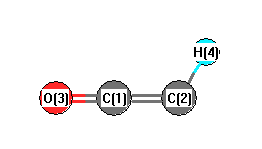 More geometry information
Calculated Bond Angles
| atom1 |
atom2 |
atom3 |
angle |
|
atom1 |
atom2 |
atom3 |
angle |
| C1 |
C2 |
H4 |
180.000 |
|
C2 |
C1 |
O3 |
180.000 |
Electronic energy levels
Charges, Dipole, Quadrupole and Polarizability
Jump to
S1C1
Energy calculated at MP2/CEP-31G*
| | hartrees |
|---|
| Energy at 0K | -27.525935 |
| Energy at 298.15K | |
| HF Energy | -27.141830 |
| Nuclear repulsion energy | 25.755370 |
The energy at 298.15K was derived from the energy at 0K
and an integrated heat capacity that used the calculated vibrational frequencies.
Vibrational Frequencies calculated at MP2/CEP-31G*
| Mode Number |
Symmetry |
Frequency
(cm-1) |
Scaled Frequency
(cm-1) |
IR Intensities
(km mol-1) |
Raman Act
(Å4/u) |
Dep P |
Dep U |
|---|
| 1 |
A' |
3264 |
3099 |
14.09 |
406.32 |
0.17 |
0.29 |
| 2 |
A' |
2398 |
2277 |
1106.90 |
5042.84 |
0.22 |
0.36 |
| 3 |
A' |
1209 |
1148 |
29.73 |
3852.63 |
0.35 |
0.52 |
| 4 |
A' |
866 |
822 |
95.29 |
2823.47 |
0.30 |
0.47 |
| 5 |
A' |
619 |
588 |
24.73 |
1608.30 |
0.34 |
0.51 |
| 6 |
A" |
479 |
455 |
2.64 |
68.13 |
0.75 |
0.86 |
Unscaled Zero Point Vibrational Energy (zpe) 4417.6 cm
-1
Scaled (by 0.9494) Zero Point Vibrational Energy (zpe) 4194.0 cm
-1
See section
III.C.1 List or set vibrational scaling factors
to change the scale factors used here.
See section
III.C.2
Calculate a vibrational scaling factor for a given set of molecules
to determine the least squares best scaling factor.
Geometric Data calculated at MP2/CEP-31G*
Point Group is Cs
Cartesians (Å)
| Atom |
x (Å) |
y (Å) |
z (Å) |
|---|
| C1 |
0.000 |
0.071 |
0.000 |
| C2 |
1.077 |
-0.790 |
0.000 |
| O3 |
-1.067 |
0.582 |
0.000 |
| H4 |
2.079 |
-0.343 |
0.000 |
Atom - Atom Distances (Å)
| |
C1 |
C2 |
O3 |
H4 |
| C1 | | 1.3786 | 1.1836 | 2.1201 |
C2 | 1.3786 | | 2.5457 | 1.0978 | O3 | 1.1836 | 2.5457 | | 3.2799 | H4 | 2.1201 | 1.0978 | 3.2799 | |
More geometry information
Calculated Bond Angles
| atom1 |
atom2 |
atom3 |
angle |
|
atom1 |
atom2 |
atom3 |
angle |
| C1 |
C2 |
H4 |
117.312 |
|
C2 |
C1 |
O3 |
166.949 |
Electronic energy levels
Charges, Dipole, Quadrupole and Polarizability
