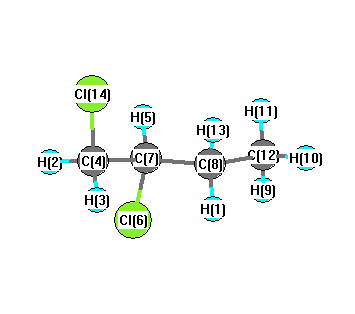
Vibrational Frequencies calculated at B3LYP/CEP-31G*
| Mode Number |
Symmetry |
Frequency
(cm-1) |
Scaled Frequency
(cm-1) |
IR Intensities
(km mol-1) |
Raman Act
(Å4/u) |
Dep P |
Dep U |
|---|
| 1 |
A |
3191 |
3081 |
11.05 |
|
|
|
| 2 |
A |
3133 |
3026 |
49.49 |
|
|
|
| 3 |
A |
3128 |
3021 |
21.99 |
|
|
|
| 4 |
A |
3115 |
3008 |
14.92 |
|
|
|
| 5 |
A |
3114 |
3007 |
32.37 |
|
|
|
| 6 |
A |
3093 |
2987 |
4.11 |
|
|
|
| 7 |
A |
3054 |
2949 |
17.33 |
|
|
|
| 8 |
A |
3048 |
2943 |
33.23 |
|
|
|
| 9 |
A |
1506 |
1454 |
8.70 |
|
|
|
| 10 |
A |
1498 |
1446 |
8.70 |
|
|
|
| 11 |
A |
1481 |
1430 |
3.41 |
|
|
|
| 12 |
A |
1475 |
1424 |
4.56 |
|
|
|
| 13 |
A |
1416 |
1367 |
3.03 |
|
|
|
| 14 |
A |
1395 |
1347 |
0.53 |
|
|
|
| 15 |
A |
1327 |
1281 |
7.78 |
|
|
|
| 16 |
A |
1315 |
1270 |
3.98 |
|
|
|
| 17 |
A |
1286 |
1242 |
12.06 |
|
|
|
| 18 |
A |
1228 |
1186 |
13.50 |
|
|
|
| 19 |
A |
1191 |
1150 |
14.08 |
|
|
|
| 20 |
A |
1119 |
1080 |
1.18 |
|
|
|
| 21 |
A |
1086 |
1049 |
1.53 |
|
|
|
| 22 |
A |
1057 |
1021 |
3.59 |
|
|
|
| 23 |
A |
1025 |
990 |
0.81 |
|
|
|
| 24 |
A |
939 |
907 |
11.71 |
|
|
|
| 25 |
A |
820 |
792 |
3.80 |
|
|
|
| 26 |
A |
799 |
772 |
18.39 |
|
|
|
| 27 |
A |
714 |
690 |
55.02 |
|
|
|
| 28 |
A |
637 |
615 |
55.25 |
|
|
|
| 29 |
A |
449 |
434 |
1.91 |
|
|
|
| 30 |
A |
370 |
357 |
1.92 |
|
|
|
| 31 |
A |
284 |
275 |
0.09 |
|
|
|
| 32 |
A |
233 |
225 |
0.51 |
|
|
|
| 33 |
A |
211 |
203 |
3.96 |
|
|
|
| 34 |
A |
182 |
176 |
3.80 |
|
|
|
| 35 |
A |
111 |
107 |
4.21 |
|
|
|
| 36 |
A |
87 |
84 |
1.19 |
|
|
|
Unscaled Zero Point Vibrational Energy (zpe) 25057.5 cm
-1
Scaled (by 0.9657) Zero Point Vibrational Energy (zpe) 24198.0 cm
-1
See section
III.C.1 List or set vibrational scaling factors
to change the scale factors used here.
See section
III.C.2
Calculate a vibrational scaling factor for a given set of molecules
to determine the least squares best scaling factor.
Charges, Dipole, Quadrupole and Polarizability
Charges from optimized geometry at B3LYP/CEP-31G*
Charges (e)
| Number |
Element |
Mulliken |
CHELPG |
AIM |
ESP |
| 1 |
H |
0.156 |
|
|
|
| 2 |
H |
0.236 |
|
|
|
| 3 |
H |
0.201 |
|
|
|
| 4 |
C |
-0.293 |
|
|
|
| 5 |
H |
0.222 |
|
|
|
| 6 |
Cl |
-0.178 |
|
|
|
| 7 |
C |
-0.182 |
|
|
|
| 8 |
C |
-0.178 |
|
|
|
| 9 |
H |
0.156 |
|
|
|
| 10 |
H |
0.180 |
|
|
|
| 11 |
H |
0.138 |
|
|
|
| 12 |
C |
-0.445 |
|
|
|
| 13 |
H |
0.146 |
|
|
|
| 14 |
Cl |
-0.160 |
|
|
|
Electric dipole moments
Electric dipole components in Debye
(What's a Debye? See section
VII.A.3)
| |
x |
y |
z |
Total |
| |
-0.590 |
-0.588 |
0.312 |
0.890 |
| CHELPG |
|
|
|
|
| AIM |
|
|
|
|
| ESP |
|
|
|
|
Electric Quadrupole moment
Quadrupole components in D Å
| Primitive |
|---|
| | x | y | z |
|---|
| x |
-53.945 |
4.762 |
0.388 |
| y |
4.762 |
-52.610 |
0.209 |
| z |
0.388 |
0.209 |
-48.734 |
|
| Traceless |
|---|
| | x | y | z |
|---|
| x |
-3.273 |
4.762 |
0.388 |
| y |
4.762 |
-1.270 |
0.209 |
| z |
0.388 |
0.209 |
4.544 |
|
| Polar |
|---|
| 3z2-r2 | 9.087 |
|---|
| x2-y2 | -1.335 |
|---|
| xy | 4.762 |
|---|
| xz | 0.388 |
|---|
| yz | 0.209 |
|---|
|
Polarizabilities
Components of the polarizability tensor.
Units are
Å
3 (Angstrom cubed)
Change units.
| |
x |
y |
z |
| x |
10.786 |
-1.777 |
-0.194 |
| y |
-1.777 |
10.855 |
0.468 |
| z |
-0.194 |
0.468 |
6.882 |
<r2> (average value of r
2) Å
2
| <r2> |
198.322 |
| (<r2>)1/2 |
14.083 |