Jump to
S2C1
Energy calculated at B3LYP/CEP-121G
| | hartrees |
|---|
| Energy at 0K | -27.052902 |
| Energy at 298.15K | -27.051044 |
| HF Energy | -27.052902 |
| Nuclear repulsion energy | 21.435775 |
The energy at 298.15K was derived from the energy at 0K
and an integrated heat capacity that used the calculated vibrational frequencies.
Geometric Data calculated at B3LYP/CEP-121G
Point Group is C∞v
Cartesians (Å)
| Atom |
x (Å) |
y (Å) |
z (Å) |
|---|
| C1 |
0.000 |
0.000 |
-1.463 |
| C2 |
0.000 |
0.000 |
-0.063 |
| O3 |
0.000 |
0.000 |
1.145 |
Atom - Atom Distances (Å)
| |
C1 |
C2 |
O3 |
| C1 | | 1.4003 | 2.6077 |
C2 | 1.4003 | | 1.2074 | O3 | 2.6077 | 1.2074 | |
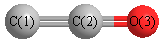 More geometry information
Calculated Bond Angles
| atom1 |
atom2 |
atom3 |
angle |
|
atom1 |
atom2 |
atom3 |
angle |
| C1 |
C2 |
O3 |
180.000 |
|
Electronic energy levels
Charges, Dipole, Quadrupole and Polarizability
Charges from optimized geometry at B3LYP/CEP-121G
Charges (e)
| Number |
Element |
Mulliken |
CHELPG |
AIM |
ESP |
| 1 |
C |
-0.090 |
|
|
|
| 2 |
C |
0.021 |
|
|
|
| 3 |
O |
0.070 |
|
|
|
Electric dipole moments
Electric dipole components in Debye
(What's a Debye? See section
VII.A.3)
| |
x |
y |
z |
Total |
| |
0.000 |
0.000 |
1.030 |
1.030 |
| CHELPG |
|
|
|
|
| AIM |
|
|
|
|
| ESP |
|
|
|
|
Electric Quadrupole moment
Quadrupole components in D Å
| Primitive |
|---|
| | x | y | z |
|---|
| x |
-15.947 |
0.000 |
0.000 |
| y |
0.000 |
-15.947 |
0.000 |
| z |
0.000 |
0.000 |
-23.151 |
|
| Traceless |
|---|
| | x | y | z |
|---|
| x |
3.602 |
0.000 |
0.000 |
| y |
0.000 |
3.602 |
0.000 |
| z |
0.000 |
0.000 |
-7.204 |
|
| Polar |
|---|
| 3z2-r2 | -14.408 |
|---|
| x2-y2 | 0.000 |
|---|
| xy | 0.000 |
|---|
| xz | 0.000 |
|---|
| yz | 0.000 |
|---|
|
Polarizabilities
Components of the polarizability tensor.
Units are
Å
3 (Angstrom cubed)
Change units.
| |
x |
y |
z |
| x |
2.328 |
0.000 |
0.000 |
| y |
0.000 |
2.328 |
0.000 |
| z |
0.000 |
0.000 |
5.996 |
<r2> (average value of r
2) Å
2
| <r2> |
27.898 |
| (<r2>)1/2 |
5.282 |
Jump to
S1C1
Energy calculated at B3LYP/CEP-121G
| | hartrees |
|---|
| Energy at 0K | -27.014884 |
| Energy at 298.15K | -27.013166 |
| HF Energy | -27.014884 |
| Nuclear repulsion energy | 21.387591 |
The energy at 298.15K was derived from the energy at 0K
and an integrated heat capacity that used the calculated vibrational frequencies.
Geometric Data calculated at B3LYP/CEP-121G
Point Group is C∞v
Cartesians (Å)
| Atom |
x (Å) |
y (Å) |
z (Å) |
|---|
| C1 |
0.000 |
0.000 |
-1.465 |
| C2 |
0.000 |
0.000 |
-0.065 |
| O3 |
0.000 |
0.000 |
1.147 |
Atom - Atom Distances (Å)
| |
C1 |
C2 |
O3 |
| C1 | | 1.3999 | 2.6121 |
C2 | 1.3999 | | 1.2122 | O3 | 2.6121 | 1.2122 | |
More geometry information
Calculated Bond Angles
| atom1 |
atom2 |
atom3 |
angle |
|
atom1 |
atom2 |
atom3 |
angle |
| C1 |
C2 |
O3 |
180.000 |
|
Electronic energy levels
Charges, Dipole, Quadrupole and Polarizability
Charges from optimized geometry at B3LYP/CEP-121G
Charges (e)
| Number |
Element |
Mulliken |
CHELPG |
AIM |
ESP |
| 1 |
C |
-0.070 |
|
|
|
| 2 |
C |
0.014 |
|
|
|
| 3 |
O |
0.056 |
|
|
|
Electric dipole moments
Electric dipole components in Debye
(What's a Debye? See section
VII.A.3)
| |
x |
y |
z |
Total |
| |
0.000 |
0.000 |
0.736 |
0.736 |
| CHELPG |
|
|
|
|
| AIM |
|
|
|
|
| ESP |
|
|
|
|
Electric Quadrupole moment
Quadrupole components in D Å
| Primitive |
|---|
| | x | y | z |
|---|
| x |
-17.829 |
0.000 |
0.000 |
| y |
0.000 |
-14.239 |
0.000 |
| z |
0.000 |
0.000 |
-22.921 |
|
| Traceless |
|---|
| | x | y | z |
|---|
| x |
0.752 |
0.000 |
0.000 |
| y |
0.000 |
6.136 |
0.000 |
| z |
0.000 |
0.000 |
-6.887 |
|
| Polar |
|---|
| 3z2-r2 | -13.774 |
|---|
| x2-y2 | -3.589 |
|---|
| xy | 0.000 |
|---|
| xz | 0.000 |
|---|
| yz | 0.000 |
|---|
|
Polarizabilities
Components of the polarizability tensor.
Units are
Å
3 (Angstrom cubed)
Change units.
| |
x |
y |
z |
| x |
1.925 |
0.000 |
0.000 |
| y |
0.000 |
2.099 |
0.000 |
| z |
0.000 |
0.000 |
5.797 |
<r2> (average value of r
2) Å
2
| <r2> |
27.945 |
| (<r2>)1/2 |
5.286 |
