Jump to
S1C2
S2C1
S2C2
Energy calculated at B3LYP/CEP-121G
| | hartrees |
|---|
| Energy at 0K | -21.627103 |
| Energy at 298.15K | -21.626078 |
| HF Energy | -21.627103 |
| Nuclear repulsion energy | 22.709393 |
The energy at 298.15K was derived from the energy at 0K
and an integrated heat capacity that used the calculated vibrational frequencies.
Vibrational Frequencies calculated at B3LYP/CEP-121G
| Mode Number |
Symmetry |
Frequency
(cm-1) |
Scaled Frequency
(cm-1) |
IR Intensities
(km mol-1) |
Raman Act
(Å4/u) |
Dep P |
Dep U |
|---|
| 1 |
A' |
3363 |
3277 |
37.37 |
|
|
|
| 2 |
A' |
1582 |
1542 |
41.06 |
|
|
|
| 3 |
A' |
1197 |
1167 |
1.46 |
|
|
|
| 4 |
A' |
417 |
406 |
0.09 |
|
|
|
| 5 |
A' |
177 |
173 |
57.43 |
|
|
|
| 6 |
A" |
418 |
408 |
0.53 |
|
|
|
Unscaled Zero Point Vibrational Energy (zpe) 3577.3 cm
-1
Scaled (by 0.9745) Zero Point Vibrational Energy (zpe) 3486.0 cm
-1
See section
III.C.1 List or set vibrational scaling factors
to change the scale factors used here.
See section
III.C.2
Calculate a vibrational scaling factor for a given set of molecules
to determine the least squares best scaling factor.
Geometric Data calculated at B3LYP/CEP-121G
Point Group is Cs
Cartesians (Å)
| Atom |
x (Å) |
y (Å) |
z (Å) |
|---|
| C1 |
0.180 |
-1.223 |
0.000 |
| C2 |
0.000 |
0.076 |
0.000 |
| N3 |
-0.247 |
1.296 |
0.000 |
| H4 |
0.648 |
-2.188 |
0.000 |
Atom - Atom Distances (Å)
| |
C1 |
C2 |
N3 |
H4 |
| C1 | | 1.3111 | 2.5548 | 1.0728 |
C2 | 1.3111 | | 1.2449 | 2.3548 | N3 | 2.5548 | 1.2449 | | 3.5971 | H4 | 1.0728 | 2.3548 | 3.5971 | |
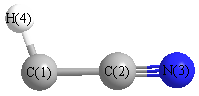 More geometry information
Calculated Bond Angles
| atom1 |
atom2 |
atom3 |
angle |
|
atom1 |
atom2 |
atom3 |
angle |
| C1 |
C2 |
N3 |
176.450 |
|
C2 |
C1 |
H4 |
161.975 |
Electronic energy levels
Charges, Dipole, Quadrupole and Polarizability
Jump to
S1C1
S2C1
S2C2
Energy calculated at B3LYP/CEP-121G
| | hartrees |
|---|
| Energy at 0K | -21.627080 |
| Energy at 298.15K | |
| HF Energy | -21.627080 |
| Nuclear repulsion energy | 22.715076 |
The energy at 298.15K was derived from the energy at 0K
and an integrated heat capacity that used the calculated vibrational frequencies.
Vibrational Frequencies calculated at B3LYP/CEP-121G
| Mode Number |
Symmetry |
Frequency
(cm-1) |
Scaled Frequency
(cm-1) |
IR Intensities
(km mol-1) |
Raman Act
(Å4/u) |
Dep P |
Dep U |
|---|
| 1 |
Σ |
3392 |
3306 |
51.05 |
|
|
|
| 2 |
Σ |
1568 |
1528 |
42.08 |
|
|
|
| 3 |
Σ |
1205 |
1174 |
0.41 |
|
|
|
| 4 |
Π |
414 |
403 |
0.79 |
|
|
|
| 4 |
Π |
414 |
403 |
0.79 |
|
|
|
| 5 |
Π |
30i |
29i |
66.30 |
|
|
|
| 5 |
Π |
30i |
29i |
66.30 |
|
|
|
Unscaled Zero Point Vibrational Energy (zpe) 3466.8 cm
-1
Scaled (by 0.9745) Zero Point Vibrational Energy (zpe) 3378.4 cm
-1
See section
III.C.1 List or set vibrational scaling factors
to change the scale factors used here.
See section
III.C.2
Calculate a vibrational scaling factor for a given set of molecules
to determine the least squares best scaling factor.
Geometric Data calculated at B3LYP/CEP-121G
Point Group is C∞v
Cartesians (Å)
| Atom |
x (Å) |
y (Å) |
z (Å) |
|---|
| C1 |
0.000 |
0.000 |
-1.230 |
| C2 |
0.000 |
0.000 |
0.072 |
| N3 |
0.000 |
0.000 |
1.322 |
| H4 |
0.000 |
0.000 |
-2.301 |
Atom - Atom Distances (Å)
| |
C1 |
C2 |
N3 |
H4 |
| C1 | | 1.3019 | 2.5523 | 1.0701 |
C2 | 1.3019 | | 1.2504 | 2.3721 | N3 | 2.5523 | 1.2504 | | 3.6224 | H4 | 1.0701 | 2.3721 | 3.6224 | |
More geometry information
Calculated Bond Angles
| atom1 |
atom2 |
atom3 |
angle |
|
atom1 |
atom2 |
atom3 |
angle |
| C1 |
C2 |
N3 |
180.000 |
|
C2 |
C1 |
H4 |
180.000 |
Electronic energy levels
Charges, Dipole, Quadrupole and Polarizability
Charges from optimized geometry at B3LYP/CEP-121G
Charges (e)
| Number |
Element |
Mulliken |
CHELPG |
AIM |
ESP |
| 1 |
C |
-0.229 |
|
|
|
| 2 |
C |
-0.324 |
|
|
|
| 3 |
N |
0.259 |
|
|
|
| 4 |
H |
0.293 |
|
|
|
Electric dipole moments
Electric dipole components in Debye
(What's a Debye? See section
VII.A.3)
| |
x |
y |
z |
Total |
| |
0.000 |
0.000 |
-3.345 |
3.345 |
| CHELPG |
|
|
|
|
| AIM |
|
|
|
|
| ESP |
|
|
|
|
Electric Quadrupole moment
Quadrupole components in D Å
| Primitive |
|---|
| | x | y | z |
|---|
| x |
-17.421 |
0.000 |
0.000 |
| y |
0.000 |
-17.421 |
0.000 |
| z |
0.000 |
0.000 |
-15.845 |
|
| Traceless |
|---|
| | x | y | z |
|---|
| x |
-0.788 |
0.000 |
0.000 |
| y |
0.000 |
-0.788 |
0.000 |
| z |
0.000 |
0.000 |
1.575 |
|
| Polar |
|---|
| 3z2-r2 | 3.151 |
|---|
| x2-y2 | 0.000 |
|---|
| xy | 0.000 |
|---|
| xz | 0.000 |
|---|
| yz | 0.000 |
|---|
|
Polarizabilities
Components of the polarizability tensor.
Units are
Å
3 (Angstrom cubed)
Change units.
| |
x |
y |
z |
| x |
1.878 |
0.000 |
0.000 |
| y |
0.000 |
1.878 |
0.000 |
| z |
0.000 |
0.000 |
6.656 |
<r2> (average value of r
2) Å
2
| <r2> |
30.658 |
| (<r2>)1/2 |
5.537 |
Jump to
S1C1
S1C2
S2C2
Energy calculated at B3LYP/CEP-121G
| | hartrees |
|---|
| Energy at 0K | -21.594553 |
| Energy at 298.15K | -21.593989 |
| HF Energy | -21.594553 |
| Nuclear repulsion energy | 22.558366 |
The energy at 298.15K was derived from the energy at 0K
and an integrated heat capacity that used the calculated vibrational frequencies.
Vibrational Frequencies calculated at B3LYP/CEP-121G
| Mode Number |
Symmetry |
Frequency
(cm-1) |
Scaled Frequency
(cm-1) |
IR Intensities
(km mol-1) |
Raman Act
(Å4/u) |
Dep P |
Dep U |
|---|
| 1 |
A' |
2965 |
2889 |
23.66 |
|
|
|
| 2 |
A' |
1956 |
1906 |
20.41 |
|
|
|
| 3 |
A' |
1046 |
1020 |
62.83 |
|
|
|
| 4 |
A' |
862 |
840 |
35.84 |
|
|
|
| 5 |
A' |
428 |
417 |
25.95 |
|
|
|
| 6 |
A" |
343 |
334 |
1.25 |
|
|
|
Unscaled Zero Point Vibrational Energy (zpe) 3799.5 cm
-1
Scaled (by 0.9745) Zero Point Vibrational Energy (zpe) 3702.7 cm
-1
See section
III.C.1 List or set vibrational scaling factors
to change the scale factors used here.
See section
III.C.2
Calculate a vibrational scaling factor for a given set of molecules
to determine the least squares best scaling factor.
Geometric Data calculated at B3LYP/CEP-121G
Point Group is Cs
Cartesians (Å)
| Atom |
x (Å) |
y (Å) |
z (Å) |
|---|
| C1 |
0.335 |
-1.266 |
0.000 |
| C2 |
0.000 |
0.100 |
0.000 |
| N3 |
-0.493 |
1.204 |
0.000 |
| H4 |
1.437 |
-1.429 |
0.000 |
Atom - Atom Distances (Å)
| |
C1 |
C2 |
N3 |
H4 |
| C1 | | 1.4062 | 2.6048 | 1.1135 |
C2 | 1.4062 | | 1.2090 | 2.0980 | N3 | 2.6048 | 1.2090 | | 3.2642 | H4 | 1.1135 | 2.0980 | 3.2642 | |
More geometry information
Electronic energy levels
Charges, Dipole, Quadrupole and Polarizability
Charges from optimized geometry at B3LYP/CEP-121G
Charges (e)
| Number |
Element |
Mulliken |
CHELPG |
AIM |
ESP |
| 1 |
C |
-0.088 |
|
|
|
| 2 |
C |
-0.311 |
|
|
|
| 3 |
N |
0.261 |
|
|
|
| 4 |
H |
0.138 |
|
|
|
Electric dipole moments
Electric dipole components in Debye
(What's a Debye? See section
VII.A.3)
| |
x |
y |
z |
Total |
| |
2.276 |
-1.068 |
0.000 |
2.514 |
| CHELPG |
|
|
|
|
| AIM |
|
|
|
|
| ESP |
|
|
|
|
Electric Quadrupole moment
Quadrupole components in D Å
| Primitive |
|---|
| | x | y | z |
|---|
| x |
-16.342 |
-1.778 |
0.000 |
| y |
-1.778 |
-22.680 |
0.000 |
| z |
0.000 |
0.000 |
-15.955 |
|
| Traceless |
|---|
| | x | y | z |
|---|
| x |
2.976 |
-1.778 |
0.000 |
| y |
-1.778 |
-6.532 |
0.000 |
| z |
0.000 |
0.000 |
3.556 |
|
| Polar |
|---|
| 3z2-r2 | 7.113 |
|---|
| x2-y2 | 6.338 |
|---|
| xy | -1.778 |
|---|
| xz | 0.000 |
|---|
| yz | 0.000 |
|---|
|
Polarizabilities
Components of the polarizability tensor.
Units are
Å
3 (Angstrom cubed)
Change units.
| |
x |
y |
z |
| x |
3.207 |
-1.491 |
0.000 |
| y |
-1.491 |
6.396 |
0.000 |
| z |
0.000 |
0.000 |
2.551 |
<r2> (average value of r
2) Å
2
| <r2> |
30.912 |
| (<r2>)1/2 |
5.560 |
Jump to
S1C1
S1C2
S2C1
Energy calculated at B3LYP/CEP-121G
| | hartrees |
|---|
| Energy at 0K | -21.594553 |
| Energy at 298.15K | -21.593989 |
| HF Energy | -21.594553 |
| Nuclear repulsion energy | 22.558366 |
The energy at 298.15K was derived from the energy at 0K
and an integrated heat capacity that used the calculated vibrational frequencies.
Vibrational Frequencies calculated at B3LYP/CEP-121G
Geometric Data calculated at B3LYP/CEP-121G
Point Group is Cs
Electronic energy levels
Charges, Dipole, Quadrupole and Polarizability
