Jump to
S1C2
Energy calculated at MP2/CEP-121G
| | hartrees |
|---|
| Energy at 0K | -35.479390 |
| Energy at 298.15K | |
| HF Energy | -35.325607 |
| Nuclear repulsion energy | 29.793134 |
The energy at 298.15K was derived from the energy at 0K
and an integrated heat capacity that used the calculated vibrational frequencies.
Vibrational Frequencies calculated at MP2/CEP-121G
| Mode Number |
Symmetry |
Frequency
(cm-1) |
Scaled Frequency
(cm-1) |
IR Intensities
(km mol-1) |
Raman Act
(Å4/u) |
Dep P |
Dep U |
|---|
| 1 |
A1 |
3248 |
3170 |
0.64 |
|
|
|
| 2 |
A1 |
700 |
683 |
13.66 |
|
|
|
| 3 |
A1 |
292 |
285 |
0.64 |
|
|
|
| 4 |
B1 |
551i |
538i |
93.64 |
|
|
|
| 5 |
B2 |
1246 |
1216 |
62.83 |
|
|
|
| 6 |
B2 |
895 |
873 |
140.54 |
|
|
|
Unscaled Zero Point Vibrational Energy (zpe) 2915.4 cm
-1
Scaled (by 0.976) Zero Point Vibrational Energy (zpe) 2845.4 cm
-1
See section
III.C.1 List or set vibrational scaling factors
to change the scale factors used here.
See section
III.C.2
Calculate a vibrational scaling factor for a given set of molecules
to determine the least squares best scaling factor.
Geometric Data calculated at MP2/CEP-121G
Point Group is C2v
Cartesians (Å)
| Atom |
x (Å) |
y (Å) |
z (Å) |
|---|
| C1 |
0.000 |
0.000 |
0.710 |
| H2 |
0.000 |
0.000 |
1.795 |
| Cl3 |
0.000 |
1.555 |
-0.178 |
| Cl4 |
0.000 |
-1.555 |
-0.178 |
Atom - Atom Distances (Å)
| |
C1 |
H2 |
Cl3 |
Cl4 |
| C1 | | 1.0850 | 1.7902 | 1.7902 |
H2 | 1.0850 | | 2.5117 | 2.5117 | Cl3 | 1.7902 | 2.5117 | | 3.1092 | Cl4 | 1.7902 | 2.5117 | 3.1092 | |
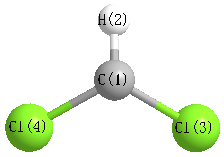 More geometry information
Calculated Bond Angles
| atom1 |
atom2 |
atom3 |
angle |
|
atom1 |
atom2 |
atom3 |
angle |
| Cl3 |
C1 |
H2 |
119.730 |
|
Cl3 |
C1 |
Cl4 |
120.541 |
| Cl4 |
C1 |
H2 |
119.730 |
|
Electronic energy levels
Charges, Dipole, Quadrupole and Polarizability
Jump to
S1C1
Energy calculated at MP2/CEP-121G
| | hartrees |
|---|
| Energy at 0K | -35.482172 |
| Energy at 298.15K | -35.483006 |
| HF Energy | -35.327306 |
| Nuclear repulsion energy | 29.666452 |
The energy at 298.15K was derived from the energy at 0K
and an integrated heat capacity that used the calculated vibrational frequencies.
Vibrational Frequencies calculated at MP2/CEP-121G
| Mode Number |
Symmetry |
Frequency
(cm-1) |
Scaled Frequency
(cm-1) |
IR Intensities
(km mol-1) |
Raman Act
(Å4/u) |
Dep P |
Dep U |
|---|
| 1 |
A' |
3183 |
3107 |
5.85 |
|
|
|
| 2 |
A' |
737 |
719 |
24.30 |
|
|
|
| 3 |
A' |
604 |
589 |
11.34 |
|
|
|
| 4 |
A' |
283 |
276 |
0.68 |
|
|
|
| 5 |
A" |
1264 |
1233 |
51.91 |
|
|
|
| 6 |
A" |
836 |
816 |
173.78 |
|
|
|
Unscaled Zero Point Vibrational Energy (zpe) 3453.0 cm
-1
Scaled (by 0.976) Zero Point Vibrational Energy (zpe) 3370.1 cm
-1
See section
III.C.1 List or set vibrational scaling factors
to change the scale factors used here.
See section
III.C.2
Calculate a vibrational scaling factor for a given set of molecules
to determine the least squares best scaling factor.
Geometric Data calculated at MP2/CEP-121G
Point Group is Cs
Cartesians (Å)
| Atom |
x (Å) |
y (Å) |
z (Å) |
|---|
| C1 |
0.015 |
0.749 |
0.000 |
| H2 |
-0.603 |
1.648 |
0.000 |
| Cl3 |
0.015 |
-0.181 |
1.552 |
| Cl4 |
0.015 |
-0.181 |
-1.552 |
Atom - Atom Distances (Å)
| |
C1 |
H2 |
Cl3 |
Cl4 |
| C1 | | 1.0912 | 1.8089 | 1.8089 |
H2 | 1.0912 | | 2.4768 | 2.4768 | Cl3 | 1.8089 | 2.4768 | | 3.1041 | Cl4 | 1.8089 | 2.4768 | 3.1041 | |
More geometry information
Calculated Bond Angles
| atom1 |
atom2 |
atom3 |
angle |
|
atom1 |
atom2 |
atom3 |
angle |
| Cl3 |
C1 |
H2 |
115.048 |
|
Cl3 |
C1 |
Cl4 |
118.185 |
| Cl4 |
C1 |
H2 |
115.048 |
|
Electronic energy levels
Charges, Dipole, Quadrupole and Polarizability
