Jump to
S2C1
Energy calculated at B3LYP/CEP-121G*
| | hartrees |
|---|
| Energy at 0K | -22.281031 |
| Energy at 298.15K | |
| HF Energy | -22.281031 |
| Nuclear repulsion energy | 27.899229 |
The energy at 298.15K was derived from the energy at 0K
and an integrated heat capacity that used the calculated vibrational frequencies.
Vibrational Frequencies calculated at B3LYP/CEP-121G*
| Mode Number |
Symmetry |
Frequency
(cm-1) |
Scaled Frequency
(cm-1) |
IR Intensities
(km mol-1) |
Raman Act
(Å4/u) |
Dep P |
Dep U |
|---|
| 1 |
Σg |
2063 |
2000 |
0.00 |
72.54 |
0.53 |
0.69 |
| 2 |
Σg |
915 |
887 |
0.00 |
105.99 |
0.38 |
0.55 |
| 3 |
Σu |
1542 |
1495 |
295.89 |
0.00 |
0.00 |
0.00 |
| 4 |
Πg |
543 |
526 |
0.00 |
3.89 |
0.75 |
0.86 |
| 4 |
Πg |
543 |
526 |
0.00 |
3.89 |
0.75 |
0.86 |
| 5 |
Πu |
232 |
225 |
22.93 |
0.00 |
0.00 |
0.00 |
| 5 |
Πu |
232 |
225 |
22.93 |
0.00 |
0.00 |
0.00 |
Unscaled Zero Point Vibrational Energy (zpe) 3034.4 cm
-1
Scaled (by 0.9694) Zero Point Vibrational Energy (zpe) 2941.5 cm
-1
See section
III.C.1 List or set vibrational scaling factors
to change the scale factors used here.
See section
III.C.2
Calculate a vibrational scaling factor for a given set of molecules
to determine the least squares best scaling factor.
Geometric Data calculated at B3LYP/CEP-121G*
Point Group is D∞h
Cartesians (Å)
| Atom |
x (Å) |
y (Å) |
z (Å) |
|---|
| C1 |
0.000 |
0.000 |
0.651 |
| C2 |
0.000 |
0.000 |
-0.651 |
| C3 |
0.000 |
0.000 |
1.974 |
| C4 |
0.000 |
0.000 |
-1.974 |
Atom - Atom Distances (Å)
| |
C1 |
C2 |
C3 |
C4 |
| C1 | | 1.3017 | 1.3231 | 2.6248 |
C2 | 1.3017 | | 2.6248 | 1.3231 | C3 | 1.3231 | 2.6248 | | 3.9479 | C4 | 2.6248 | 1.3231 | 3.9479 | |
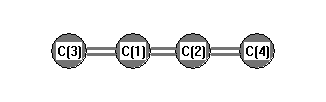 More geometry information
Calculated Bond Angles
| atom1 |
atom2 |
atom3 |
angle |
|
atom1 |
atom2 |
atom3 |
angle |
| C1 |
C2 |
C4 |
180.000 |
|
C2 |
C1 |
C3 |
180.000 |
Electronic energy levels
Charges, Dipole, Quadrupole and Polarizability
Charges from optimized geometry at B3LYP/CEP-121G*
Charges (e)
| Number |
Element |
Mulliken |
CHELPG |
AIM |
ESP |
| 1 |
C |
0.443 |
|
|
|
| 2 |
C |
0.443 |
|
|
|
| 3 |
C |
-0.443 |
|
|
|
| 4 |
C |
-0.443 |
|
|
|
Electric dipole moments
Electric dipole components in Debye
(What's a Debye? See section
VII.A.3)
| |
x |
y |
z |
Total |
| |
0.000 |
0.000 |
0.000 |
0.000 |
| CHELPG |
|
|
|
|
| AIM |
|
|
|
|
| ESP |
|
|
|
|
Electric Quadrupole moment
Quadrupole components in D Å
| Primitive |
|---|
| | x | y | z |
|---|
| x |
-21.774 |
0.000 |
0.000 |
| y |
0.000 |
-21.774 |
0.000 |
| z |
0.000 |
0.000 |
-33.170 |
|
| Traceless |
|---|
| | x | y | z |
|---|
| x |
5.698 |
0.000 |
0.000 |
| y |
0.000 |
5.698 |
0.000 |
| z |
0.000 |
0.000 |
-11.396 |
|
| Polar |
|---|
| 3z2-r2 | -22.791 |
|---|
| x2-y2 | 0.000 |
|---|
| xy | 0.000 |
|---|
| xz | 0.000 |
|---|
| yz | 0.000 |
|---|
|
Polarizabilities
Components of the polarizability tensor.
Units are
Å
3 (Angstrom cubed)
Change units.
| |
x |
y |
z |
| x |
3.576 |
0.000 |
0.000 |
| y |
0.000 |
3.576 |
0.000 |
| z |
0.000 |
0.000 |
13.731 |
<r2> (average value of r
2) Å
2
| <r2> |
50.532 |
| (<r2>)1/2 |
7.109 |
Jump to
S1C1
Energy calculated at B3LYP/CEP-121G*
| | hartrees |
|---|
| Energy at 0K | -22.252374 |
| Energy at 298.15K | |
| HF Energy | -22.252374 |
| Nuclear repulsion energy | 27.858331 |
The energy at 298.15K was derived from the energy at 0K
and an integrated heat capacity that used the calculated vibrational frequencies.
Vibrational Frequencies calculated at B3LYP/CEP-121G*
| Mode Number |
Symmetry |
Frequency
(cm-1) |
Scaled Frequency
(cm-1) |
IR Intensities
(km mol-1) |
Raman Act
(Å4/u) |
Dep P |
Dep U |
|---|
| 1 |
Σg |
2068 |
2005 |
0.00 |
86.81 |
0.39 |
0.56 |
| 2 |
Σg |
912 |
884 |
0.00 |
86.59 |
0.31 |
0.48 |
| 3 |
Σu |
1552 |
1505 |
380.37 |
0.00 |
0.00 |
0.00 |
| 4 |
Πg |
606 |
588 |
0.00 |
8.55 |
0.75 |
0.86 |
| 4 |
Πg |
521 |
505 |
0.00 |
4.91 |
0.75 |
0.86 |
| 5 |
Πu |
251 |
244 |
6.35 |
0.00 |
0.00 |
0.00 |
| 5 |
Πu |
227 |
220 |
34.76 |
0.00 |
0.00 |
0.00 |
Unscaled Zero Point Vibrational Energy (zpe) 3069.1 cm
-1
Scaled (by 0.9694) Zero Point Vibrational Energy (zpe) 2975.2 cm
-1
See section
III.C.1 List or set vibrational scaling factors
to change the scale factors used here.
See section
III.C.2
Calculate a vibrational scaling factor for a given set of molecules
to determine the least squares best scaling factor.
Geometric Data calculated at B3LYP/CEP-121G*
Point Group is D∞h
Cartesians (Å)
| Atom |
x (Å) |
y (Å) |
z (Å) |
|---|
| C1 |
0.000 |
0.000 |
0.653 |
| C2 |
0.000 |
0.000 |
-0.653 |
| C3 |
0.000 |
0.000 |
1.977 |
| C4 |
0.000 |
0.000 |
-1.977 |
Atom - Atom Distances (Å)
| |
C1 |
C2 |
C3 |
C4 |
| C1 | | 1.3057 | 1.3237 | 2.6295 |
C2 | 1.3057 | | 2.6295 | 1.3237 | C3 | 1.3237 | 2.6295 | | 3.9532 | C4 | 2.6295 | 1.3237 | 3.9532 | |
More geometry information
Electronic energy levels
Charges, Dipole, Quadrupole and Polarizability
Charges from optimized geometry at B3LYP/CEP-121G*
Charges (e)
| Number |
Element |
Mulliken |
CHELPG |
AIM |
ESP |
| 1 |
C |
0.444 |
|
|
|
| 2 |
C |
0.444 |
|
|
|
| 3 |
C |
-0.444 |
|
|
|
| 4 |
C |
-0.444 |
|
|
|
Electric dipole moments
Electric dipole components in Debye
(What's a Debye? See section
VII.A.3)
| |
x |
y |
z |
Total |
| |
0.000 |
0.000 |
0.000 |
0.000 |
| CHELPG |
|
|
|
|
| AIM |
|
|
|
|
| ESP |
|
|
|
|
Electric Quadrupole moment
Quadrupole components in D Å
| Primitive |
|---|
| | x | y | z |
|---|
| x |
-23.751 |
0.000 |
0.000 |
| y |
0.000 |
-19.986 |
0.000 |
| z |
0.000 |
0.000 |
-32.917 |
|
| Traceless |
|---|
| | x | y | z |
|---|
| x |
2.700 |
0.000 |
0.000 |
| y |
0.000 |
8.348 |
0.000 |
| z |
0.000 |
0.000 |
-11.048 |
|
| Polar |
|---|
| 3z2-r2 | -22.096 |
|---|
| x2-y2 | -3.765 |
|---|
| xy | 0.000 |
|---|
| xz | 0.000 |
|---|
| yz | 0.000 |
|---|
|
Polarizabilities
Components of the polarizability tensor.
Units are
Å
3 (Angstrom cubed)
Change units.
| |
x |
y |
z |
| x |
3.277 |
0.000 |
0.000 |
| y |
0.000 |
3.396 |
0.000 |
| z |
0.000 |
0.000 |
13.230 |
<r2> (average value of r
2) Å
2
| <r2> |
50.625 |
| (<r2>)1/2 |
7.115 |
