Jump to
S1C2
Energy calculated at HF/CEP-121G*
| | hartrees |
|---|
| Energy at 0K | -22.248904 |
| Energy at 298.15K | -22.250337 |
| HF Energy | -22.248904 |
| Nuclear repulsion energy | 18.000605 |
The energy at 298.15K was derived from the energy at 0K
and an integrated heat capacity that used the calculated vibrational frequencies.
Vibrational Frequencies calculated at HF/CEP-121G*
| Mode Number |
Symmetry |
Frequency
(cm-1) |
Scaled Frequency
(cm-1) |
IR Intensities
(km mol-1) |
Raman Act
(Å4/u) |
Dep P |
Dep U |
|---|
| 1 |
A' |
4092 |
3697 |
99.79 |
|
|
|
| 2 |
A' |
3117 |
2816 |
157.22 |
|
|
|
| 3 |
A' |
1639 |
1481 |
66.43 |
|
|
|
| 4 |
A' |
1417 |
1281 |
159.63 |
|
|
|
| 5 |
A' |
1326 |
1198 |
126.21 |
|
|
|
| 6 |
A" |
1127 |
1019 |
152.81 |
|
|
|
Unscaled Zero Point Vibrational Energy (zpe) 6359.2 cm
-1
Scaled (by 0.9034) Zero Point Vibrational Energy (zpe) 5744.9 cm
-1
See section
III.C.1 List or set vibrational scaling factors
to change the scale factors used here.
See section
III.C.2
Calculate a vibrational scaling factor for a given set of molecules
to determine the least squares best scaling factor.
Geometric Data calculated at HF/CEP-121G*
Point Group is Cs
Cartesians (Å)
| Atom |
x (Å) |
y (Å) |
z (Å) |
|---|
| C1 |
0.011 |
0.739 |
0.000 |
| O2 |
0.011 |
-0.568 |
0.000 |
| H3 |
-1.061 |
0.989 |
0.000 |
| H4 |
0.908 |
-0.879 |
0.000 |
Atom - Atom Distances (Å)
| |
C1 |
O2 |
H3 |
H4 |
| C1 | | 1.3071 | 1.1004 | 1.8506 |
O2 | 1.3071 | | 1.8901 | 0.9500 | H3 | 1.1004 | 1.8901 | | 2.7144 | H4 | 1.8506 | 0.9500 | 2.7144 | |
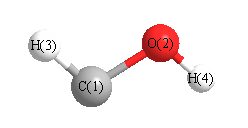 More geometry information
Calculated Bond Angles
| atom1 |
atom2 |
atom3 |
angle |
|
atom1 |
atom2 |
atom3 |
angle |
| C1 |
O2 |
H4 |
109.124 |
|
O2 |
C1 |
H3 |
103.124 |
Electronic energy levels
Charges, Dipole, Quadrupole and Polarizability
Charges from optimized geometry at HF/CEP-121G*
Charges (e)
| Number |
Element |
Mulliken |
CHELPG |
AIM |
ESP |
| 1 |
C |
-0.095 |
|
|
|
| 2 |
O |
-0.479 |
|
|
|
| 3 |
H |
0.103 |
|
|
|
| 4 |
H |
0.471 |
|
|
|
Electric dipole moments
Electric dipole components in Debye
(What's a Debye? See section
VII.A.3)
| |
x |
y |
z |
Total |
| |
0.167 |
-1.351 |
0.000 |
1.361 |
| CHELPG |
|
|
|
|
| AIM |
|
|
|
|
| ESP |
|
|
|
|
Electric Quadrupole moment
Quadrupole components in D Å
| Primitive |
|---|
| | x | y | z |
|---|
| x |
-11.078 |
-4.069 |
0.000 |
| y |
-4.069 |
-13.829 |
0.000 |
| z |
0.000 |
0.000 |
-11.879 |
|
| Traceless |
|---|
| | x | y | z |
|---|
| x |
1.776 |
-4.069 |
0.000 |
| y |
-4.069 |
-2.350 |
0.000 |
| z |
0.000 |
0.000 |
0.574 |
|
| Polar |
|---|
| 3z2-r2 | 1.148 |
|---|
| x2-y2 | 2.751 |
|---|
| xy | -4.069 |
|---|
| xz | 0.000 |
|---|
| yz | 0.000 |
|---|
|
Polarizabilities
Components of the polarizability tensor.
Units are
Å
3 (Angstrom cubed)
Change units.
| |
x |
y |
z |
| x |
2.455 |
-0.486 |
0.000 |
| y |
-0.486 |
2.411 |
0.000 |
| z |
0.000 |
0.000 |
1.637 |
<r2> (average value of r
2) Å
2
| <r2> |
15.482 |
| (<r2>)1/2 |
3.935 |
Jump to
S1C1
Energy calculated at HF/CEP-121G*
| | hartrees |
|---|
| Energy at 0K | -22.238668 |
| Energy at 298.15K | -22.240087 |
| HF Energy | -22.238668 |
| Nuclear repulsion energy | 17.939256 |
The energy at 298.15K was derived from the energy at 0K
and an integrated heat capacity that used the calculated vibrational frequencies.
Vibrational Frequencies calculated at HF/CEP-121G*
| Mode Number |
Symmetry |
Frequency
(cm-1) |
Scaled Frequency
(cm-1) |
IR Intensities
(km mol-1) |
Raman Act
(Å4/u) |
Dep P |
Dep U |
|---|
| 1 |
A' |
4010 |
3623 |
32.48 |
|
|
|
| 2 |
A' |
3012 |
2721 |
247.06 |
|
|
|
| 3 |
A' |
1595 |
1441 |
61.92 |
|
|
|
| 4 |
A' |
1413 |
1277 |
224.88 |
|
|
|
| 5 |
A' |
1356 |
1225 |
3.03 |
|
|
|
| 6 |
A" |
1029 |
930 |
48.32 |
|
|
|
Unscaled Zero Point Vibrational Energy (zpe) 6207.7 cm
-1
Scaled (by 0.9034) Zero Point Vibrational Energy (zpe) 5608.1 cm
-1
See section
III.C.1 List or set vibrational scaling factors
to change the scale factors used here.
See section
III.C.2
Calculate a vibrational scaling factor for a given set of molecules
to determine the least squares best scaling factor.
Geometric Data calculated at HF/CEP-121G*
Point Group is Cs
Cartesians (Å)
| Atom |
x (Å) |
y (Å) |
z (Å) |
|---|
| C1 |
0.120 |
0.741 |
0.000 |
| O2 |
0.120 |
-0.567 |
0.000 |
| H3 |
-0.940 |
1.065 |
0.000 |
| H4 |
-0.740 |
-0.978 |
0.000 |
Atom - Atom Distances (Å)
| |
C1 |
O2 |
H3 |
H4 |
| C1 | | 1.3081 | 1.1085 | 1.9225 |
O2 | 1.3081 | | 1.9461 | 0.9534 | H3 | 1.1085 | 1.9461 | | 2.0531 | H4 | 1.9225 | 0.9534 | 2.0531 | |
More geometry information
Calculated Bond Angles
| atom1 |
atom2 |
atom3 |
angle |
|
atom1 |
atom2 |
atom3 |
angle |
| C1 |
O2 |
H4 |
115.553 |
|
O2 |
C1 |
H3 |
106.996 |
Electronic energy levels
Charges, Dipole, Quadrupole and Polarizability
Charges from optimized geometry at HF/CEP-121G*
Charges (e)
| Number |
Element |
Mulliken |
CHELPG |
AIM |
ESP |
| 1 |
C |
-0.033 |
|
|
|
| 2 |
O |
-0.482 |
|
|
|
| 3 |
H |
0.070 |
|
|
|
| 4 |
H |
0.445 |
|
|
|
Electric dipole moments
Electric dipole components in Debye
(What's a Debye? See section
VII.A.3)
| |
x |
y |
z |
Total |
| |
-3.346 |
-1.455 |
0.000 |
3.648 |
| CHELPG |
|
|
|
|
| AIM |
|
|
|
|
| ESP |
|
|
|
|
Electric Quadrupole moment
Quadrupole components in D Å
| Primitive |
|---|
| | x | y | z |
|---|
| x |
-12.360 |
-0.133 |
0.000 |
| y |
-0.133 |
-13.403 |
0.000 |
| z |
0.000 |
0.000 |
-11.813 |
|
| Traceless |
|---|
| | x | y | z |
|---|
| x |
0.248 |
-0.133 |
0.000 |
| y |
-0.133 |
-1.316 |
0.000 |
| z |
0.000 |
0.000 |
1.069 |
|
| Polar |
|---|
| 3z2-r2 | 2.137 |
|---|
| x2-y2 | 1.043 |
|---|
| xy | -0.133 |
|---|
| xz | 0.000 |
|---|
| yz | 0.000 |
|---|
|
Polarizabilities
Components of the polarizability tensor.
Units are
Å
3 (Angstrom cubed)
Change units.
| |
x |
y |
z |
| x |
2.420 |
-0.118 |
0.000 |
| y |
-0.118 |
2.623 |
0.000 |
| z |
0.000 |
0.000 |
1.631 |
<r2> (average value of r
2) Å
2
| <r2> |
15.616 |
| (<r2>)1/2 |
3.952 |
