Jump to
S2C1
Energy calculated at HF/CEP-121G*
| | hartrees |
|---|
| Energy at 0K | -20.631091 |
| Energy at 298.15K | -20.630967 |
| HF Energy | -20.631091 |
| Nuclear repulsion energy | 12.197536 |
The energy at 298.15K was derived from the energy at 0K
and an integrated heat capacity that used the calculated vibrational frequencies.
Geometric Data calculated at HF/CEP-121G*
Point Group is Cs
Cartesians (Å)
| Atom |
x (Å) |
y (Å) |
z (Å) |
|---|
| C1 |
0.045 |
1.209 |
0.000 |
| Cl2 |
0.045 |
-0.512 |
0.000 |
| H3 |
-1.024 |
1.451 |
0.000 |
Atom - Atom Distances (Å)
| |
C1 |
Cl2 |
H3 |
| C1 | | 1.7213 | 1.0954 |
Cl2 | 1.7213 | | 2.2350 | H3 | 1.0954 | 2.2350 | |
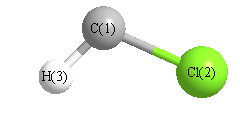 More geometry information
Calculated Bond Angles
| atom1 |
atom2 |
atom3 |
angle |
|
atom1 |
atom2 |
atom3 |
angle |
| Cl2 |
C1 |
H3 |
102.755 |
|
Electronic energy levels
Charges, Dipole, Quadrupole and Polarizability
Charges from optimized geometry at HF/CEP-121G*
Charges (e)
| Number |
Element |
Mulliken |
CHELPG |
AIM |
ESP |
| 1 |
C |
-0.053 |
|
|
|
| 2 |
Cl |
-0.098 |
|
|
|
| 3 |
H |
0.150 |
|
|
|
Electric dipole moments
Electric dipole components in Debye
(What's a Debye? See section
VII.A.3)
| |
x |
y |
z |
Total |
| |
-1.740 |
-0.070 |
0.000 |
1.741 |
| CHELPG |
|
|
|
|
| AIM |
|
|
|
|
| ESP |
|
|
|
|
Electric Quadrupole moment
Quadrupole components in D Å
| Primitive |
|---|
| | x | y | z |
|---|
| x |
-19.047 |
-3.060 |
0.000 |
| y |
-3.060 |
-19.481 |
0.000 |
| z |
0.000 |
0.000 |
-17.446 |
|
| Traceless |
|---|
| | x | y | z |
|---|
| x |
-0.583 |
-3.060 |
0.000 |
| y |
-3.060 |
-1.235 |
0.000 |
| z |
0.000 |
0.000 |
1.818 |
|
| Polar |
|---|
| 3z2-r2 | 3.636 |
|---|
| x2-y2 | 0.434 |
|---|
| xy | -3.060 |
|---|
| xz | 0.000 |
|---|
| yz | 0.000 |
|---|
|
Polarizabilities
Components of the polarizability tensor.
Units are
Å
3 (Angstrom cubed)
Change units.
| |
x |
y |
z |
| x |
2.457 |
-0.299 |
0.000 |
| y |
-0.299 |
4.562 |
0.000 |
| z |
0.000 |
0.000 |
2.128 |
<r2> (average value of r
2) Å
2
| <r2> |
22.514 |
| (<r2>)1/2 |
4.745 |
Jump to
S1C1
Energy calculated at HF/CEP-121G*
| | hartrees |
|---|
| Energy at 0K | -20.656474 |
| Energy at 298.15K | -20.656344 |
| HF Energy | -20.656474 |
| Nuclear repulsion energy | 12.161250 |
The energy at 298.15K was derived from the energy at 0K
and an integrated heat capacity that used the calculated vibrational frequencies.
Geometric Data calculated at HF/CEP-121G*
Point Group is Cs
Cartesians (Å)
| Atom |
x (Å) |
y (Å) |
z (Å) |
|---|
| C1 |
0.037 |
1.181 |
0.000 |
| Cl2 |
0.037 |
-0.522 |
0.000 |
| H3 |
-0.848 |
1.793 |
0.000 |
Atom - Atom Distances (Å)
| |
C1 |
Cl2 |
H3 |
| C1 | | 1.7032 | 1.0760 |
Cl2 | 1.7032 | | 2.4788 | H3 | 1.0760 | 2.4788 | |
More geometry information
Calculated Bond Angles
| atom1 |
atom2 |
atom3 |
angle |
|
atom1 |
atom2 |
atom3 |
angle |
| Cl2 |
C1 |
H3 |
124.684 |
|
Electronic energy levels
Charges, Dipole, Quadrupole and Polarizability
Charges from optimized geometry at HF/CEP-121G*
Charges (e)
| Number |
Element |
Mulliken |
CHELPG |
AIM |
ESP |
| 1 |
C |
-0.109 |
|
|
|
| 2 |
Cl |
-0.093 |
|
|
|
| 3 |
H |
0.201 |
|
|
|
Electric dipole moments
Electric dipole components in Debye
(What's a Debye? See section
VII.A.3)
| |
x |
y |
z |
Total |
| |
-0.697 |
1.044 |
0.000 |
1.255 |
| CHELPG |
|
|
|
|
| AIM |
|
|
|
|
| ESP |
|
|
|
|
Electric Quadrupole moment
Quadrupole components in D Å
| Primitive |
|---|
| | x | y | z |
|---|
| x |
-17.873 |
-1.339 |
0.000 |
| y |
-1.339 |
-16.078 |
0.000 |
| z |
0.000 |
0.000 |
-19.015 |
|
| Traceless |
|---|
| | x | y | z |
|---|
| x |
-0.326 |
-1.339 |
0.000 |
| y |
-1.339 |
2.366 |
0.000 |
| z |
0.000 |
0.000 |
-2.040 |
|
| Polar |
|---|
| 3z2-r2 | -4.079 |
|---|
| x2-y2 | -1.795 |
|---|
| xy | -1.339 |
|---|
| xz | 0.000 |
|---|
| yz | 0.000 |
|---|
|
Polarizabilities
Components of the polarizability tensor.
Units are
Å
3 (Angstrom cubed)
Change units.
| |
x |
y |
z |
| x |
2.066 |
-0.210 |
0.000 |
| y |
-0.210 |
4.093 |
0.000 |
| z |
0.000 |
0.000 |
1.779 |
<r2> (average value of r
2) Å
2
| <r2> |
22.464 |
| (<r2>)1/2 |
4.740 |
