Jump to
S1C2
S2C1
S2C2
Energy calculated at HF/CEP-121G*
| | hartrees |
|---|
| Energy at 0K | -21.155372 |
| Energy at 298.15K | -21.154736 |
| HF Energy | -21.155372 |
| Nuclear repulsion energy | 22.993175 |
The energy at 298.15K was derived from the energy at 0K
and an integrated heat capacity that used the calculated vibrational frequencies.
Vibrational Frequencies calculated at HF/CEP-121G*
| Mode Number |
Symmetry |
Frequency
(cm-1) |
Scaled Frequency
(cm-1) |
IR Intensities
(km mol-1) |
Raman Act
(Å4/u) |
Dep P |
Dep U |
|---|
| 1 |
A' |
3470 |
3135 |
10.65 |
|
|
|
| 2 |
A' |
1608 |
1452 |
132.69 |
|
|
|
| 3 |
A' |
1171 |
1058 |
4.20 |
|
|
|
| 4 |
A' |
674 |
609 |
16.81 |
|
|
|
| 5 |
A' |
368 |
333 |
0.21 |
|
|
|
| 6 |
A" |
397 |
358 |
0.02 |
|
|
|
Unscaled Zero Point Vibrational Energy (zpe) 3843.5 cm
-1
Scaled (by 0.9034) Zero Point Vibrational Energy (zpe) 3472.3 cm
-1
See section
III.C.1 List or set vibrational scaling factors
to change the scale factors used here.
See section
III.C.2
Calculate a vibrational scaling factor for a given set of molecules
to determine the least squares best scaling factor.
Geometric Data calculated at HF/CEP-121G*
Point Group is Cs
Cartesians (Å)
| Atom |
x (Å) |
y (Å) |
z (Å) |
|---|
| C1 |
0.299 |
-1.207 |
0.000 |
| C2 |
0.000 |
0.094 |
0.000 |
| N3 |
-0.418 |
1.222 |
0.000 |
| H4 |
1.130 |
-1.878 |
0.000 |
Atom - Atom Distances (Å)
| |
C1 |
C2 |
N3 |
H4 |
| C1 | | 1.3355 | 2.5330 | 1.0683 |
C2 | 1.3355 | | 1.2028 | 2.2734 | N3 | 2.5330 | 1.2028 | | 3.4654 | H4 | 1.0683 | 2.2734 | 3.4654 | |
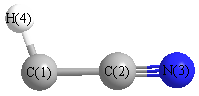 More geometry information
Calculated Bond Angles
| atom1 |
atom2 |
atom3 |
angle |
|
atom1 |
atom2 |
atom3 |
angle |
| C1 |
C2 |
N3 |
172.615 |
|
C2 |
C1 |
H4 |
141.846 |
Electronic energy levels
Charges, Dipole, Quadrupole and Polarizability
Jump to
S1C1
S2C1
S2C2
Energy calculated at HF/CEP-121G*
| | hartrees |
|---|
| Energy at 0K | -21.152506 |
| Energy at 298.15K | |
| HF Energy | -21.152506 |
| Nuclear repulsion energy | 23.022188 |
The energy at 298.15K was derived from the energy at 0K
and an integrated heat capacity that used the calculated vibrational frequencies.
Vibrational Frequencies calculated at HF/CEP-121G*
| Mode Number |
Symmetry |
Frequency
(cm-1) |
Scaled Frequency
(cm-1) |
IR Intensities
(km mol-1) |
Raman Act
(Å4/u) |
Dep P |
Dep U |
|---|
| 1 |
Σ |
3545 |
3203 |
50.19 |
|
|
|
| 2 |
Σ |
1523 |
1376 |
116.33 |
|
|
|
| 3 |
Σ |
1227 |
1109 |
0.33 |
|
|
|
| 4 |
Π |
393 |
355 |
0.87 |
|
|
|
| 4 |
Π |
393 |
355 |
0.87 |
|
|
|
| 5 |
Π |
438i |
396i |
53.38 |
|
|
|
| 5 |
Π |
438i |
396i |
53.38 |
|
|
|
Unscaled Zero Point Vibrational Energy (zpe) 3102.8 cm
-1
Scaled (by 0.9034) Zero Point Vibrational Energy (zpe) 2803.0 cm
-1
See section
III.C.1 List or set vibrational scaling factors
to change the scale factors used here.
See section
III.C.2
Calculate a vibrational scaling factor for a given set of molecules
to determine the least squares best scaling factor.
Geometric Data calculated at HF/CEP-121G*
Point Group is C∞v
Cartesians (Å)
| Atom |
x (Å) |
y (Å) |
z (Å) |
|---|
| C1 |
0.000 |
0.000 |
-1.217 |
| C2 |
0.000 |
0.000 |
0.078 |
| N3 |
0.000 |
0.000 |
1.302 |
| H4 |
0.000 |
0.000 |
-2.279 |
Atom - Atom Distances (Å)
| |
C1 |
C2 |
N3 |
H4 |
| C1 | | 1.2945 | 2.5183 | 1.0619 |
C2 | 1.2945 | | 1.2237 | 2.3565 | N3 | 2.5183 | 1.2237 | | 3.5802 | H4 | 1.0619 | 2.3565 | 3.5802 | |
More geometry information
Calculated Bond Angles
| atom1 |
atom2 |
atom3 |
angle |
|
atom1 |
atom2 |
atom3 |
angle |
| C1 |
C2 |
N3 |
180.000 |
|
C2 |
C1 |
H4 |
180.000 |
Electronic energy levels
Charges, Dipole, Quadrupole and Polarizability
Charges from optimized geometry at HF/CEP-121G*
Charges (e)
| Number |
Element |
Mulliken |
CHELPG |
AIM |
ESP |
| 1 |
C |
-0.201 |
|
|
|
| 2 |
C |
-0.168 |
|
|
|
| 3 |
N |
0.010 |
|
|
|
| 4 |
H |
0.359 |
|
|
|
Electric dipole moments
Electric dipole components in Debye
(What's a Debye? See section
VII.A.3)
| |
x |
y |
z |
Total |
| |
0.000 |
0.000 |
-3.210 |
3.210 |
| CHELPG |
|
|
|
|
| AIM |
|
|
|
|
| ESP |
|
|
|
|
Electric Quadrupole moment
Quadrupole components in D Å
| Primitive |
|---|
| | x | y | z |
|---|
| x |
-17.396 |
0.000 |
0.000 |
| y |
0.000 |
-17.396 |
0.000 |
| z |
0.000 |
0.000 |
-15.412 |
|
| Traceless |
|---|
| | x | y | z |
|---|
| x |
-0.992 |
0.000 |
0.000 |
| y |
0.000 |
-0.992 |
0.000 |
| z |
0.000 |
0.000 |
1.984 |
|
| Polar |
|---|
| 3z2-r2 | 3.967 |
|---|
| x2-y2 | 0.000 |
|---|
| xy | 0.000 |
|---|
| xz | 0.000 |
|---|
| yz | 0.000 |
|---|
|
Polarizabilities
Components of the polarizability tensor.
Units are
Å
3 (Angstrom cubed)
Change units.
| |
x |
y |
z |
| x |
1.987 |
0.000 |
0.000 |
| y |
0.000 |
1.987 |
0.000 |
| z |
0.000 |
0.000 |
5.917 |
<r2> (average value of r
2) Å
2
| <r2> |
30.061 |
| (<r2>)1/2 |
5.483 |
Jump to
S1C1
S1C2
S2C2
Energy calculated at HF/CEP-121G*
| | hartrees |
|---|
| Energy at 0K | -21.096011 |
| Energy at 298.15K | -21.095519 |
| HF Energy | -21.096011 |
| Nuclear repulsion energy | 23.098467 |
The energy at 298.15K was derived from the energy at 0K
and an integrated heat capacity that used the calculated vibrational frequencies.
Vibrational Frequencies calculated at HF/CEP-121G*
| Mode Number |
Symmetry |
Frequency
(cm-1) |
Scaled Frequency
(cm-1) |
IR Intensities
(km mol-1) |
Raman Act
(Å4/u) |
Dep P |
Dep U |
|---|
| 1 |
A' |
3250 |
2936 |
16.20 |
|
|
|
| 2 |
A' |
2328 |
2103 |
33.02 |
|
|
|
| 3 |
A' |
1154 |
1042 |
57.11 |
|
|
|
| 4 |
A' |
989 |
893 |
36.40 |
|
|
|
| 5 |
A' |
464 |
419 |
26.82 |
|
|
|
| 6 |
A" |
350 |
316 |
13.70 |
|
|
|
Unscaled Zero Point Vibrational Energy (zpe) 4266.5 cm
-1
Scaled (by 0.9034) Zero Point Vibrational Energy (zpe) 3854.4 cm
-1
See section
III.C.1 List or set vibrational scaling factors
to change the scale factors used here.
See section
III.C.2
Calculate a vibrational scaling factor for a given set of molecules
to determine the least squares best scaling factor.
Geometric Data calculated at HF/CEP-121G*
Point Group is Cs
Cartesians (Å)
| Atom |
x (Å) |
y (Å) |
z (Å) |
|---|
| C1 |
-0.225 |
-1.291 |
0.000 |
| C2 |
0.000 |
0.116 |
0.000 |
| N3 |
0.086 |
1.262 |
0.000 |
| H4 |
0.750 |
-1.779 |
0.000 |
Atom - Atom Distances (Å)
| |
C1 |
C2 |
N3 |
H4 |
| C1 | | 1.4244 | 2.5714 | 1.0908 |
C2 | 1.4244 | | 1.1493 | 2.0377 | N3 | 2.5714 | 1.1493 | | 3.1123 | H4 | 1.0908 | 2.0377 | 3.1123 | |
More geometry information
Electronic energy levels
Charges, Dipole, Quadrupole and Polarizability
Charges from optimized geometry at HF/CEP-121G*
Charges (e)
| Number |
Element |
Mulliken |
CHELPG |
AIM |
ESP |
| 1 |
C |
-0.079 |
|
|
|
| 2 |
C |
-0.061 |
|
|
|
| 3 |
N |
-0.032 |
|
|
|
| 4 |
H |
0.171 |
|
|
|
Electric dipole moments
Electric dipole components in Debye
(What's a Debye? See section
VII.A.3)
| |
x |
y |
z |
Total |
| |
1.573 |
-2.092 |
0.000 |
2.617 |
| CHELPG |
|
|
|
|
| AIM |
|
|
|
|
| ESP |
|
|
|
|
Electric Quadrupole moment
Quadrupole components in D Å
| Primitive |
|---|
| | x | y | z |
|---|
| x |
-18.477 |
-3.621 |
0.000 |
| y |
-3.621 |
-20.543 |
0.000 |
| z |
0.000 |
0.000 |
-15.952 |
|
| Traceless |
|---|
| | x | y | z |
|---|
| x |
-0.229 |
-3.621 |
0.000 |
| y |
-3.621 |
-3.329 |
0.000 |
| z |
0.000 |
0.000 |
3.558 |
|
| Polar |
|---|
| 3z2-r2 | 7.116 |
|---|
| x2-y2 | 2.066 |
|---|
| xy | -3.621 |
|---|
| xz | 0.000 |
|---|
| yz | 0.000 |
|---|
|
Polarizabilities
Components of the polarizability tensor.
Units are
Å
3 (Angstrom cubed)
Change units.
| |
x |
y |
z |
| x |
2.547 |
0.154 |
0.000 |
| y |
0.154 |
5.912 |
0.000 |
| z |
0.000 |
0.000 |
2.568 |
<r2> (average value of r
2) Å
2
| <r2> |
30.090 |
| (<r2>)1/2 |
5.485 |
Jump to
S1C1
S1C2
S2C1
Energy calculated at HF/CEP-121G*
| | hartrees |
|---|
| Energy at 0K | -21.096011 |
| Energy at 298.15K | -21.095519 |
| HF Energy | -21.096011 |
| Nuclear repulsion energy | 23.098467 |
The energy at 298.15K was derived from the energy at 0K
and an integrated heat capacity that used the calculated vibrational frequencies.
Vibrational Frequencies calculated at HF/CEP-121G*
Geometric Data calculated at HF/CEP-121G*
Point Group is Cs
Electronic energy levels
Charges, Dipole, Quadrupole and Polarizability
