Jump to
S1C2
Energy calculated at wB97X-D/CEP-121G*
| | hartrees |
|---|
| Energy at 0K | -26.290845 |
| Energy at 298.15K | -26.291522 |
| HF Energy | -26.290845 |
| Nuclear repulsion energy | |
The energy at 298.15K was derived from the energy at 0K
and an integrated heat capacity that used the calculated vibrational frequencies.
Vibrational Frequencies calculated at wB97X-D/CEP-121G*
| Mode Number |
Symmetry |
Frequency
(cm-1) |
Scaled Frequency
(cm-1) |
IR Intensities
(km mol-1) |
Raman Act
(Å4/u) |
Dep P |
Dep U |
|---|
| 1 |
A' |
3725 |
3725 |
256.46 |
|
|
|
| 2 |
A' |
2047 |
2047 |
805.73 |
|
|
|
| 3 |
A' |
867 |
867 |
5.62 |
|
|
|
| 4 |
A' |
585 |
585 |
325.66 |
|
|
|
| 5 |
A' |
430 |
430 |
159.94 |
|
|
|
| 6 |
A" |
477 |
477 |
2.25 |
|
|
|
Unscaled Zero Point Vibrational Energy (zpe) 4065.7 cm
-1
Scaled (by 1) Zero Point Vibrational Energy (zpe) 4065.7 cm
-1
See section
III.C.1 List or set vibrational scaling factors
to change the scale factors used here.
See section
III.C.2
Calculate a vibrational scaling factor for a given set of molecules
to determine the least squares best scaling factor.
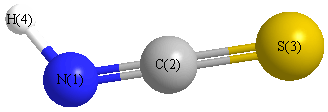
Geometric Data calculated at wB97X-D/CEP-121G*
Point Group is Cs
Cartesians (Å)
| Atom |
x (Å) |
y (Å) |
z (Å) |
|---|
| N1 |
-0.147 |
1.701 |
0.000 |
| C2 |
0.000 |
0.502 |
0.000 |
| S3 |
0.032 |
-1.086 |
0.000 |
| H4 |
0.514 |
2.461 |
0.000 |
Atom - Atom Distances (Å)
| |
N1 |
C2 |
S3 |
H4 |
| N1 | | 1.2079 | 2.7922 | 1.0079 |
C2 | 1.2079 | | 1.5879 | 2.0256 | S3 | 2.7922 | 1.5879 | | 3.5794 | H4 | 1.0079 | 2.0256 | 3.5794 | |
 More geometry information
Calculated Bond Angles
| atom1 |
atom2 |
atom3 |
angle |
|
atom1 |
atom2 |
atom3 |
angle |
| N1 |
C2 |
S3 |
174.156 |
|
C2 |
N1 |
H4 |
131.969 |
Electronic energy levels
Charges, Dipole, Quadrupole and Polarizability
Charges from optimized geometry at wB97X-D/CEP-121G*
Charges (e)
| Number |
Element |
Mulliken |
CHELPG |
AIM |
ESP |
| 1 |
N |
-0.272 |
|
|
|
| 2 |
C |
0.098 |
|
|
|
| 3 |
S |
-0.211 |
|
|
|
| 4 |
H |
0.385 |
|
|
|
Electric dipole moments
Electric dipole components in Debye
(What's a Debye? See section
VII.A.3)
| |
x |
y |
z |
Total |
| |
1.291 |
1.891 |
0.000 |
2.290 |
| CHELPG |
|
|
|
|
| AIM |
|
|
|
|
| ESP |
|
|
|
|
Electric Quadrupole moment
Quadrupole components in D Å
| Primitive |
|---|
| | x | y | z |
|---|
| x |
-23.593 |
3.390 |
0.000 |
| y |
3.390 |
-18.061 |
0.000 |
| z |
0.000 |
0.000 |
-24.455 |
|
| Traceless |
|---|
| | x | y | z |
|---|
| x |
-2.335 |
3.390 |
0.000 |
| y |
3.390 |
5.963 |
0.000 |
| z |
0.000 |
0.000 |
-3.628 |
|
| Polar |
|---|
| 3z2-r2 | -7.256 |
|---|
| x2-y2 | -5.532 |
|---|
| xy | 3.390 |
|---|
| xz | 0.000 |
|---|
| yz | 0.000 |
|---|
|
Polarizabilities
Components of the polarizability tensor.
Units are
Å
3 (Angstrom cubed)
Change units.
| |
x |
y |
z |
| x |
2.819 |
-0.259 |
0.000 |
| y |
-0.259 |
9.309 |
0.000 |
| z |
0.000 |
0.000 |
2.716 |
<r2> (average value of r
2) Å
2
| <r2> |
42.739 |
| (<r2>)1/2 |
6.538 |
Jump to
S1C1
Energy calculated at wB97X-D/CEP-121G*
| | hartrees |
|---|
| Energy at 0K | -26.288203 |
| Energy at 298.15K | |
| HF Energy | -26.288203 |
| Nuclear repulsion energy | |
The energy at 298.15K was derived from the energy at 0K
and an integrated heat capacity that used the calculated vibrational frequencies.
Vibrational Frequencies calculated at wB97X-D/CEP-121G*
| Mode Number |
Symmetry |
Frequency
(cm-1) |
Scaled Frequency
(cm-1) |
IR Intensities
(km mol-1) |
Raman Act
(Å4/u) |
Dep P |
Dep U |
|---|
| 1 |
Σ |
3922 |
3922 |
720.81 |
|
|
|
| 2 |
Σ |
2179 |
2179 |
821.81 |
|
|
|
| 3 |
Σ |
841 |
841 |
39.13 |
|
|
|
| 4 |
Π |
476 |
476 |
7.71 |
|
|
|
| 4 |
Π |
476 |
476 |
7.71 |
|
|
|
| 5 |
Π |
351i |
351i |
179.46 |
|
|
|
| 5 |
Π |
351i |
351i |
179.46 |
|
|
|
Unscaled Zero Point Vibrational Energy (zpe) 3596.3 cm
-1
Scaled (by 1) Zero Point Vibrational Energy (zpe) 3596.3 cm
-1
See section
III.C.1 List or set vibrational scaling factors
to change the scale factors used here.
See section
III.C.2
Calculate a vibrational scaling factor for a given set of molecules
to determine the least squares best scaling factor.
Geometric Data calculated at wB97X-D/CEP-121G*
Point Group is C∞v
Cartesians (Å)
| Atom |
x (Å) |
y (Å) |
z (Å) |
|---|
| N1 |
0.000 |
0.000 |
-1.688 |
| C2 |
0.000 |
0.000 |
-0.505 |
| S3 |
0.000 |
0.000 |
1.096 |
| H4 |
0.000 |
0.000 |
-2.685 |
Atom - Atom Distances (Å)
| |
N1 |
C2 |
S3 |
H4 |
| N1 | | 1.1833 | 2.7837 | 0.9966 |
C2 | 1.1833 | | 1.6005 | 2.1798 | S3 | 2.7837 | 1.6005 | | 3.7803 | H4 | 0.9966 | 2.1798 | 3.7803 | |
More geometry information
Calculated Bond Angles
| atom1 |
atom2 |
atom3 |
angle |
|
atom1 |
atom2 |
atom3 |
angle |
| N1 |
C2 |
S3 |
180.000 |
|
C2 |
N1 |
H4 |
180.000 |
Electronic energy levels
Charges, Dipole, Quadrupole and Polarizability
Charges from optimized geometry at wB97X-D/CEP-121G*
Charges (e)
| Number |
Element |
Mulliken |
CHELPG |
AIM |
ESP |
| 1 |
N |
-0.246 |
|
|
|
| 2 |
C |
0.107 |
|
|
|
| 3 |
S |
-0.264 |
|
|
|
| 4 |
H |
0.403 |
|
|
|
Electric dipole moments
Electric dipole components in Debye
(What's a Debye? See section
VII.A.3)
| |
x |
y |
z |
Total |
| |
0.000 |
0.000 |
-3.296 |
3.296 |
| CHELPG |
|
|
|
|
| AIM |
|
|
|
|
| ESP |
|
|
|
|
Electric Quadrupole moment
Quadrupole components in D Å
| Primitive |
|---|
| | x | y | z |
|---|
| x |
-24.399 |
0.000 |
0.000 |
| y |
0.000 |
-24.399 |
0.000 |
| z |
0.000 |
0.000 |
-14.452 |
|
| Traceless |
|---|
| | x | y | z |
|---|
| x |
-4.973 |
0.000 |
0.000 |
| y |
0.000 |
-4.973 |
0.000 |
| z |
0.000 |
0.000 |
9.947 |
|
| Polar |
|---|
| 3z2-r2 | 19.894 |
|---|
| x2-y2 | 0.000 |
|---|
| xy | 0.000 |
|---|
| xz | 0.000 |
|---|
| yz | 0.000 |
|---|
|
Polarizabilities
Components of the polarizability tensor.
Units are
Å
3 (Angstrom cubed)
Change units.
| |
x |
y |
z |
| x |
2.691 |
0.000 |
0.000 |
| y |
0.000 |
2.691 |
0.000 |
| z |
0.000 |
0.000 |
9.044 |
<r2> (average value of r
2) Å
2
| <r2> |
42.846 |
| (<r2>)1/2 |
6.546 |
