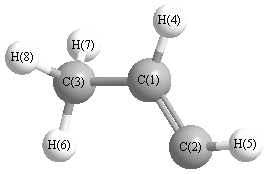
Vibrational Frequencies calculated at HF/CEP-121G*
| Mode Number |
Symmetry |
Frequency
(cm-1) |
Scaled Frequency
(cm-1) |
IR Intensities
(km mol-1) |
Raman Act
(Å4/u) |
Dep P |
Dep U |
|---|
| 1 |
A' |
3387 |
3060 |
5.70 |
|
|
|
| 2 |
A' |
3274 |
2958 |
47.46 |
|
|
|
| 3 |
A' |
3235 |
2922 |
17.07 |
|
|
|
| 4 |
A' |
3179 |
2872 |
46.85 |
|
|
|
| 5 |
A' |
1640 |
1481 |
4.52 |
|
|
|
| 6 |
A' |
1579 |
1427 |
2.08 |
|
|
|
| 7 |
A' |
1542 |
1393 |
2.46 |
|
|
|
| 8 |
A' |
1327 |
1199 |
1.46 |
|
|
|
| 9 |
A' |
1212 |
1095 |
3.94 |
|
|
|
| 10 |
A' |
982 |
887 |
0.10 |
|
|
|
| 11 |
A' |
901 |
814 |
10.50 |
|
|
|
| 12 |
A' |
435 |
393 |
5.28 |
|
|
|
| 13 |
A" |
3234 |
2921 |
49.00 |
|
|
|
| 14 |
A" |
1615 |
1459 |
5.84 |
|
|
|
| 15 |
A" |
1139 |
1029 |
4.61 |
|
|
|
| 16 |
A" |
878 |
793 |
1.32 |
|
|
|
| 17 |
A" |
633 |
572 |
58.46 |
|
|
|
| 18 |
A" |
182 |
164 |
0.02 |
|
|
|
Unscaled Zero Point Vibrational Energy (zpe) 15186.2 cm
-1
Scaled (by 0.9034) Zero Point Vibrational Energy (zpe) 13719.2 cm
-1
See section
III.C.1 List or set vibrational scaling factors
to change the scale factors used here.
See section
III.C.2
Calculate a vibrational scaling factor for a given set of molecules
to determine the least squares best scaling factor.
Charges, Dipole, Quadrupole and Polarizability
Charges from optimized geometry at HF/CEP-121G*
Charges (e)
| Number |
Element |
Mulliken |
CHELPG |
AIM |
ESP |
| 1 |
C |
-0.068 |
|
|
|
| 2 |
C |
-0.304 |
|
|
|
| 3 |
C |
-0.508 |
|
|
|
| 4 |
H |
0.186 |
|
|
|
| 5 |
H |
0.185 |
|
|
|
| 6 |
H |
0.182 |
|
|
|
| 7 |
H |
0.163 |
|
|
|
| 8 |
H |
0.163 |
|
|
|
Electric dipole moments
Electric dipole components in Debye
(What's a Debye? See section
VII.A.3)
| |
x |
y |
z |
Total |
| |
-0.495 |
0.482 |
0.000 |
0.691 |
| CHELPG |
|
|
|
|
| AIM |
|
|
|
|
| ESP |
|
|
|
|
Electric Quadrupole moment
Quadrupole components in D Å
| Primitive |
|---|
| | x | y | z |
|---|
| x |
-18.480 |
1.016 |
0.000 |
| y |
1.016 |
-18.582 |
0.000 |
| z |
0.000 |
0.000 |
-21.229 |
|
| Traceless |
|---|
| | x | y | z |
|---|
| x |
1.426 |
1.016 |
0.000 |
| y |
1.016 |
1.273 |
0.000 |
| z |
0.000 |
0.000 |
-2.698 |
|
| Polar |
|---|
| 3z2-r2 | -5.396 |
|---|
| x2-y2 | 0.102 |
|---|
| xy | 1.016 |
|---|
| xz | 0.000 |
|---|
| yz | 0.000 |
|---|
|
Polarizabilities
Components of the polarizability tensor.
Units are
Å
3 (Angstrom cubed)
Change units.
| |
x |
y |
z |
| x |
6.463 |
0.296 |
0.000 |
| y |
0.296 |
4.209 |
0.000 |
| z |
0.000 |
0.000 |
3.380 |
<r2> (average value of r
2) Å
2
| <r2> |
44.844 |
| (<r2>)1/2 |
6.697 |