Jump to
S1C2
Vibrational Frequencies calculated at QCISD(T)/aug-cc-pVDZ
Geometric Data calculated at QCISD(T)/aug-cc-pVDZ
Electronic energy levels
Charges, Dipole, Quadrupole and Polarizability
Jump to
S1C1
Energy calculated at QCISD(T)/aug-cc-pVDZ
| | hartrees |
|---|
| Energy at 0K | -207.482870 |
| Energy at 298.15K | -207.486143 |
| HF Energy | -206.797489 |
| Nuclear repulsion energy | 100.786511 |
The energy at 298.15K was derived from the energy at 0K
and an integrated heat capacity that used the calculated vibrational frequencies.
Vibrational Frequencies calculated at QCISD(T)/aug-cc-pVDZ
| Mode Number |
Symmetry |
Frequency
(cm-1) |
Scaled Frequency
(cm-1) |
IR Intensities
(km mol-1) |
Raman Act
(Å4/u) |
Dep P |
Dep U |
|---|
| 1 |
A |
3795 |
3710 |
|
|
|
|
| 2 |
A |
3122 |
3052 |
|
|
|
|
| 3 |
A |
3041 |
2974 |
|
|
|
|
| 4 |
A |
2242 |
2192 |
|
|
|
|
| 5 |
A |
1471 |
1438 |
|
|
|
|
| 6 |
A |
1407 |
1375 |
|
|
|
|
| 7 |
A |
1353 |
1323 |
|
|
|
|
| 8 |
A |
1211 |
1184 |
|
|
|
|
| 9 |
A |
1067 |
1043 |
|
|
|
|
| 10 |
A |
976 |
954 |
|
|
|
|
| 11 |
A |
886 |
866 |
|
|
|
|
| 12 |
A |
557 |
544 |
|
|
|
|
| 13 |
A |
361 |
353 |
|
|
|
|
| 14 |
A |
289 |
282 |
|
|
|
|
| 15 |
A |
204 |
199 |
|
|
|
|
Unscaled Zero Point Vibrational Energy (zpe) 10989.8 cm
-1
Scaled (by 0.9778) Zero Point Vibrational Energy (zpe) 10745.8 cm
-1
See section
III.C.1 List or set vibrational scaling factors
to change the scale factors used here.
See section
III.C.2
Calculate a vibrational scaling factor for a given set of molecules
to determine the least squares best scaling factor.
Geometric Data calculated at QCISD(T)/aug-cc-pVDZ
Point Group is C1
Cartesians (Å)
| Atom |
x (Å) |
y (Å) |
z (Å) |
|---|
| C1 |
-0.582 |
0.598 |
0.039 |
| C2 |
0.833 |
0.115 |
-0.006 |
| O3 |
-1.527 |
-0.460 |
-0.111 |
| H4 |
-0.726 |
1.159 |
0.982 |
| H5 |
-0.748 |
1.287 |
-0.806 |
| H6 |
-1.410 |
-1.079 |
0.625 |
| N7 |
1.943 |
-0.281 |
-0.015 |
Atom - Atom Distances (Å)
| |
C1 |
C2 |
O3 |
H4 |
H5 |
H6 |
N7 |
| C1 | | 1.4958 | 1.4264 | 1.1066 | 1.1018 | 1.9598 | 2.6746 |
C2 | 1.4958 | | 2.4311 | 2.1200 | 2.1231 | 2.6182 | 1.1790 | O3 | 1.4264 | 2.4311 | | 2.1112 | 2.0349 | 0.9684 | 3.4759 | H4 | 1.1066 | 2.1200 | 2.1112 | | 1.7922 | 2.3669 | 3.1922 | H5 | 1.1018 | 2.1231 | 2.0349 | 1.7922 | | 2.8425 | 3.2128 | H6 | 1.9598 | 2.6182 | 0.9684 | 2.3669 | 2.8425 | | 3.5056 | N7 | 2.6746 | 1.1790 | 3.4759 | 3.1922 | 3.2128 | 3.5056 | |
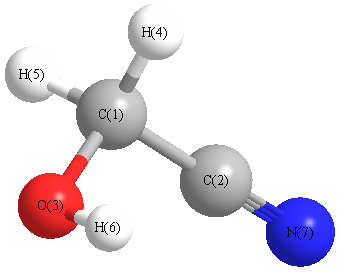 More geometry information
Calculated Bond Angles
| atom1 |
atom2 |
atom3 |
angle |
|
atom1 |
atom2 |
atom3 |
angle |
| C1 |
C2 |
N7 |
178.458 |
|
C1 |
O3 |
H6 |
108.321 |
| C2 |
C1 |
O3 |
112.576 |
|
C2 |
C1 |
H4 |
108.174 |
| C2 |
C1 |
H5 |
108.687 |
|
O3 |
C1 |
H4 |
112.297 |
| O3 |
C1 |
H5 |
106.487 |
|
H4 |
C1 |
H5 |
108.489 |
Electronic energy levels
Charges, Dipole, Quadrupole and Polarizability
