Jump to
S1C2
Energy calculated at QCISD(T)=FULL/aug-cc-pVDZ
| | hartrees |
|---|
| Energy at 0K | -454.099304 |
| Energy at 298.15K | -454.103012 |
| HF Energy | -453.714107 |
| Nuclear repulsion energy | 56.570338 |
The energy at 298.15K was derived from the energy at 0K
and an integrated heat capacity that used the calculated vibrational frequencies.
Vibrational Frequencies calculated at QCISD(T)=FULL/aug-cc-pVDZ
| Mode Number |
Symmetry |
Frequency
(cm-1) |
Scaled Frequency
(cm-1) |
IR Intensities
(km mol-1) |
Raman Act
(Å4/u) |
Dep P |
Dep U |
|---|
| 1 |
A' |
3470 |
3366 |
|
|
|
|
| 2 |
A' |
2672 |
2592 |
|
|
|
|
| 3 |
A' |
1606 |
1558 |
|
|
|
|
| 4 |
A' |
1028 |
997 |
|
|
|
|
| 5 |
A' |
902 |
875 |
|
|
|
|
| 6 |
A' |
658 |
638 |
|
|
|
|
| 7 |
A" |
3568 |
3461 |
|
|
|
|
| 8 |
A" |
1128 |
1094 |
|
|
|
|
| 9 |
A" |
380 |
368 |
|
|
|
|
Unscaled Zero Point Vibrational Energy (zpe) 7705.8 cm
-1
Scaled (by 0.9701) Zero Point Vibrational Energy (zpe) 7475.4 cm
-1
See section
III.C.1 List or set vibrational scaling factors
to change the scale factors used here.
See section
III.C.2
Calculate a vibrational scaling factor for a given set of molecules
to determine the least squares best scaling factor.
Geometric Data calculated at QCISD(T)=FULL/aug-cc-pVDZ
Point Group is Cs
Cartesians (Å)
| Atom |
x (Å) |
y (Å) |
z (Å) |
|---|
| N1 |
0.012 |
1.140 |
0.000 |
| S2 |
0.012 |
-0.632 |
0.000 |
| H3 |
-1.337 |
-0.768 |
0.000 |
| H4 |
0.534 |
1.449 |
0.823 |
| H5 |
0.534 |
1.449 |
-0.823 |
Atom - Atom Distances (Å)
| |
N1 |
S2 |
H3 |
H4 |
H5 |
| N1 | | 1.7718 | 2.3365 | 1.0224 | 1.0224 |
S2 | 1.7718 | | 1.3556 | 2.2977 | 2.2977 | H3 | 2.3365 | 1.3556 | | 3.0154 | 3.0154 | H4 | 1.0224 | 2.2977 | 3.0154 | | 1.6457 | H5 | 1.0224 | 2.2977 | 3.0154 | 1.6457 | |
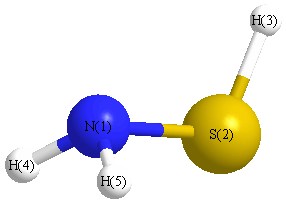 More geometry information
Calculated Bond Angles
| atom1 |
atom2 |
atom3 |
angle |
|
atom1 |
atom2 |
atom3 |
angle |
| N1 |
S2 |
H3 |
95.764 |
|
S2 |
N1 |
H4 |
107.592 |
| S2 |
N1 |
H5 |
107.592 |
|
H4 |
N1 |
H5 |
107.184 |
Electronic energy levels
Charges, Dipole, Quadrupole and Polarizability
Jump to
S1C1
Energy calculated at QCISD(T)=FULL/aug-cc-pVDZ
| | hartrees |
|---|
| Energy at 0K | -454.098291 |
| Energy at 298.15K | -454.102060 |
| HF Energy | -453.714088 |
| Nuclear repulsion energy | 56.763696 |
The energy at 298.15K was derived from the energy at 0K
and an integrated heat capacity that used the calculated vibrational frequencies.
Vibrational Frequencies calculated at QCISD(T)=FULL/aug-cc-pVDZ
| Mode Number |
Symmetry |
Frequency
(cm-1) |
Scaled Frequency
(cm-1) |
IR Intensities
(km mol-1) |
Raman Act
(Å4/u) |
Dep P |
Dep U |
|---|
| 1 |
A' |
3476 |
3372 |
|
|
|
|
| 2 |
A' |
2603 |
2525 |
|
|
|
|
| 3 |
A' |
1594 |
1546 |
|
|
|
|
| 4 |
A' |
1007 |
977 |
|
|
|
|
| 5 |
A' |
877 |
851 |
|
|
|
|
| 6 |
A' |
641 |
622 |
|
|
|
|
| 7 |
A" |
3583 |
3476 |
|
|
|
|
| 8 |
A" |
1113 |
1080 |
|
|
|
|
| 9 |
A" |
469 |
455 |
|
|
|
|
Unscaled Zero Point Vibrational Energy (zpe) 7681.0 cm
-1
Scaled (by 0.9701) Zero Point Vibrational Energy (zpe) 7451.4 cm
-1
See section
III.C.1 List or set vibrational scaling factors
to change the scale factors used here.
See section
III.C.2
Calculate a vibrational scaling factor for a given set of molecules
to determine the least squares best scaling factor.
Geometric Data calculated at QCISD(T)=FULL/aug-cc-pVDZ
Point Group is Cs
Electronic energy levels
Charges, Dipole, Quadrupole and Polarizability
