Jump to
S1C2
S1C3
Energy calculated at HF/aug-cc-pVDZ
| | hartrees |
|---|
| Energy at 0K | -254.191132 |
| Energy at 298.15K | -254.190523 |
| HF Energy | -254.191132 |
| Nuclear repulsion energy | 46.406628 |
The energy at 298.15K was derived from the energy at 0K
and an integrated heat capacity that used the calculated vibrational frequencies.
Geometric Data calculated at HF/aug-cc-pVDZ
Point Group is C∞v
Cartesians (Å)
| Atom |
x (Å) |
y (Å) |
z (Å) |
|---|
| C1 |
0.000 |
0.000 |
-0.713 |
| N2 |
0.000 |
0.000 |
-1.865 |
| Na3 |
0.000 |
0.000 |
1.575 |
Atom - Atom Distances (Å)
| |
C1 |
N2 |
Na3 |
| C1 | | 1.1519 | 2.2878 |
N2 | 1.1519 | | 3.4397 | Na3 | 2.2878 | 3.4397 | |
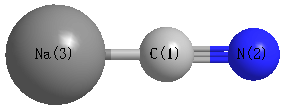 More geometry information
Calculated Bond Angles
| atom1 |
atom2 |
atom3 |
angle |
|
atom1 |
atom2 |
atom3 |
angle |
| C1 |
N2 |
Na3 |
0.000 |
|
C1 |
Na3 |
N2 |
0.000 |
| N2 |
C1 |
Na3 |
180.000 |
|
Electronic energy levels
Charges, Dipole, Quadrupole and Polarizability
Charges from optimized geometry at HF/aug-cc-pVDZ
Charges (e)
| Number |
Element |
Mulliken |
CHELPG |
AIM |
ESP |
| 1 |
C |
-0.239 |
|
|
|
| 2 |
N |
-0.509 |
|
|
|
| 3 |
Na |
0.748 |
|
|
|
Electric dipole moments
Electric dipole components in Debye
(What's a Debye? See section
VII.A.3)
| |
x |
y |
z |
Total |
| |
0.000 |
0.000 |
11.615 |
11.615 |
| CHELPG |
|
|
|
|
| AIM |
|
|
|
|
| ESP |
|
|
|
|
Electric Quadrupole moment
Quadrupole components in D Å
| Primitive |
|---|
| | x | y | z |
|---|
| x |
-17.208 |
0.000 |
0.000 |
| y |
0.000 |
-17.208 |
0.000 |
| z |
0.000 |
0.000 |
-13.851 |
|
| Traceless |
|---|
| | x | y | z |
|---|
| x |
-1.679 |
0.000 |
0.000 |
| y |
0.000 |
-1.679 |
0.000 |
| z |
0.000 |
0.000 |
3.357 |
|
| Polar |
|---|
| 3z2-r2 | 6.714 |
|---|
| x2-y2 | 0.000 |
|---|
| xy | 0.000 |
|---|
| xz | 0.000 |
|---|
| yz | 0.000 |
|---|
|
Polarizabilities
Components of the polarizability tensor.
Units are
Å
3 (Angstrom cubed)
Change units.
| |
x |
y |
z |
| x |
2.987 |
0.000 |
0.000 |
| y |
0.000 |
2.987 |
0.000 |
| z |
0.000 |
0.000 |
4.698 |
<r2> (average value of r
2) Å
2
| <r2> |
64.725 |
| (<r2>)1/2 |
8.045 |
Jump to
S1C1
S1C3
Energy calculated at HF/aug-cc-pVDZ
| | hartrees |
|---|
| Energy at 0K | -254.198240 |
| Energy at 298.15K | -254.197913 |
| HF Energy | -254.198240 |
| Nuclear repulsion energy | 51.271229 |
The energy at 298.15K was derived from the energy at 0K
and an integrated heat capacity that used the calculated vibrational frequencies.
Geometric Data calculated at HF/aug-cc-pVDZ
Point Group is Cs
Cartesians (Å)
| Atom |
x (Å) |
y (Å) |
z (Å) |
|---|
| C1 |
1.137 |
0.780 |
0.000 |
| N2 |
0.000 |
1.030 |
0.000 |
| Na3 |
-0.620 |
-1.080 |
0.000 |
Atom - Atom Distances (Å)
| |
C1 |
N2 |
Na3 |
| C1 | | 1.1640 | 2.5587 |
N2 | 1.1640 | | 2.1993 | Na3 | 2.5587 | 2.1993 | |
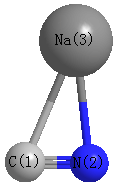 More geometry information
Calculated Bond Angles
| atom1 |
atom2 |
atom3 |
angle |
|
atom1 |
atom2 |
atom3 |
angle |
| C1 |
N2 |
Na3 |
93.975 |
|
C1 |
Na3 |
N2 |
26.989 |
| N2 |
C1 |
Na3 |
59.036 |
|
Electronic energy levels
Charges, Dipole, Quadrupole and Polarizability
Charges from optimized geometry at HF/aug-cc-pVDZ
Charges (e)
| Number |
Element |
Mulliken |
CHELPG |
AIM |
ESP |
| 1 |
C |
-0.335 |
|
|
|
| 2 |
N |
-0.477 |
|
|
|
| 3 |
Na |
0.812 |
|
|
|
Electric dipole moments
Electric dipole components in Debye
(What's a Debye? See section
VII.A.3)
| |
x |
y |
z |
Total |
| |
-4.828 |
-8.129 |
0.000 |
9.454 |
| CHELPG |
|
|
|
|
| AIM |
|
|
|
|
| ESP |
|
|
|
|
Electric Quadrupole moment
Quadrupole components in D Å
| Primitive |
|---|
| | x | y | z |
|---|
| x |
-19.880 |
2.866 |
0.000 |
| y |
2.866 |
-13.688 |
0.000 |
| z |
0.000 |
0.000 |
-17.251 |
|
| Traceless |
|---|
| | x | y | z |
|---|
| x |
-4.410 |
2.866 |
0.000 |
| y |
2.866 |
4.877 |
0.000 |
| z |
0.000 |
0.000 |
-0.467 |
|
| Polar |
|---|
| 3z2-r2 | -0.933 |
|---|
| x2-y2 | -6.192 |
|---|
| xy | 2.866 |
|---|
| xz | 0.000 |
|---|
| yz | 0.000 |
|---|
|
Polarizabilities
Components of the polarizability tensor.
Units are
Å
3 (Angstrom cubed)
Change units.
| |
x |
y |
z |
| x |
4.046 |
-0.100 |
0.000 |
| y |
-0.100 |
3.288 |
0.000 |
| z |
0.000 |
0.000 |
3.034 |
<r2> (average value of r
2) Å
2
| <r2> |
46.474 |
| (<r2>)1/2 |
6.817 |
Jump to
S1C1
S1C2
Energy calculated at HF/aug-cc-pVDZ
| | hartrees |
|---|
| Energy at 0K | -254.197587 |
| Energy at 298.15K | -254.196791 |
| HF Energy | -254.197587 |
| Nuclear repulsion energy | 48.827024 |
The energy at 298.15K was derived from the energy at 0K
and an integrated heat capacity that used the calculated vibrational frequencies.
Geometric Data calculated at HF/aug-cc-pVDZ
Point Group is C∞v
Cartesians (Å)
| Atom |
x (Å) |
y (Å) |
z (Å) |
|---|
| C1 |
0.000 |
0.000 |
-1.849 |
| N2 |
0.000 |
0.000 |
-0.686 |
| Na3 |
0.000 |
0.000 |
1.445 |
Atom - Atom Distances (Å)
| |
C1 |
N2 |
Na3 |
| C1 | | 1.1630 | 3.2946 |
N2 | 1.1630 | | 2.1316 | Na3 | 3.2946 | 2.1316 | |
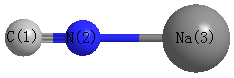 More geometry information
Calculated Bond Angles
| atom1 |
atom2 |
atom3 |
angle |
|
atom1 |
atom2 |
atom3 |
angle |
| C1 |
N2 |
Na3 |
180.000 |
|
C1 |
Na3 |
N2 |
0.000 |
| N2 |
C1 |
Na3 |
0.000 |
|
Electronic energy levels
Charges, Dipole, Quadrupole and Polarizability
Charges from optimized geometry at HF/aug-cc-pVDZ
Charges (e)
| Number |
Element |
Mulliken |
CHELPG |
AIM |
ESP |
| 1 |
C |
-0.329 |
|
|
|
| 2 |
N |
-0.464 |
|
|
|
| 3 |
Na |
0.794 |
|
|
|
Electric dipole moments
Electric dipole components in Debye
(What's a Debye? See section
VII.A.3)
| |
x |
y |
z |
Total |
| |
0.000 |
0.000 |
11.152 |
11.152 |
| CHELPG |
|
|
|
|
| AIM |
|
|
|
|
| ESP |
|
|
|
|
Electric Quadrupole moment
Quadrupole components in D Å
| Primitive |
|---|
| | x | y | z |
|---|
| x |
-17.159 |
0.000 |
0.000 |
| y |
0.000 |
-17.159 |
0.000 |
| z |
0.000 |
0.000 |
-15.629 |
|
| Traceless |
|---|
| | x | y | z |
|---|
| x |
-0.765 |
0.000 |
0.000 |
| y |
0.000 |
-0.765 |
0.000 |
| z |
0.000 |
0.000 |
1.530 |
|
| Polar |
|---|
| 3z2-r2 | 3.059 |
|---|
| x2-y2 | 0.000 |
|---|
| xy | 0.000 |
|---|
| xz | 0.000 |
|---|
| yz | 0.000 |
|---|
|
Polarizabilities
Components of the polarizability tensor.
Units are
Å
3 (Angstrom cubed)
Change units.
| |
x |
y |
z |
| x |
2.975 |
0.000 |
0.000 |
| y |
0.000 |
2.975 |
0.000 |
| z |
0.000 |
0.000 |
4.412 |
<r2> (average value of r
2) Å
2
| <r2> |
57.193 |
| (<r2>)1/2 |
7.563 |
