Jump to
S1C2
S1C3
Energy calculated at B2PLYP=FULL/aug-cc-pVDZ
| | hartrees |
|---|
| Energy at 0K | -1592.212659 |
| Energy at 298.15K | |
| HF Energy | -1592.014344 |
| Nuclear repulsion energy | 343.907746 |
The energy at 298.15K was derived from the energy at 0K
and an integrated heat capacity that used the calculated vibrational frequencies.
Vibrational Frequencies calculated at B2PLYP=FULL/aug-cc-pVDZ
| Mode Number |
Symmetry |
Frequency
(cm-1) |
Scaled Frequency
(cm-1) |
IR Intensities
(km mol-1) |
Raman Act
(Å4/u) |
Dep P |
Dep U |
|---|
| 1 |
A1 |
501 |
482 |
0.00 |
45.65 |
0.04 |
0.08 |
| 2 |
A1 |
199 |
191 |
0.00 |
1.08 |
0.70 |
0.82 |
| 3 |
B1 |
430 |
414 |
0.00 |
20.08 |
0.75 |
0.86 |
| 4 |
B2 |
302 |
291 |
0.05 |
7.61 |
0.75 |
0.86 |
| 5 |
E |
408 |
393 |
0.05 |
3.81 |
0.75 |
0.86 |
| 5 |
E |
408 |
393 |
0.05 |
3.81 |
0.75 |
0.86 |
Unscaled Zero Point Vibrational Energy (zpe) 1124.3 cm
-1
Scaled (by 0.9618) Zero Point Vibrational Energy (zpe) 1081.3 cm
-1
See section
III.C.1 List or set vibrational scaling factors
to change the scale factors used here.
See section
III.C.2
Calculate a vibrational scaling factor for a given set of molecules
to determine the least squares best scaling factor.
Geometric Data calculated at B2PLYP=FULL/aug-cc-pVDZ
Point Group is D2d
Cartesians (Å)
| Atom |
x (Å) |
y (Å) |
z (Å) |
|---|
| S1 |
0.000 |
1.456 |
0.327 |
| S2 |
0.000 |
-1.456 |
0.327 |
| S3 |
-1.456 |
0.000 |
-0.327 |
| S4 |
1.456 |
0.000 |
-0.327 |
Atom - Atom Distances (Å)
| |
S1 |
S2 |
S3 |
S4 |
| S1 | | 2.9117 | 2.1601 | 2.1601 |
S2 | 2.9117 | | 2.1601 | 2.1601 | S3 | 2.1601 | 2.1601 | | 2.9117 | S4 | 2.1601 | 2.1601 | 2.9117 | |
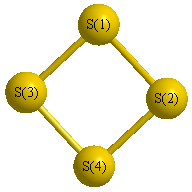 More geometry information
Calculated Bond Angles
| atom1 |
atom2 |
atom3 |
angle |
|
atom1 |
atom2 |
atom3 |
angle |
| S1 |
S2 |
S4 |
47.625 |
|
S1 |
S3 |
S4 |
47.625 |
| S2 |
S1 |
S3 |
47.625 |
|
S2 |
S4 |
S3 |
47.625 |
Electronic energy levels
Charges, Dipole, Quadrupole and Polarizability
Jump to
S1C1
S1C3
Energy calculated at B2PLYP=FULL/aug-cc-pVDZ
| | hartrees |
|---|
| Energy at 0K | -1592.255627 |
| Energy at 298.15K | |
| HF Energy | -1592.004215 |
| Nuclear repulsion energy | 324.254932 |
The energy at 298.15K was derived from the energy at 0K
and an integrated heat capacity that used the calculated vibrational frequencies.
Vibrational Frequencies calculated at B2PLYP=FULL/aug-cc-pVDZ
| Mode Number |
Symmetry |
Frequency
(cm-1) |
Scaled Frequency
(cm-1) |
IR Intensities
(km mol-1) |
Raman Act
(Å4/u) |
Dep P |
Dep U |
|---|
| 1 |
A1 |
670 |
644 |
0.00 |
43.30 |
0.09 |
0.16 |
| 2 |
A1 |
235 |
226 |
0.00 |
19.11 |
0.55 |
0.71 |
| 3 |
A1 |
128 |
123 |
6.45 |
0.00 |
0.64 |
0.78 |
| 4 |
A2 |
218 |
210 |
0.00 |
0.00 |
0.75 |
0.86 |
| 5 |
B2 |
656 |
631 |
34.43 |
0.00 |
0.75 |
0.86 |
| 6 |
B2 |
302 |
290 |
0.00 |
8.61 |
0.75 |
0.86 |
Unscaled Zero Point Vibrational Energy (zpe) 1104.3 cm
-1
Scaled (by 0.9618) Zero Point Vibrational Energy (zpe) 1062.1 cm
-1
See section
III.C.1 List or set vibrational scaling factors
to change the scale factors used here.
See section
III.C.2
Calculate a vibrational scaling factor for a given set of molecules
to determine the least squares best scaling factor.
Geometric Data calculated at B2PLYP=FULL/aug-cc-pVDZ
Point Group is C2v
Cartesians (Å)
| Atom |
x (Å) |
y (Å) |
z (Å) |
|---|
| S1 |
0.000 |
1.325 |
0.971 |
| S2 |
0.000 |
-1.325 |
0.971 |
| S3 |
0.000 |
1.325 |
-0.971 |
| S4 |
0.000 |
-1.325 |
-0.971 |
Atom - Atom Distances (Å)
| |
S1 |
S2 |
S3 |
S4 |
| S1 | | 2.6505 | 1.9412 | 3.2854 |
S2 | 2.6505 | | 3.2854 | 1.9412 | S3 | 1.9412 | 3.2854 | | 2.6506 | S4 | 3.2854 | 1.9412 | 2.6506 | |
More geometry information
Calculated Bond Angles
| atom1 |
atom2 |
atom3 |
angle |
|
atom1 |
atom2 |
atom3 |
angle |
| S1 |
S2 |
S4 |
90.001 |
|
S1 |
S3 |
S4 |
89.999 |
| S2 |
S1 |
S3 |
90.001 |
|
S2 |
S4 |
S3 |
89.999 |
Electronic energy levels
Charges, Dipole, Quadrupole and Polarizability
Jump to
S1C1
S1C2
Energy calculated at B2PLYP=FULL/aug-cc-pVDZ
| | hartrees |
|---|
| Energy at 0K | -1592.255627 |
| Energy at 298.15K | |
| HF Energy | -1592.004214 |
| Nuclear repulsion energy | 324.262443 |
The energy at 298.15K was derived from the energy at 0K
and an integrated heat capacity that used the calculated vibrational frequencies.
Vibrational Frequencies calculated at B2PLYP=FULL/aug-cc-pVDZ
| Mode Number |
Symmetry |
Frequency
(cm-1) |
Scaled Frequency
(cm-1) |
IR Intensities
(km mol-1) |
Raman Act
(Å4/u) |
Dep P |
Dep U |
|---|
| 1 |
Ag |
670 |
644 |
0.00 |
43.31 |
0.09 |
0.16 |
| 2 |
Ag |
235 |
226 |
0.00 |
18.90 |
0.56 |
0.71 |
| 3 |
Au |
218 |
210 |
0.00 |
0.00 |
0.00 |
0.00 |
| 4 |
B1u |
656 |
631 |
34.46 |
0.00 |
0.00 |
0.00 |
| 5 |
B2u |
129 |
124 |
6.46 |
0.00 |
0.00 |
0.00 |
| 6 |
B3g |
302 |
290 |
0.00 |
8.61 |
0.75 |
0.86 |
Unscaled Zero Point Vibrational Energy (zpe) 1104.3 cm
-1
Scaled (by 0.9618) Zero Point Vibrational Energy (zpe) 1062.1 cm
-1
See section
III.C.1 List or set vibrational scaling factors
to change the scale factors used here.
See section
III.C.2
Calculate a vibrational scaling factor for a given set of molecules
to determine the least squares best scaling factor.
Geometric Data calculated at B2PLYP=FULL/aug-cc-pVDZ
Point Group is D2h
Cartesians (Å)
| Atom |
x (Å) |
y (Å) |
z (Å) |
|---|
| S1 |
0.000 |
0.971 |
1.325 |
| S2 |
0.000 |
0.971 |
-1.325 |
| S3 |
0.000 |
-0.971 |
1.325 |
| S4 |
0.000 |
-0.971 |
-1.325 |
Atom - Atom Distances (Å)
| |
S1 |
S2 |
S3 |
S4 |
| S1 | | 2.6502 | 1.9414 | 3.2852 |
S2 | 2.6502 | | 3.2852 | 1.9414 | S3 | 1.9414 | 3.2852 | | 2.6502 | S4 | 3.2852 | 1.9414 | 2.6502 | |
More geometry information
Calculated Bond Angles
| atom1 |
atom2 |
atom3 |
angle |
|
atom1 |
atom2 |
atom3 |
angle |
| S1 |
S2 |
S4 |
90.000 |
|
S1 |
S3 |
S4 |
90.000 |
| S2 |
S1 |
S3 |
90.000 |
|
S2 |
S4 |
S3 |
90.000 |
Electronic energy levels
Charges, Dipole, Quadrupole and Polarizability
