Jump to
S1C2
S2C1
S2C2
Energy calculated at QCISD(T)=FULL/aug-cc-pVDZ
| | hartrees |
|---|
| Energy at 0K | -39.050473 |
| Energy at 298.15K | -39.050286 |
| HF Energy | -38.927923 |
| Nuclear repulsion energy | 6.071372 |
The energy at 298.15K was derived from the energy at 0K
and an integrated heat capacity that used the calculated vibrational frequencies.
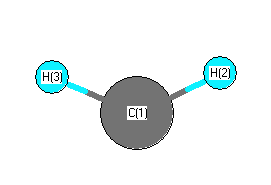
Geometric Data calculated at QCISD(T)=FULL/aug-cc-pVDZ
Point Group is C2v
Cartesians (Å)
| Atom |
x (Å) |
y (Å) |
z (Å) |
|---|
| C1 |
0.000 |
0.000 |
0.109 |
| H2 |
0.000 |
1.003 |
-0.326 |
| H3 |
0.000 |
-1.003 |
-0.326 |
Atom - Atom Distances (Å)
| |
C1 |
H2 |
H3 |
| C1 | | 1.0934 | 1.0934 |
H2 | 1.0934 | | 2.0068 | H3 | 1.0934 | 2.0068 | |
 More geometry information
Calculated Bond Angles
| atom1 |
atom2 |
atom3 |
angle |
|
atom1 |
atom2 |
atom3 |
angle |
| H2 |
C1 |
H3 |
133.187 |
|
Electronic energy levels
Charges, Dipole, Quadrupole and Polarizability
Jump to
S1C1
S2C1
S2C2
Energy calculated at QCISD(T)=FULL/aug-cc-pVDZ
| | hartrees |
|---|
| Energy at 0K | -39.040395 |
| Energy at 298.15K | |
| HF Energy | -38.915982 |
| Nuclear repulsion energy | 6.108587 |
The energy at 298.15K was derived from the energy at 0K
and an integrated heat capacity that used the calculated vibrational frequencies.
Geometric Data calculated at QCISD(T)=FULL/aug-cc-pVDZ
Point Group is D∞h
Cartesians (Å)
| Atom |
x (Å) |
y (Å) |
z (Å) |
|---|
| C1 |
0.000 |
0.000 |
0.000 |
| H2 |
0.000 |
0.000 |
1.082 |
| H3 |
0.000 |
0.000 |
-1.082 |
Atom - Atom Distances (Å)
| |
C1 |
H2 |
H3 |
| C1 | | 1.0823 | 1.0823 |
H2 | 1.0823 | | 2.1646 | H3 | 1.0823 | 2.1646 | |
More geometry information
Calculated Bond Angles
| atom1 |
atom2 |
atom3 |
angle |
|
atom1 |
atom2 |
atom3 |
angle |
| H2 |
C1 |
H3 |
180.000 |
|
Electronic energy levels
Charges, Dipole, Quadrupole and Polarizability
Jump to
S1C1
S1C2
S2C2
Energy calculated at QCISD(T)=FULL/aug-cc-pVDZ
| | hartrees |
|---|
| Energy at 0K | -38.883848 |
| Energy at 298.15K | |
| Nuclear repulsion energy | |
The energy at 298.15K was derived from the energy at 0K
and an integrated heat capacity that used the calculated vibrational frequencies.
Geometric Data calculated at QCISD(T)=FULL/aug-cc-pVDZ
Point Group is D∞h
Electronic energy levels
Charges, Dipole, Quadrupole and Polarizability
Jump to
S1C1
S1C2
S2C1
Energy calculated at QCISD(T)=FULL/aug-cc-pVDZ
| | hartrees |
|---|
| Energy at 0K | -38.883848 |
| Energy at 298.15K | |
| Nuclear repulsion energy | |
The energy at 298.15K was derived from the energy at 0K
and an integrated heat capacity that used the calculated vibrational frequencies.
Vibrational Frequencies calculated at QCISD(T)=FULL/aug-cc-pVDZ
Geometric Data calculated at QCISD(T)=FULL/aug-cc-pVDZ
Point Group is D∞h
Electronic energy levels
Charges, Dipole, Quadrupole and Polarizability
