Jump to
S1C2
S2C1
S2C2
Energy calculated at QCISD/aug-cc-pVDZ
| | hartrees |
|---|
| Energy at 0K | -131.078685 |
| Energy at 298.15K | -131.078072 |
| HF Energy | -130.695672 |
| Nuclear repulsion energy | 46.586153 |
The energy at 298.15K was derived from the energy at 0K
and an integrated heat capacity that used the calculated vibrational frequencies.
Vibrational Frequencies calculated at QCISD/aug-cc-pVDZ
| Mode Number |
Symmetry |
Frequency
(cm-1) |
Scaled Frequency
(cm-1) |
IR Intensities
(km mol-1) |
Raman Act
(Å4/u) |
Dep P |
Dep U |
|---|
| 1 |
A' |
3335 |
3231 |
18.00 |
|
|
|
| 2 |
A' |
1822 |
1765 |
42.93 |
|
|
|
| 3 |
A' |
1142 |
1106 |
9.79 |
|
|
|
| 4 |
A' |
655 |
634 |
24.91 |
|
|
|
| 5 |
A' |
377 |
366 |
2.29 |
|
|
|
| 6 |
A" |
410 |
398 |
0.62 |
|
|
|
Unscaled Zero Point Vibrational Energy (zpe) 3870.6 cm
-1
Scaled (by 0.9687) Zero Point Vibrational Energy (zpe) 3749.5 cm
-1
See section
III.C.1 List or set vibrational scaling factors
to change the scale factors used here.
See section
III.C.2
Calculate a vibrational scaling factor for a given set of molecules
to determine the least squares best scaling factor.
Geometric Data calculated at QCISD/aug-cc-pVDZ
Point Group is Cs
Cartesians (Å)
| Atom |
x (Å) |
y (Å) |
z (Å) |
|---|
| C1 |
0.073 |
-1.254 |
0.000 |
| C2 |
0.000 |
0.096 |
0.000 |
| N3 |
-0.175 |
1.289 |
0.000 |
| H4 |
0.782 |
-2.075 |
0.000 |
Atom - Atom Distances (Å)
| |
C1 |
C2 |
N3 |
H4 |
| C1 | | 1.3516 | 2.5548 | 1.0851 |
C2 | 1.3516 | | 1.2059 | 2.3077 | N3 | 2.5548 | 1.2059 | | 3.4977 | H4 | 1.0851 | 2.3077 | 3.4977 | |
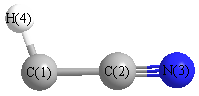 More geometry information
Calculated Bond Angles
| atom1 |
atom2 |
atom3 |
angle |
|
atom1 |
atom2 |
atom3 |
angle |
| C1 |
C2 |
N3 |
174.784 |
|
C2 |
C1 |
H4 |
142.323 |
Electronic energy levels
Charges, Dipole, Quadrupole and Polarizability
Jump to
S1C1
S2C1
S2C2
Energy calculated at QCISD/aug-cc-pVDZ
| | hartrees |
|---|
| Energy at 0K | -131.075698 |
| Energy at 298.15K | |
| HF Energy | -130.693209 |
| Nuclear repulsion energy | 46.725983 |
The energy at 298.15K was derived from the energy at 0K
and an integrated heat capacity that used the calculated vibrational frequencies.
Vibrational Frequencies calculated at QCISD/aug-cc-pVDZ
| Mode Number |
Symmetry |
Frequency
(cm-1) |
Scaled Frequency
(cm-1) |
IR Intensities
(km mol-1) |
Raman Act
(Å4/u) |
Dep P |
Dep U |
|---|
| 1 |
Σ |
3416 |
3309 |
62.86 |
|
|
|
| 2 |
Σ |
1663 |
1611 |
46.35 |
|
|
|
| 3 |
Σ |
1223 |
1184 |
4.22 |
|
|
|
| 4 |
Π |
414 |
401 |
0.01 |
|
|
|
| 4 |
Π |
414 |
401 |
0.01 |
|
|
|
| 5 |
Π |
499i |
484i |
46.41 |
|
|
|
| 5 |
Π |
499i |
484i |
46.41 |
|
|
|
Unscaled Zero Point Vibrational Energy (zpe) 3065.4 cm
-1
Scaled (by 0.9687) Zero Point Vibrational Energy (zpe) 2969.4 cm
-1
See section
III.C.1 List or set vibrational scaling factors
to change the scale factors used here.
See section
III.C.2
Calculate a vibrational scaling factor for a given set of molecules
to determine the least squares best scaling factor.
Geometric Data calculated at QCISD/aug-cc-pVDZ
Point Group is C∞v
Cartesians (Å)
| Atom |
x (Å) |
y (Å) |
z (Å) |
|---|
| C1 |
0.000 |
0.000 |
-1.229 |
| C2 |
0.000 |
0.000 |
0.087 |
| N3 |
0.000 |
0.000 |
1.309 |
| H4 |
0.000 |
0.000 |
-2.307 |
Atom - Atom Distances (Å)
| |
C1 |
C2 |
N3 |
H4 |
| C1 | | 1.3160 | 2.5376 | 1.0776 |
C2 | 1.3160 | | 1.2216 | 2.3936 | N3 | 2.5376 | 1.2216 | | 3.6152 | H4 | 1.0776 | 2.3936 | 3.6152 | |
More geometry information
Calculated Bond Angles
| atom1 |
atom2 |
atom3 |
angle |
|
atom1 |
atom2 |
atom3 |
angle |
| C1 |
C2 |
N3 |
180.000 |
|
C2 |
C1 |
H4 |
180.000 |
Electronic energy levels
Charges, Dipole, Quadrupole and Polarizability
Charges from optimized geometry at QCISD/aug-cc-pVDZ
Charges (e)
| Number |
Element |
Mulliken |
CHELPG |
AIM |
ESP |
| 1 |
C |
0.614 |
|
|
|
| 2 |
C |
-0.045 |
|
|
|
| 3 |
N |
-0.334 |
|
|
|
| 4 |
H |
-0.236 |
|
|
|
Electric dipole moments
Electric dipole components in Debye
(What's a Debye? See section
VII.A.3)
| |
x |
y |
z |
Total |
| |
0.000 |
0.000 |
-3.309 |
3.309 |
| CHELPG |
|
|
|
|
| AIM |
|
|
|
|
| ESP |
|
|
|
|
Electric Quadrupole moment
Quadrupole components in D Å
Polarizabilities
Components of the polarizability tensor.
Units are
Å
3 (Angstrom cubed)
Change units.
| |
x |
y |
z |
| x |
0.000 |
0.000 |
0.000 |
| y |
0.000 |
0.000 |
0.000 |
| z |
0.000 |
0.000 |
0.000 |
<r2> (average value of r
2) Å
2
| <r2> |
37.170 |
| (<r2>)1/2 |
6.097 |
Jump to
S1C1
S1C2
S2C2
Energy calculated at QCISD/aug-cc-pVDZ
| | hartrees |
|---|
| Energy at 0K | -131.055165 |
| Energy at 298.15K | -131.054544 |
| HF Energy | -130.634304 |
| Nuclear repulsion energy | 46.208729 |
The energy at 298.15K was derived from the energy at 0K
and an integrated heat capacity that used the calculated vibrational frequencies.
Vibrational Frequencies calculated at QCISD/aug-cc-pVDZ
| Mode Number |
Symmetry |
Frequency
(cm-1) |
Scaled Frequency
(cm-1) |
IR Intensities
(km mol-1) |
Raman Act
(Å4/u) |
Dep P |
Dep U |
|---|
| 1 |
A' |
3040 |
2945 |
14.16 |
|
|
|
| 2 |
A' |
2088 |
2023 |
48.85 |
|
|
|
| 3 |
A' |
1061 |
1028 |
61.07 |
|
|
|
| 4 |
A' |
975 |
945 |
9.51 |
|
|
|
| 5 |
A' |
416 |
403 |
16.91 |
|
|
|
| 6 |
A" |
282 |
273 |
9.59 |
|
|
|
Unscaled Zero Point Vibrational Energy (zpe) 3930.9 cm
-1
Scaled (by 0.9687) Zero Point Vibrational Energy (zpe) 3807.9 cm
-1
See section
III.C.1 List or set vibrational scaling factors
to change the scale factors used here.
See section
III.C.2
Calculate a vibrational scaling factor for a given set of molecules
to determine the least squares best scaling factor.
Geometric Data calculated at QCISD/aug-cc-pVDZ
Point Group is Cs
Cartesians (Å)
| Atom |
x (Å) |
y (Å) |
z (Å) |
|---|
| C1 |
0.008 |
-1.319 |
0.000 |
| C2 |
0.000 |
0.102 |
0.000 |
| N3 |
-0.160 |
1.279 |
0.000 |
| H4 |
1.074 |
-1.646 |
0.000 |
Atom - Atom Distances (Å)
| |
C1 |
C2 |
N3 |
H4 |
| C1 | | 1.4212 | 2.6039 | 1.1149 |
C2 | 1.4212 | | 1.1881 | 2.0517 | N3 | 2.6039 | 1.1881 | | 3.1751 | H4 | 1.1149 | 2.0517 | 3.1751 | |
More geometry information
Electronic energy levels
Charges, Dipole, Quadrupole and Polarizability
Jump to
S1C1
S1C2
S2C1
Energy calculated at QCISD/aug-cc-pVDZ
| | hartrees |
|---|
| Energy at 0K | -131.055165 |
| Energy at 298.15K | -131.054544 |
| HF Energy | -130.634304 |
| Nuclear repulsion energy | 46.208729 |
The energy at 298.15K was derived from the energy at 0K
and an integrated heat capacity that used the calculated vibrational frequencies.
Vibrational Frequencies calculated at QCISD/aug-cc-pVDZ
Geometric Data calculated at QCISD/aug-cc-pVDZ
Point Group is Cs
Electronic energy levels
Charges, Dipole, Quadrupole and Polarizability
