All results from a given calculation for C3H3NS (Thiazole)
using model chemistry: CCSD=FULL/aug-cc-pVDZ
19 10 17 12 22
States and conformations
| State |
Conformation |
minimum conformation |
conformer description |
state description |
| 1 |
1 |
yes |
CS |
1A' |
Energy calculated at CCSD=FULL/aug-cc-pVDZ
| | hartrees |
|---|
| Energy at 0K | -568.093031 |
| Energy at 298.15K | |
| HF Energy | -567.329498 |
| Nuclear repulsion energy | 203.268675 |
The energy at 298.15K was derived from the energy at 0K
and an integrated heat capacity that used the calculated vibrational frequencies.
Vibrational Frequencies calculated at CCSD=FULL/aug-cc-pVDZ
Geometric Data calculated at CCSD=FULL/aug-cc-pVDZ
Point Group is Cs
Cartesians (Å)
| Atom |
x (Å) |
y (Å) |
z (Å) |
|---|
| S1 |
0.000 |
1.197 |
0.000 |
| C2 |
-1.205 |
-0.068 |
0.000 |
| C3 |
1.229 |
-0.034 |
0.000 |
| N4 |
-0.746 |
-1.293 |
0.000 |
| C5 |
0.645 |
-1.277 |
0.000 |
| H6 |
-2.268 |
0.176 |
0.000 |
| H7 |
2.288 |
0.218 |
0.000 |
| H8 |
1.187 |
-2.223 |
0.000 |
Atom - Atom Distances (Å)
| |
S1 |
C2 |
C3 |
N4 |
C5 |
H6 |
H7 |
H8 |
| S1 | | 1.7474 | 1.7400 | 2.5990 | 2.5568 | 2.4875 | 2.4889 | 3.6199 |
C2 | 1.7474 | | 2.4351 | 1.3082 | 2.2104 | 1.0904 | 3.5052 | 3.2197 | C3 | 1.7400 | 2.4351 | | 2.3419 | 1.3734 | 3.5039 | 1.0883 | 2.1890 | N4 | 2.5990 | 1.3082 | 2.3419 | | 1.3906 | 2.1154 | 3.3889 | 2.1446 | C5 | 2.5568 | 2.2104 | 1.3734 | 1.3906 | | 3.2554 | 2.2213 | 1.0900 | H6 | 2.4875 | 1.0904 | 3.5039 | 2.1154 | 3.2554 | | 4.5565 | 4.2061 | H7 | 2.4889 | 3.5052 | 1.0883 | 3.3889 | 2.2213 | 4.5565 | | 2.6774 | H8 | 3.6199 | 3.2197 | 2.1890 | 2.1446 | 1.0900 | 4.2061 | 2.6774 | |
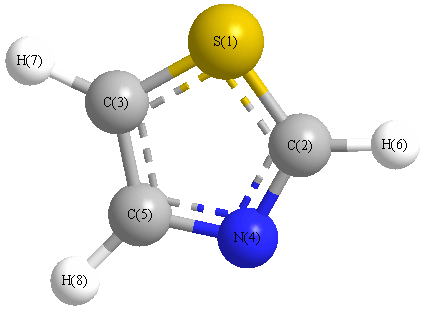 More geometry information
Calculated Bond Angles
| atom1 |
atom2 |
atom3 |
angle |
|
atom1 |
atom2 |
atom3 |
angle |
| S1 |
C2 |
N4 |
115.802 |
|
S1 |
C2 |
H6 |
120.698 |
| S1 |
C3 |
C5 |
109.857 |
|
S1 |
C3 |
H7 |
121.575 |
| C2 |
S1 |
C3 |
88.575 |
|
C2 |
N4 |
C5 |
109.936 |
| C3 |
C5 |
N4 |
115.831 |
|
C3 |
C5 |
H8 |
124.998 |
| N4 |
C2 |
H6 |
123.500 |
|
N4 |
C5 |
H8 |
119.171 |
| C5 |
C3 |
H7 |
128.568 |
|
Electronic energy levels
Charges, Dipole, Quadrupole and Polarizability
