return to home page Computational Chemistry Comparison and Benchmark DataBase Release 22 (May 2022) Standard Reference Database 101 National Institute of Standards and Technology
You are here: Calculated > Energy > Optimized > Energy

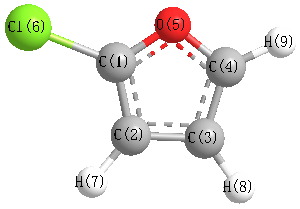
All results from a given calculation for C4H3ClO (Furan, 2-chloro)

using model chemistry: QCISD(T)/aug-cc-pVDZ

19 10 17 12 22

States and conformations

State Conformation minimum conformation conformer description state description
1 1 yes CS 1A'
Energy calculated at QCISD(T)/aug-cc-pVDZ
 hartrees
Energy at 0K-688.522963
Energy at 298.15K-688.526630
HF Energy-687.567536
Nuclear repulsion energy262.241051
The energy at 298.15K was derived from the energy at 0K and an integrated heat capacity that used the calculated vibrational frequencies.
Vibrational Frequencies calculated at QCISD(T)/aug-cc-pVDZ
Mode Number Symmetry Frequency
(cm-1)
Scaled Frequency
(cm-1)
IR Intensities
(km mol-1)
Raman Act
(Å4/u)
Dep P Dep U
1 A' 3292 3219        
2 A' 3274 3202        
3 A' 3253 3181        
4 A' 1588 1553        
5 A' 1514 1481        
6 A' 1384 1353        
7 A' 1223 1196        
8 A' 1184 1158        
9 A' 1125 1100        
10 A' 1061 1037        
11 A' 1011 988        
12 A' 910 890        
13 A' 874 855        
14 A' 487 476        
15 A' 306 299        
16 A" 802 784        
17 A" 770 753        
18 A" 707 692        
19 A" 590 577        
20 A" 577 564        
21 A" 213 208        

Unscaled Zero Point Vibrational Energy (zpe) 13072.4 cm-1
Scaled (by 0.9778) Zero Point Vibrational Energy (zpe) 12782.2 cm-1
See section III.C.1 List or set vibrational scaling factors to change the scale factors used here.
See section III.C.2 Calculate a vibrational scaling factor for a given set of molecules to determine the least squares best scaling factor.
Rotational Constants (cm-1) from geometry optimized at QCISD(T)/aug-cc-pVDZ
ABC
0.30093 0.07000 0.05679

See section I.F.4 to change rotational constant units
Geometric Data calculated at QCISD(T)/aug-cc-pVDZ

Point Group is Cs

Cartesians (Å)
Atom x (Å) y (Å) z (Å)
C1 0.000 0.272 0.000
C2 1.327 -0.083 0.000
C3 1.331 -1.537 0.000
C4 0.012 -1.929 0.000
O5 -0.825 -0.823 0.000
Cl6 -0.783 1.808 0.000
H7 2.177 0.599 0.000
H8 2.199 -2.198 0.000
H9 -0.492 -2.894 0.000

Atom - Atom Distances (Å)
  C1 C2 C3 C4 O5 Cl6 H7 H8 H9
C11.37402.24652.20131.37111.72372.20133.30723.2042
C21.37401.45452.26662.27602.83341.08962.28743.3484
C32.24651.45451.37572.27153.95742.29811.09082.2723
C42.20132.26661.37571.38743.82073.32842.20361.0887
O51.37112.27602.27151.38742.63123.32183.32232.0978
Cl61.72372.83343.95743.82072.63123.19704.99394.7110
H72.20131.08962.29813.32843.32183.19702.79714.3961
H83.30722.28741.09082.20363.32234.99392.79712.7799
H93.20423.34842.27231.08872.09784.71104.39612.7799

picture of Furan, 2-chloro state 1 conformation 1
More geometry information
Calculated Bond Angles
atom1 atom2 atom3 angle atom1 atom2 atom3 angle
C1 C2 C3 105.128 C1 C2 H7 126.250
C1 O5 C4 105.879 C2 C1 O5 112.016
C2 C1 Cl6 131.989 C2 C3 C4 106.390
C2 C3 H8 127.390 C3 C2 H7 128.622
C3 C4 O5 110.587 C3 C4 H9 134.124
C4 C3 H8 126.220 O5 C1 Cl6 115.995
O5 C4 H9 115.289
Electronic energy levels
Charges, Dipole, Quadrupole and Polarizability