Jump to
S1C2
Energy calculated at B2PLYP=FULL/aug-cc-pVDZ
| | hartrees |
|---|
| Energy at 0K | -168.460335 |
| Energy at 298.15K | |
| HF Energy | -168.280152 |
| Nuclear repulsion energy | 59.932660 |
The energy at 298.15K was derived from the energy at 0K
and an integrated heat capacity that used the calculated vibrational frequencies.
Vibrational Frequencies calculated at B2PLYP=FULL/aug-cc-pVDZ
| Mode Number |
Symmetry |
Frequency
(cm-1) |
Scaled Frequency
(cm-1) |
IR Intensities
(km mol-1) |
Raman Act
(Å4/u) |
Dep P |
Dep U |
|---|
| 1 |
Σ |
3520 |
3385 |
270.51 |
38.87 |
0.22 |
0.36 |
| 2 |
Σ |
2269 |
2182 |
427.65 |
31.21 |
0.04 |
0.07 |
| 3 |
Σ |
1276 |
1227 |
97.95 |
33.78 |
0.21 |
0.34 |
| 4 |
Π |
531 |
511 |
5.31 |
0.02 |
0.75 |
0.86 |
| 4 |
Π |
531 |
511 |
5.31 |
0.02 |
0.75 |
0.86 |
| 5 |
Π |
213i |
205i |
70.06 |
4.80 |
0.75 |
0.86 |
| 5 |
Π |
213i |
205i |
70.06 |
4.80 |
0.75 |
0.86 |
Unscaled Zero Point Vibrational Energy (zpe) 3850.7 cm
-1
Scaled (by 0.9618) Zero Point Vibrational Energy (zpe) 3703.6 cm
-1
See section
III.C.1 List or set vibrational scaling factors
to change the scale factors used here.
See section
III.C.2
Calculate a vibrational scaling factor for a given set of molecules
to determine the least squares best scaling factor.
Geometric Data calculated at B2PLYP=FULL/aug-cc-pVDZ
Point Group is C∞v
Cartesians (Å)
| Atom |
x (Å) |
y (Å) |
z (Å) |
|---|
| O1 |
0.000 |
0.000 |
1.192 |
| N2 |
0.000 |
0.000 |
-0.018 |
| C3 |
0.000 |
0.000 |
-1.192 |
| H4 |
0.000 |
0.000 |
-2.259 |
Atom - Atom Distances (Å)
| |
O1 |
N2 |
C3 |
H4 |
| O1 | | 1.2102 | 2.3840 | 3.4509 |
N2 | 1.2102 | | 1.1738 | 2.2407 | C3 | 2.3840 | 1.1738 | | 1.0669 | H4 | 3.4509 | 2.2407 | 1.0669 | |
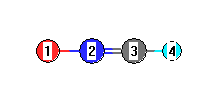 More geometry information
Calculated Bond Angles
| atom1 |
atom2 |
atom3 |
angle |
|
atom1 |
atom2 |
atom3 |
angle |
| O1 |
N2 |
C3 |
180.000 |
|
N2 |
C3 |
H4 |
180.000 |
Electronic energy levels
Charges, Dipole, Quadrupole and Polarizability
Jump to
S1C1
Energy calculated at B2PLYP=FULL/aug-cc-pVDZ
| | hartrees |
|---|
| Energy at 0K | -168.460516 |
| Energy at 298.15K | -168.461098 |
| HF Energy | -168.278798 |
| Nuclear repulsion energy | 59.911188 |
The energy at 298.15K was derived from the energy at 0K
and an integrated heat capacity that used the calculated vibrational frequencies.
Vibrational Frequencies calculated at B2PLYP=FULL/aug-cc-pVDZ
| Mode Number |
Symmetry |
Frequency
(cm-1) |
Scaled Frequency
(cm-1) |
IR Intensities
(km mol-1) |
Raman Act
(Å4/u) |
Dep P |
Dep U |
|---|
| 1 |
A' |
3485 |
3352 |
217.17 |
|
|
|
| 2 |
A' |
2244 |
2159 |
439.75 |
|
|
|
| 3 |
A' |
1281 |
1232 |
79.39 |
|
|
|
| 4 |
A' |
531 |
511 |
8.91 |
|
|
|
| 5 |
A' |
291 |
280 |
132.43 |
|
|
|
| 6 |
A" |
531 |
511 |
5.92 |
|
|
|
Unscaled Zero Point Vibrational Energy (zpe) 4182.0 cm
-1
Scaled (by 0.9618) Zero Point Vibrational Energy (zpe) 4022.3 cm
-1
See section
III.C.1 List or set vibrational scaling factors
to change the scale factors used here.
See section
III.C.2
Calculate a vibrational scaling factor for a given set of molecules
to determine the least squares best scaling factor.
Geometric Data calculated at B2PLYP=FULL/aug-cc-pVDZ
Point Group is Cs
Cartesians (Å)
| Atom |
x (Å) |
y (Å) |
z (Å) |
|---|
| O1 |
-0.898 |
-0.779 |
0.000 |
| N2 |
0.000 |
0.028 |
0.000 |
| C3 |
0.946 |
0.733 |
0.000 |
| H4 |
1.510 |
1.642 |
0.000 |
Atom - Atom Distances (Å)
| |
O1 |
N2 |
C3 |
H4 |
| O1 | | 1.2077 | 2.3849 | 3.4150 |
N2 | 1.2077 | | 1.1798 | 2.2102 | C3 | 2.3849 | 1.1798 | | 1.0698 | H4 | 3.4150 | 2.2102 | 1.0698 | |
More geometry information
Calculated Bond Angles
| atom1 |
atom2 |
atom3 |
angle |
|
atom1 |
atom2 |
atom3 |
angle |
| O1 |
N2 |
C3 |
174.750 |
|
N2 |
C3 |
H4 |
158.518 |
Electronic energy levels
Charges, Dipole, Quadrupole and Polarizability
