Jump to
S1C2
Energy calculated at B2PLYP=FULL/aug-cc-pVDZ
| | hartrees |
|---|
| Energy at 0K | -151.808112 |
| Energy at 298.15K | |
| HF Energy | -151.661817 |
| Nuclear repulsion energy | 52.112828 |
The energy at 298.15K was derived from the energy at 0K
and an integrated heat capacity that used the calculated vibrational frequencies.
Vibrational Frequencies calculated at B2PLYP=FULL/aug-cc-pVDZ
| Mode Number |
Symmetry |
Frequency
(cm-1) |
Scaled Frequency
(cm-1) |
IR Intensities
(km mol-1) |
Raman Act
(Å4/u) |
Dep P |
Dep U |
|---|
| 1 |
Σ |
3485 |
3352 |
133.72 |
47.40 |
0.22 |
0.36 |
| 2 |
Σ |
2125 |
2044 |
332.40 |
15.81 |
0.06 |
0.11 |
| 3 |
Σ |
1289 |
1240 |
26.20 |
39.08 |
0.13 |
0.24 |
| 4 |
Π |
555 |
533 |
0.95 |
0.34 |
0.75 |
0.86 |
| 4 |
Π |
511 |
491 |
3.88 |
1.00 |
0.75 |
0.86 |
| 5 |
Π |
344 |
331 |
27.34 |
0.56 |
0.75 |
0.86 |
| 5 |
Π |
481i |
463i |
119.48 |
8.32 |
0.75 |
0.86 |
Unscaled Zero Point Vibrational Energy (zpe) 3913.5 cm
-1
Scaled (by 0.9618) Zero Point Vibrational Energy (zpe) 3764.0 cm
-1
See section
III.C.1 List or set vibrational scaling factors
to change the scale factors used here.
See section
III.C.2
Calculate a vibrational scaling factor for a given set of molecules
to determine the least squares best scaling factor.
Geometric Data calculated at B2PLYP=FULL/aug-cc-pVDZ
Point Group is C∞v
Cartesians (Å)
| Atom |
x (Å) |
y (Å) |
z (Å) |
|---|
| C1 |
0.000 |
0.000 |
0.021 |
| C2 |
0.000 |
0.000 |
-1.252 |
| O3 |
0.000 |
0.000 |
1.213 |
| H4 |
0.000 |
0.000 |
-2.321 |
Atom - Atom Distances (Å)
| |
C1 |
C2 |
O3 |
H4 |
| C1 | | 1.2731 | 1.1915 | 2.3421 |
C2 | 1.2731 | | 2.4646 | 1.0690 | O3 | 1.1915 | 2.4646 | | 3.5336 | H4 | 2.3421 | 1.0690 | 3.5336 | |
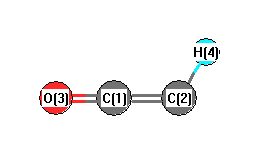 More geometry information
Calculated Bond Angles
| atom1 |
atom2 |
atom3 |
angle |
|
atom1 |
atom2 |
atom3 |
angle |
| C1 |
C2 |
H4 |
180.000 |
|
C2 |
C1 |
O3 |
180.000 |
Electronic energy levels
Charges, Dipole, Quadrupole and Polarizability
Jump to
S1C1
Energy calculated at B2PLYP=FULL/aug-cc-pVDZ
| | hartrees |
|---|
| Energy at 0K | -151.812515 |
| Energy at 298.15K | |
| HF Energy | -151.663834 |
| Nuclear repulsion energy | 51.906009 |
The energy at 298.15K was derived from the energy at 0K
and an integrated heat capacity that used the calculated vibrational frequencies.
Vibrational Frequencies calculated at B2PLYP=FULL/aug-cc-pVDZ
| Mode Number |
Symmetry |
Frequency
(cm-1) |
Scaled Frequency
(cm-1) |
IR Intensities
(km mol-1) |
Raman Act
(Å4/u) |
Dep P |
Dep U |
|---|
| 1 |
A' |
3330 |
3203 |
31.63 |
88.95 |
0.29 |
0.45 |
| 2 |
A' |
2086 |
2007 |
389.86 |
6.60 |
0.19 |
0.33 |
| 3 |
A' |
1218 |
1171 |
5.39 |
39.77 |
0.16 |
0.28 |
| 4 |
A' |
599 |
576 |
153.58 |
3.06 |
0.36 |
0.53 |
| 5 |
A' |
521 |
501 |
96.09 |
1.91 |
0.33 |
0.49 |
| 6 |
A" |
488 |
469 |
1.36 |
0.20 |
0.75 |
0.86 |
Unscaled Zero Point Vibrational Energy (zpe) 4120.7 cm
-1
Scaled (by 0.9618) Zero Point Vibrational Energy (zpe) 3963.3 cm
-1
See section
III.C.1 List or set vibrational scaling factors
to change the scale factors used here.
See section
III.C.2
Calculate a vibrational scaling factor for a given set of molecules
to determine the least squares best scaling factor.
Geometric Data calculated at B2PLYP=FULL/aug-cc-pVDZ
Point Group is Cs
Cartesians (Å)
| Atom |
x (Å) |
y (Å) |
z (Å) |
|---|
| C1 |
0.000 |
0.058 |
0.000 |
| C2 |
1.106 |
-0.654 |
0.000 |
| O3 |
-1.098 |
0.489 |
0.000 |
| H4 |
2.143 |
-0.341 |
0.000 |
Atom - Atom Distances (Å)
| |
C1 |
C2 |
O3 |
H4 |
| C1 | | 1.3155 | 1.1793 | 2.1802 |
C2 | 1.3155 | | 2.4826 | 1.0830 | O3 | 1.1793 | 2.4826 | | 3.3457 | H4 | 2.1802 | 1.0830 | 3.3457 | |
More geometry information
Calculated Bond Angles
| atom1 |
atom2 |
atom3 |
angle |
|
atom1 |
atom2 |
atom3 |
angle |
| C1 |
C2 |
H4 |
130.488 |
|
C2 |
C1 |
O3 |
168.686 |
Electronic energy levels
Charges, Dipole, Quadrupole and Polarizability
