Jump to
S1C2
Energy calculated at CCSD(T)/aug-cc-pVTZ
| | hartrees |
|---|
| Energy at 0K | -191.611087 |
| Energy at 298.15K | |
| HF Energy | -190.834929 |
| Nuclear repulsion energy | 102.821978 |
The energy at 298.15K was derived from the energy at 0K
and an integrated heat capacity that used the calculated vibrational frequencies.
Vibrational Frequencies calculated at CCSD(T)/aug-cc-pVTZ
| Mode Number |
Symmetry |
Frequency
(cm-1) |
Scaled Frequency
(cm-1) |
IR Intensities
(km mol-1) |
Raman Act
(Å4/u) |
Dep P |
Dep U |
|---|
| 1 |
A' |
3235 |
3138 |
|
|
|
|
| 2 |
A' |
3187 |
3092 |
|
|
|
|
| 3 |
A' |
3137 |
3043 |
|
|
|
|
| 4 |
A' |
2920 |
2832 |
|
|
|
|
| 5 |
A' |
1750 |
1697 |
|
|
|
|
| 6 |
A' |
1657 |
1607 |
|
|
|
|
| 7 |
A' |
1452 |
1408 |
|
|
|
|
| 8 |
A' |
1382 |
1341 |
|
|
|
|
| 9 |
A' |
1290 |
1252 |
|
|
|
|
| 10 |
A' |
1171 |
1135 |
|
|
|
|
| 11 |
A' |
917 |
889 |
|
|
|
|
| 12 |
A' |
566 |
549 |
|
|
|
|
| 13 |
A' |
314 |
305 |
|
|
|
|
| 14 |
A" |
1017 |
987 |
|
|
|
|
| 15 |
A" |
1000 |
970 |
|
|
|
|
| 16 |
A" |
968 |
939 |
|
|
|
|
| 17 |
A" |
600 |
582 |
|
|
|
|
| 18 |
A" |
159 |
154 |
|
|
|
|
Unscaled Zero Point Vibrational Energy (zpe) 13361.3 cm
-1
Scaled (by 0.9699) Zero Point Vibrational Energy (zpe) 12959.1 cm
-1
See section
III.C.1 List or set vibrational scaling factors
to change the scale factors used here.
See section
III.C.2
Calculate a vibrational scaling factor for a given set of molecules
to determine the least squares best scaling factor.
Geometric Data calculated at CCSD(T)/aug-cc-pVTZ
Point Group is Cs
Cartesians (Å)
| Atom |
x (Å) |
y (Å) |
z (Å) |
|---|
| C1 |
-0.152 |
-0.744 |
0.000 |
| C2 |
0.000 |
0.725 |
0.000 |
| C3 |
1.223 |
1.278 |
0.000 |
| O4 |
-1.224 |
-1.320 |
0.000 |
| H5 |
0.799 |
-1.311 |
0.000 |
| H6 |
-0.910 |
1.315 |
0.000 |
| H7 |
1.370 |
2.351 |
0.000 |
| H8 |
2.110 |
0.652 |
0.000 |
Atom - Atom Distances (Å)
| |
C1 |
C2 |
C3 |
O4 |
H5 |
H6 |
H7 |
H8 |
| C1 | | 1.4769 | 2.4453 | 1.2167 | 1.1081 | 2.1941 | 3.4487 | 2.6587 |
C2 | 1.4769 | | 1.3420 | 2.3834 | 2.1877 | 1.0843 | 2.1257 | 2.1115 | C3 | 2.4453 | 1.3420 | | 3.5688 | 2.6237 | 2.1327 | 1.0828 | 1.0859 | O4 | 1.2167 | 2.3834 | 3.5688 | | 2.0236 | 2.6540 | 4.4945 | 3.8739 | H5 | 1.1081 | 2.1877 | 2.6237 | 2.0236 | | 3.1337 | 3.7062 | 2.3608 | H6 | 2.1941 | 1.0843 | 2.1327 | 2.6540 | 3.1337 | | 2.5032 | 3.0917 | H7 | 3.4487 | 2.1257 | 1.0828 | 4.4945 | 3.7062 | 2.5032 | | 1.8531 | H8 | 2.6587 | 2.1115 | 1.0859 | 3.8739 | 2.3608 | 3.0917 | 1.8531 | |
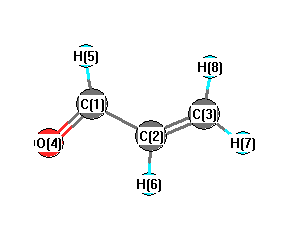 More geometry information
Calculated Bond Angles
| atom1 |
atom2 |
atom3 |
angle |
|
atom1 |
atom2 |
atom3 |
angle |
| C1 |
C2 |
C3 |
120.251 |
|
C1 |
C2 |
H6 |
117.062 |
| C2 |
C1 |
O4 |
124.177 |
|
C2 |
C1 |
H5 |
114.875 |
| C2 |
C3 |
H7 |
122.113 |
|
C2 |
C3 |
H8 |
120.479 |
| C3 |
C2 |
H6 |
122.687 |
|
O4 |
C1 |
H5 |
120.948 |
| H7 |
C3 |
H8 |
117.408 |
|
Electronic energy levels
Charges, Dipole, Quadrupole and Polarizability
Jump to
S1C1
Energy calculated at CCSD(T)/aug-cc-pVTZ
| | hartrees |
|---|
| Energy at 0K | -191.607782 |
| Energy at 298.15K | |
| HF Energy | -190.830895 |
| Nuclear repulsion energy | 104.375968 |
The energy at 298.15K was derived from the energy at 0K
and an integrated heat capacity that used the calculated vibrational frequencies.
Vibrational Frequencies calculated at CCSD(T)/aug-cc-pVTZ
| Mode Number |
Symmetry |
Frequency
(cm-1) |
Scaled Frequency
(cm-1) |
IR Intensities
(km mol-1) |
Raman Act
(Å4/u) |
Dep P |
Dep U |
|---|
| 1 |
A' |
3246 |
3148 |
|
|
|
|
| 2 |
A' |
3173 |
3078 |
|
|
|
|
| 3 |
A' |
3146 |
3052 |
|
|
|
|
| 4 |
A' |
2948 |
2860 |
|
|
|
|
| 5 |
A' |
1747 |
1695 |
|
|
|
|
| 6 |
A' |
1652 |
1603 |
|
|
|
|
| 7 |
A' |
1433 |
1390 |
|
|
|
|
| 8 |
A' |
1421 |
1378 |
|
|
|
|
| 9 |
A' |
1301 |
1262 |
|
|
|
|
| 10 |
A' |
1059 |
1027 |
|
|
|
|
| 11 |
A' |
931 |
903 |
|
|
|
|
| 12 |
A' |
670 |
650 |
|
|
|
|
| 13 |
A' |
281 |
273 |
|
|
|
|
| 14 |
A" |
1012 |
981 |
|
|
|
|
| 15 |
A" |
1000 |
970 |
|
|
|
|
| 16 |
A" |
974 |
945 |
|
|
|
|
| 17 |
A" |
545 |
529 |
|
|
|
|
| 18 |
A" |
115 |
112 |
|
|
|
|
Unscaled Zero Point Vibrational Energy (zpe) 13326.9 cm
-1
Scaled (by 0.9699) Zero Point Vibrational Energy (zpe) 12925.8 cm
-1
See section
III.C.1 List or set vibrational scaling factors
to change the scale factors used here.
See section
III.C.2
Calculate a vibrational scaling factor for a given set of molecules
to determine the least squares best scaling factor.
Geometric Data calculated at CCSD(T)/aug-cc-pVTZ
Point Group is Cs
Cartesians (Å)
| Atom |
x (Å) |
y (Å) |
z (Å) |
|---|
| C1 |
-0.894 |
-0.288 |
0.000 |
| C2 |
0.000 |
0.901 |
0.000 |
| C3 |
1.335 |
0.769 |
0.000 |
| O4 |
-0.496 |
-1.439 |
0.000 |
| H5 |
-1.977 |
-0.074 |
0.000 |
| H6 |
-0.474 |
1.877 |
0.000 |
| H7 |
1.990 |
1.631 |
0.000 |
| H8 |
1.781 |
-0.219 |
0.000 |
Atom - Atom Distances (Å)
| |
C1 |
C2 |
C3 |
O4 |
H5 |
H6 |
H7 |
H8 |
| C1 | | 1.4876 | 2.4668 | 1.2173 | 1.1049 | 2.2056 | 3.4642 | 2.6758 |
C2 | 1.4876 | | 1.3417 | 2.3921 | 2.2047 | 1.0850 | 2.1199 | 2.1043 | C3 | 2.4668 | 1.3417 | | 2.8688 | 3.4182 | 2.1216 | 1.0827 | 1.0843 | O4 | 1.2173 | 2.3921 | 2.8688 | | 2.0143 | 3.3161 | 3.9508 | 2.5838 | H5 | 1.1049 | 2.2047 | 3.4182 | 2.0143 | | 2.4630 | 4.3185 | 3.7617 | H6 | 2.2056 | 1.0850 | 2.1216 | 3.3161 | 2.4630 | | 2.4765 | 3.0792 | H7 | 3.4642 | 2.1199 | 1.0827 | 3.9508 | 4.3185 | 2.4765 | | 1.8621 | H8 | 2.6758 | 2.1043 | 1.0843 | 2.5838 | 3.7617 | 3.0792 | 1.8621 | |
More geometry information
Calculated Bond Angles
| atom1 |
atom2 |
atom3 |
angle |
|
atom1 |
atom2 |
atom3 |
angle |
| C1 |
C2 |
C3 |
121.274 |
|
C1 |
C2 |
H6 |
117.175 |
| C2 |
C1 |
O4 |
124.040 |
|
C2 |
C1 |
H5 |
115.728 |
| C2 |
C3 |
H7 |
121.584 |
|
C2 |
C3 |
H8 |
119.941 |
| C3 |
C2 |
H6 |
121.551 |
|
O4 |
C1 |
H5 |
120.232 |
| H7 |
C3 |
H8 |
118.475 |
|
Electronic energy levels
Charges, Dipole, Quadrupole and Polarizability
