Jump to
S1C2
Vibrational Frequencies calculated at CCSD(T)/aug-cc-pVTZ
Geometric Data calculated at CCSD(T)/aug-cc-pVTZ
Electronic energy levels
Charges, Dipole, Quadrupole and Polarizability
Jump to
S1C1
Energy calculated at CCSD(T)/aug-cc-pVTZ
| | hartrees |
|---|
| Energy at 0K | -207.657431 |
| Energy at 298.15K | -207.660710 |
| HF Energy | -206.848981 |
| Nuclear repulsion energy | 101.855338 |
The energy at 298.15K was derived from the energy at 0K
and an integrated heat capacity that used the calculated vibrational frequencies.
Vibrational Frequencies calculated at CCSD(T)/aug-cc-pVTZ
| Mode Number |
Symmetry |
Frequency
(cm-1) |
Scaled Frequency
(cm-1) |
IR Intensities
(km mol-1) |
Raman Act
(Å4/u) |
Dep P |
Dep U |
|---|
| 1 |
A |
3820 |
3705 |
|
|
|
|
| 2 |
A |
3124 |
3030 |
|
|
|
|
| 3 |
A |
3049 |
2957 |
|
|
|
|
| 4 |
A |
2277 |
2209 |
|
|
|
|
| 5 |
A |
1499 |
1454 |
|
|
|
|
| 6 |
A |
1420 |
1377 |
|
|
|
|
| 7 |
A |
1374 |
1333 |
|
|
|
|
| 8 |
A |
1229 |
1192 |
|
|
|
|
| 9 |
A |
1085 |
1052 |
|
|
|
|
| 10 |
A |
991 |
961 |
|
|
|
|
| 11 |
A |
893 |
866 |
|
|
|
|
| 12 |
A |
567 |
550 |
|
|
|
|
| 13 |
A |
362 |
351 |
|
|
|
|
| 14 |
A |
284 |
275 |
|
|
|
|
| 15 |
A |
200 |
194 |
|
|
|
|
Unscaled Zero Point Vibrational Energy (zpe) 11086.6 cm
-1
Scaled (by 0.9699) Zero Point Vibrational Energy (zpe) 10752.9 cm
-1
See section
III.C.1 List or set vibrational scaling factors
to change the scale factors used here.
See section
III.C.2
Calculate a vibrational scaling factor for a given set of molecules
to determine the least squares best scaling factor.
Geometric Data calculated at CCSD(T)/aug-cc-pVTZ
Point Group is C1
Cartesians (Å)
| Atom |
x (Å) |
y (Å) |
z (Å) |
|---|
| C1 |
-0.575 |
0.594 |
0.039 |
| C2 |
0.825 |
0.115 |
-0.007 |
| O3 |
-1.511 |
-0.456 |
-0.111 |
| H4 |
-0.717 |
1.148 |
0.971 |
| H5 |
-0.736 |
1.278 |
-0.794 |
| H6 |
-1.395 |
-1.075 |
0.618 |
| N7 |
1.919 |
-0.280 |
-0.015 |
Atom - Atom Distances (Å)
| |
C1 |
C2 |
O3 |
H4 |
H5 |
H6 |
N7 |
| C1 | | 1.4807 | 1.4144 | 1.0943 | 1.0898 | 1.9480 | 2.6431 |
C2 | 1.4807 | | 2.4072 | 2.0983 | 2.1007 | 2.5953 | 1.1627 | O3 | 1.4144 | 2.4072 | | 2.0913 | 2.0185 | 0.9633 | 3.4356 | H4 | 1.0943 | 2.0983 | 2.0913 | | 1.7705 | 2.3511 | 3.1558 | H5 | 1.0898 | 2.1007 | 2.0185 | 1.7705 | | 2.8226 | 3.1760 | H6 | 1.9480 | 2.5953 | 0.9633 | 2.3511 | 2.8226 | | 3.4660 | N7 | 2.6431 | 1.1627 | 3.4356 | 3.1558 | 3.1760 | 3.4660 | |
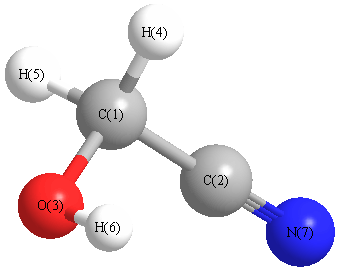 More geometry information
Calculated Bond Angles
| atom1 |
atom2 |
atom3 |
angle |
|
atom1 |
atom2 |
atom3 |
angle |
| C1 |
C2 |
N7 |
178.340 |
|
C1 |
O3 |
H6 |
108.532 |
| C2 |
C1 |
O3 |
112.478 |
|
C2 |
C1 |
H4 |
108.211 |
| C2 |
C1 |
H5 |
108.668 |
|
O3 |
C1 |
H4 |
112.320 |
| O3 |
C1 |
H5 |
106.710 |
|
H4 |
C1 |
H5 |
108.319 |
Electronic energy levels
Charges, Dipole, Quadrupole and Polarizability
